Reminders of God’s word can guide our daily lives, but only if we follow those reminders. Yesterday, I introduced the blog’s mascot, “Ebenezer, the ‘But God…’ Squirrel.” Ebenezer is a reminder that however difficult or frustrating our situation, if we actively and intentionally inject God into the situation, He can and will show us the best way forward. However, what if we try to say “But God” but take the wrong path anyway? If we do, we are not alone.
Ebenezer, trying to get your attention.
A search of the exact words “but God” in the ESV Bible gives 43 results, and the first one is found in Genesis 3:3, which says “but God said, ‘You shall not eat of the fruit of the tree that is in the midst of the garden, neither shall you touch it, lest you die.’” This verse occurs when the serpent in the garden questions God’s word that Adam and Eve were limited by God in what they should and shouldn’t do. Eve, the speaker in the quote above, responds rightly that God had been specific about what not to do. As most of my readers will know, even though Eve knew God’s word, the serpent was able to convince her to ignore it.
As they say in the financial industry, “past performance is no guarantee of future results,” but I will guarantee anyway that today and every day every one of us face temptation to do something God wants to protect us from. I also am confident of the words “but God…” that “If you recall them daily and live by them, they will transform your life completely,” as I quoted earlier from James Montgomery Boice. But we must live by them to be transformed by God, not just quote them.
Today, pray that we all would be distracted by God’s word as easily as we are sometimes distracted by a passing squirrel when we are tempted to ignore His voice in our souls. And if God delivers you from temptation today, make a note, a perpetual “stone of help” that God’s word is good!
Keep an eye out for Ebenezer as an ongoing series here, covering the 43 direct “but God” references, but also others.
“If I speak in the tongues of men and of angels, but have not love, I am a noisy gong or a clanging cymbal. And if I have prophetic powers, and understand all mysteries and all knowledge, and if I have all faith, so as to remove mountains, but have not love, I am nothing. If I give away all I have, and if I deliver up my body to be burned, but have not love, I gain nothing.”
In these verses Paul uses wild exaggeration to make a point about the importance of love above all else. Can anyone move mountains with faith? It’s never been literally done, but even if someone did, and the reason for doing it was wrong, it would mean nothing. Has anyone literally given away everything they have?
Also note the repetition of the word “all,” which appears 4 times. Nobody but God has all understanding, knowledge, and faith, and in Jesus He gave up all He had for us. Paul is saying that even if we were Godlike in these things, which we aren’t, without love even it wouldn’t matter.
No matter how “impressive” our actions are, if done for the wrong reason, they are useless.
Even if we move mountains, love is what really matters.
The Apostle Paul wrote in Philippians 4:13 “I can do all things through him who strengthens me,” yet he also wrote in 2 Corinthians 12:7-9 that “to keep me from becoming conceited,” a “thorn was given me in the flesh.” He writes: “Three times I pleaded with the Lord about this, that it should leave me. But he said to me, ‘My grace is sufficient for you, for my power is made perfect in weakness.’ Therefore I will boast all the more gladly of my weaknesses, so that the power of Christ may rest upon me.”
The nature of Paul’s “thorn” has been disputed for centuries, but Galatians 4:13 suggests it was a physical problem, a “bodily ailment” rather than a moral shortcoming. So, the lesson of the “thorn” is not that God prevented Paul from overcoming some specific sin to keep him humble – He wants Paul (and us) to be satisfied with nothing less than righteousness.
However, one lesson of the “thorn” is that Paul didn’t mean by “I can do all things” that he could do whatever he wanted and succeed. Instead, the “thorn” is an example of a battle Paul would not win, because this “thorn” had a purpose in bringing Paul closer to God’s grace and power. In God’s wisdom, Paul was better off with this ailment than without it.
Yesterday’s post said “Picking your battles, rather than trying to fight and win every fight that comes your way, is a good piece of advice. However, who should pick which battles to fight?” In the case of the “thorn”, God picked a battle for Paul not to fight, telling him instead to focus on growing in faith. The thorn had a purpose in Paul’s striving toward righteousness, which was more important than any physical ailment. Had Paul continued to insist to God that the thorn should be removed, he would still have the thorn, but he would also not grow in his relationship with his Lord.
Sometimes there are battles He wants us to fight in His strength for His glory, and sometimes there are battles He tells us not to fight so we can focus on His grace and power while in this life, in light of His promises to heal our physical ailments in Paradise.
Today’s post closes the same way as yesterdays: “Sometimes life is hard on purpose, so that God alone may be glorified in victory, and also so that we may grow in our faith in His strength. When we let Him pick our battles, we learn that His righteousness is the only thing that will satisfy us. Nothing less will do.”
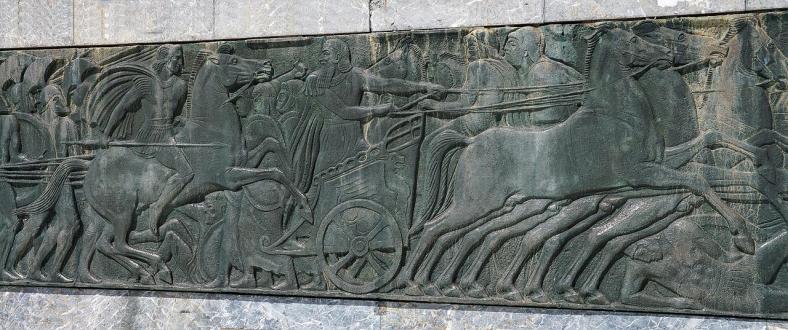
Picking your battles, rather than trying to fight and win every fight that comes your way, is a good piece of advice. However, who should pick which battles to fight? The Old Testament book of Judges is a record of the consequences of Israel’s failure to completely conquer the promised land, a battle God gave them to fight and win. Judges also shows more generally what happens when anyone picks the wrong battles to fight: they end up with less than what God intended for them.
For example, Judges 1:19 tells us: “And the LORD was with Judah, and he took possession of the hill country, but he could not drive out the inhabitants of the plain because they had chariots of iron.”
This verse, especially the second part, is written from a human perspective. God did not tell Israel to conquer all of the promised land, except for the plains. God is not afraid of chariots. He told them to conquer all of it, but Israel thought that chariots couldn’t be defeated, so they decided not to fight in the plain. By using their own judgement and preferring to fight in hills or forests where chariots were less effective, they failed to fully receive what God had promised them.
An application to us is that our inheritance is Christ’s righteousness, and Jesus tells us “Blessed are those who hunger and thirst for righteousness, for they shall be satisfied.”[1] Jesus is telling us that righteousness is like food and drink. We can never have enough because no matter how much we eat and drink, our hunger and thirst soon return. We are all in different places, at different levels of knowledge and maturity, but in Christ we are all on the same path and have an appetite only He can satisfy.
To be satisfied, we cannot settle for what we have already accomplished, the hill country we have already taken. To be satisfied, we must fight the chariots in the plains if that is what God wants us to do, so that we learn to rely on His strength. To be satisfied, we move from only fighting battles we choose based on our own wisdom and ability to choosing the battles we will win in His strength.
Sometimes life is hard on purpose, so that God alone may be glorified in victory, and also so that we may grow in our faith in His strength. When we let Him pick our battles, we learn that His righteousness is the only thing that will satisfy us. Nothing less will do.
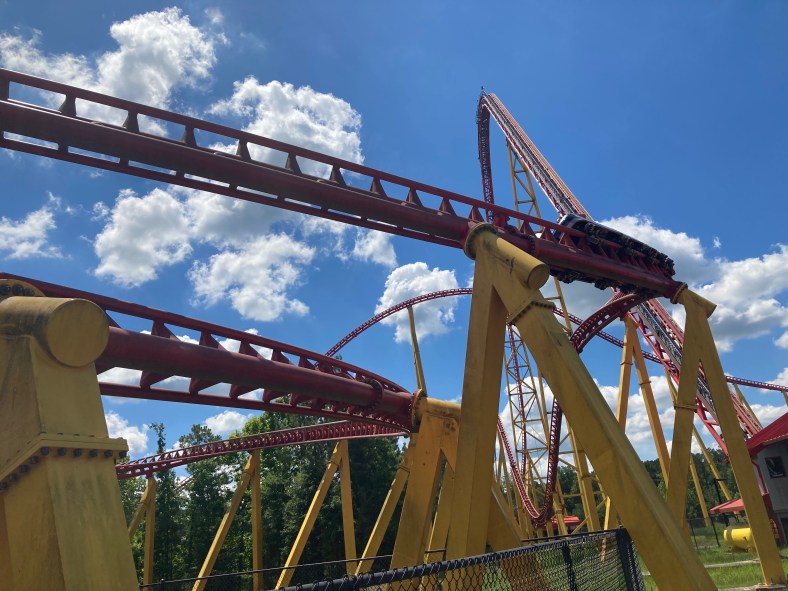
Intimidator 305 at King’s Dominion. The first hill at the top, with the following airtime hill in the middle.
My teenage son is a roller coaster enthusiast. He memorizes how tall they all are, how many inversions they each have, who the manufacturers are, how they work, and anything else he can find out. He takes lots of pictures of roller coasters, including the one I used for this post. Fortunately, I like them too. We’ve been on well over 100 different coasters together and will ride anything, but we do have slightly different tastes. Usually, he likes airtime more than I do, and I like intensity more than he does. As an enthusiast, he’s the one who told me what a greyout is: “a transient loss of vision characterized by a perceived dimming of light and color, sometimes accompanied by a loss of peripheral vision.”[1] Caused by low brain oxygen levels, a greyout can happen on roller coasters and can be a precursor to fainting.
Intimidator 305 at King’s Dominion in Virginia was my first greyout. The ride, with a 90-mph top speed on the 300-foot first drop, is themed after NASCAR driver Dale Earnhardt, whose nickname was “The Intimidator.” At the bottom of that first drop, the track banks into a 270-degree turn to the right, and the first time on it, the edges of my vision began to fade as blood rushed to my legs and feet. I felt the intensity rising, and my field of vision gradually narrowed into a small pinpoint, and I nervously tensed up. However, before I knew it, I was fine and back to enjoying the ride.
After we got off, I mentioned my greyout and my enthusiast son explained why I recovered so quickly. It was no accident. Intimidator 305 was designed by people who knew what the ride would do to people, so after the 270-degree turn, there is a 150-foot airtime hill. As the train comes up this hill, the track bends down at a lower angle than the train would go on its own momentum, which not only gives riders “airtime” as they feel weightless, but also gives a rush of blood to the brain. So, by design, I experienced greyout, followed by an amazingly quick return to normal, without fainting.
What’s the spiritual lesson in this? There are times where our lives feel like we’re in that disorienting 270-degree turn at 90 mph. Our awareness narrows to where we can only see the problems in front of us and our body begins to feel stress. In some cases, the stress itself might become the only thing we can see, having forgotten what caused it. That intense turn can seem like it will never end, and we can’t see the relief ahead of us. Sometimes it comes after a great success, perhaps right after the thrill of dropping down a hill at high speed…Or perhaps after experiencing a miracle. Peter had such faith that he walked on water, “But when he saw the wind, he was afraid, and beginning to sink he cried out, ‘Lord, save me.’”[2] Even Apostles felt hopeless sometimes.
Like Peter, when we cry out “Lord, save me” we may need a reminder of 1 Corinthians 10:13, where Paul wrote: “No temptation has overtaken you that is not common to man. God is faithful, and He will not let you be tempted beyond your ability, but with the temptation he will also provide the way of escape, that you may be able to endure it.”
We may need a reminder from a Christian enthusiast, or maybe from our Father Himself, that we have a way of escape by design. After every sharp turn we think will never end is a refreshing moment where we feel weightless, held by our Lord in His loving embrace. In Peter’s case, “Jesus immediately reached out his hand and took hold of him, saying to him, ‘O you of little faith, why did you doubt?’ And when they got into the boat, the wind ceased.”[3] In the Father’s wisdom, relief will not always be immediate – it may take longer than we expect, but it is inevitable because He promises it.
That day, we rode Intimidator 305 three more times and every time I wasn’t as worried about the greyout because I knew that airtime hill was coming. It’s now one of my favorites. Thankfully, our lives also are in the hands of a Designer who knows how to teach us to trust Him, and also how to heal us when life’s troubles feel like they’re going to knock us out.








 Driving Toward the Morning Sun