“Let Not the Flood Sweep Over Me”

Yesterday’s post was about Jeremiah’s comparison of false religion to a broken cistern, with God alternatively being “the fountain of living waters.”[1]  Jeremiah lived when most of God’s people – including most of the priests and prophets – had turned from Him to follow other gods.  As Jeremiah remained faithful, correctly predicting that Jerusalem would fall to Babylon, he was persecuted, including this instance in Jeremiah 38:6, where King Zedekiah’s officials “took Jeremiah and cast him into the cistern of Malchiah, the king’s son, which was in the court of the guard, letting Jeremiah down by ropes. And there was no water in the cistern, but only mud, and Jeremiah sank in the mud.”

Since God is “the fountain of living waters,” the only path to eternal blessing, it’s incredibly ironic that Jeremiah, one of the few remaining faithful prophets and therefore a rare source of God’s “living waters,” should be cast into a cistern with no water.  Perhaps it was broken.  King Zedekiah thought he could silence the “living waters” Jeremiah represented by casting them into a cistern, trading truth for falsehood.

Photo by Mishal Ibrahim on Unsplash

Later, Jeremiah seems to recall the cistern experience in Lamentations 3:52-57, where he said:

I have been hunted like a bird
            by those who were my enemies without cause;
they flung me alive into the pit
            and cast stones on me;
water closed over my head;
            I said, ‘I am lost.’
‘I called on your name, O LORD,
            from the depths of the pit;
you heard my plea, ‘Do not close
            your ear to my cry for help!’
You came near when I called on you;
            you said, ‘Do not fear!’”

Returning to the book of Jeremiah, we read that Ebed-melech, an Ethiopian eunuch, heard of Jeremiah’s situation and pleaded his case: “My lord the king, these men have done evil in all that they did to Jeremiah the prophet by casting him into the cistern, and he will die there of hunger, for there is no bread left in the city.”[2]  This unlikely source – a foreigner – was Jeremiah’s deliverance from God to rescue Jeremiah from the well.  Ebed-melech gathered 30 men, “Then they drew Jeremiah up with ropes and lifted him out of the cistern. And Jeremiah remained in the court of the guard.”

Jeremiah was not the only Old Testament figure to suffer for his faithfulness.  Many years earlier, King David also referred to “sinking in the mire” in the Messianic Psalm 69, verses 14-15:

“Deliver me
            from sinking in the mire;
let me be delivered from my enemies
            and from the deep waters.
Let not the flood sweep over me,
            or the deep swallow me up,
            or the pit close its mouth over me.”

David knew this feeling of sinking came not because of his sin, but when he was faithfully serving his Lord.  David’s “sinking in the mire” happened under these circumstances from verse 9 of the same Psalm:

For zeal for your house has consumed me,
            and the reproaches of those who reproach you have fallen on me.”

In Jeremiah’s case, as well as David’s and that of Jesus, whom Psalm 69 foreshadowed[3], we know that cannot judge our faithfulness based on whether it improves our circumstances.  When we do, we might stop being faithful because it seems we are “sinking in the mire.”  Being reproached by the world and feeling down aren’t the circumstances we prefer, but “Blessed are those who are persecuted for righteousness’ sake, for theirs is the kingdom of heaven.”[4]  Through these and all other circumstances, God develops in us deeper trust in Him.

Therefore, with David may we pray:

But as for me, my prayer is to you, O LORD.
            At an acceptable time, O God,
            in the abundance of your steadfast love answer me in your saving faithfulness.” – Psalm 69:13

And in His time, He will deliver us, perhaps in ways we don’t expect.

Coda

In 1995, Christian rock group Jars of Clay released their self-titled album, and the track “Flood” has similar themes to this post.  The song was also a mainstream hit, charting as high as No. 12 on the Billboard Modern Rock Tracks chart,[5] amazing for a song that is essentially a prayer like David’s in Psalm 69.

You can check out the song’s lyrics here: https://genius.com/Jars-of-clay-flood-lyrics

Or, if you have 3 ½ minutes, watch the music video here:


[1] Jeremiah 3:13
[2] Jeremiah 38:9
[3] John 2:17, 15:25, Acts 1:20, Romans 11:9-10, 15:3
[4] Matthew 5:10
[5] https://en.wikipedia.org/wiki/Flood_(Jars_of_Clay_song)


Is Christianity Like Improv Comedy?

The TV show Whose Line is it Anyway? is probably the most-widely-known form of improvisational comedy, and one of my favorites.  Four performers act out short scenes based on a set of rules for each scene or game, spontaneously adding their own creativity and (if successful) humor.  For example, in the “Props” game, pictured, the performers were given two “P” shaped props to make jokes about.  The show wouldn’t be any good if they just showed us the props and explained the rules over and over again.  The show is pointless without spontaneous creativity.  But why am I writing about improv on a Christian blog?  Today is the next post in the series on listening for our Master’s voice, and in God’s (and Gideon’s) victory over the Midianites, the Bible leaves a key point unsaid, leaving us to ask: Whose Plan is it Anyway?

Whose Pun is it Anyway?

In Judges 6-7, God delivers Israel from the Midianites using Gideon, who thought God couldn’t use him because “my clan is the weakest in Manasseh, and I am the least in my father’s house.”  At times, Gideon doubts God is speaking to him and that He really means what He says, but God patiently answers Gideon’s questions and performs miracles, encouraging Gideon to move forward.

Eventually, Gideon and his 300-man army attacked the enemy army, which was “like locusts in abundance, and their camels were without number, as the sand that is on the seashore in abundance.[1]  After Gideon split his army into three groups, this was the plan of attack:

So Gideon and the hundred men who were with him came to the outskirts of the camp at the beginning of the middle watch, when they had just set the watch. And they blew the trumpets and smashed the jars that were in their hands.  Then the three companies blew the trumpets and broke the jars. They held in their left hands the torches, and in their right hands the trumpets to blow. And they cried out, ‘A sword for the LORD and for Gideon!’”[2]

Whose Plan is it Anyway?
This is where improv comes in: the text does not tell us who came up with this wacky attack plan.  Was it God’s idea or was it Gideons?  Why leave it ambiguous?  I think it is because, either way, it is not a decisive factor in the victory.  The attack plan works because of God’s involvement, no matter whose idea it was.  If it was Gideon’s idea, he was only using the abilities his Maker had given Him for the purpose of glorifying Him.  If it was God’s, Gideon was also only using the abilities God gave him and dedicating them to God’s glory.

What’s amazing is that Gideon went from testing God with fleece to carrying out this attack.  God had Gideon convinced it would work, and that it would work because God would make it work.  Victory didn’t come from any advantage Gideon had or created, and all along God was determined to get the glory.  The plan would have failed if God had not put fear into the camp, and let Gideon know about that fear by way of a dream a Midianite soldier had.

Like improv comedy, God’s rules only go so far before the performers need to take over.  God gives us patterns, which are like the rules of an improv skit, not step-by-step instructions in every aspect of our lives.  Adam and Eve were shown a pattern in the Garden of Eden, Moses was given a pattern for the tabernacle on the mountain, and Jesus lived a pattern of how love the Father and our neighbor.  Beyond the patterns and rules there is so much to do and explore.  His will is for His people to make the world like Eden, to worship Him as He should be worshiped, and to love the world the way Jesus loved.

The Little Things
To hear and obey His voice, we must spend time with Him in prayer and study, diligently learning the patterns He has laid out for us, but He does not expect us to stop there. At some point, we must take the guidance we have and move forward with the wisdom and creativity He has endowed us each with.  When we do we will be like the servant who successfully invested his Master’s resources, and in return “His master said to him, ‘Well done, good and faithful servant. You have been faithful over a little; I will set you over much. Enter into the joy of your master.’”[3]

However, if we either do not diligently seek Him, or if we say He has not given us enough, we may find ourselves cast out from the Master’s presence, hearing: “you ought to have invested my money with the bankers, and at my coming I should have received what was my own with interest.”[4]

In Gideon’s story, we see God’s compassionate understanding toward His people who struggle to hear and obey His voice but keep trying.  We, like Gideon, are not always faithful over the little things such as prayer, study, and regular worship.  But Only He fully knows the depth of our doubts and struggles, and He provides what we need to trust Him and move forward in faith, knowing our doubt is never fully overcome until eternity.

In the story, we also see that we must often act on trust, even when we think we have incomplete information.  Like Gideon, we should be imperfectly persistent, wrestling with God who knows our faith is imperfect.  He can bridge the gap to us in His unlimited grace.

So, where does God’s guiding voice stop, and our God-given creativity begin?  Like a good improv comedy scene, the parts can come together perfectly, glorify God, and encourage His people to come along in faith, as the men of Naphtali, Asher, Manasseh, and Ephraim joined the battle against the Midianites once it was clear God had delivered the victory[5].  When we seek Him and find Him, and in faith move forward to spread His character and creativity in the world, glorifying Him.

God is glorified when His people attempt things that sometimes don’t make sense, then succeed because He provided the way.  It’s always His plan anyway.

Soli Deo Gloria


[1] Judges 7:12
[2] Judges 7:19-20
[3] Matthew 25:21
[4] Matthew 25:27
[5] Judges 7:23-25

A Detour into the Total Perspective Vortex

In the previous post in this series on our Master’s voice, I wrote that: “We can’t see the reasons God wants us to trust Him because there is far more at work than we could ever imagine.”  Sometimes truth is stranger than fiction, but sometimes great illustrations come from strange fictional places, like Jim Carrey movies and Douglas Adams books for example.

In The Restaurant at the End of the Universe,[1] the sequel to the sci-fi comedy classic The Hitchhiker’s Guide to the Galaxy, author Douglas Adams imagines a technology that harnesses full awareness of the universe as a profoundly cruel torture device.  When Trin Tragula invented the “Total Perspective Vortex” to annoy his wife who kept accusing him of blowing things out of proportion, he found that when he tested it on her, “the shock completely annihilated her brain.”  A victim is placed in the TPV and presented with a realistic model of the entire universe, with a tiny dot on top of a tiny dot that says, “you are here.”  He concluded that “a sense of proportion” in such a massive universe would only make someone feel completely insignificant, hopeless, and insane beyond all hope of recovery.  It’s a sci-fi comedy, but still, be careful what you wish for.

Another example from a different angle is the Jim Carrey movie, Bruce Almighty.  This hilarious (but irreverent) comedy is based on Carrey’s character Bruce Nolan raging against God about his frustrating life.  God, played by Morgan Freeman, appears and challenges Bruce to do any better, giving him “the job” for a temporary period to teach him a lesson.  The 3-ish-minute video embedded here is my favorite part of the movie, where Bruce tries to figure out how to deal with his new awareness of all the prayers of the world.

If God thought it was possible, or a good idea, for us to know it all, we would.  After all, even Nipper the dog from the “His Master’s Voice” painting would be distracted and unable to get anything done if he saw this picture, even though it contains only good news:

Our Master speaks to us as our creator, knowing both our limitations, but also what we are capable of as His marvelous creatures if we trust Him!

This post is fourth in a series that started with this post on His Master’s Voice. More to come…


[1] Adams, Douglas. The Restaurant at the End of the Universe.  (1980).  P. 79

God Tells Gideon a Secret

Photo by Byron Johnson on Unsplash

Today we come back to the topic of our Master’s voice, which began with the painting “His Master’s Voice” and continues through the story of Gideon in the book of Judges, chapters 6 and 7.  So far, Gideon has done his best to discern whether God was really talking to him, then set out with an army of 22,000 soldiers, which Gideon faithfully whittled down to only 300, at God’s instruction.  Against an army “like locusts in abundance,” Gideon might have needed a little reassurance, because outside of a miracle[1] his army was going to fail miserably.

That very night, God spoke to Gideon, saying: “Arise, go down against the camp, for I have given it into your hand.  But if you are afraid to go down, go down to the camp with Purah your servant.  And you shall hear what they say, and afterward your hands shall be strengthened to go down against the camp.[2]  We know Gideon was still afraid because he took Purah and went down into the camp.  We also know that God made provision for Gideon’s fear, instead of counting on Gideon to have perfect faith.  Should Gideon have needed extra reassurance?  No, but God provided what was needed to overcome Gideon’s fear, which was a bit more insight into God’s plan.  Victory in battle is never a matter of how many soldiers are on God’s side, as if spiritual warfare was determined by democracy, but by whose side God is on.

When Gideon snuck into the camp: “behold, a man was telling a dream to his comrade. And he said, ‘Behold, I dreamed a dream, and behold, a cake of barley bread tumbled into the camp of Midian and came to the tent and struck it so that it fell and turned it upside down, so that the tent lay flat.’  And his comrade answered, ‘This is no other than the sword of Gideon the son of Joash, a man of Israel; God has given into his hand Midian and all the camp.’”[3]

Victory in battle is never

a matter of how many

soldiers are on God’s side

Some commentators suggest that the “barley” reference means that an inferior army would win, since barley was considered inferior to wheat and other grains, but what we know is that this dream put fear into the Midianite camp and emboldened Gideon to trust God, even though he didn’t understand Him.  Overhearing these words in the camp let Gideon know that that God was at work in far more ways than he could imagine, that victory belongs to the LORD, and that he can trust that God has the knowledge he lacked.  God is trustworthy, even if we don’t fully understand Him.

We only know part of our part in God’s plan.  He knows all of our part, and also all of everyone else’s part.  Each of us are but one of millions of Christians trying to figure out our relationship with God, and we have no idea what those other millions are up to.  But God does, and if we insist God tells us everything before we act, we not only disobey God, but lose out on the opportunity to impact those other lives and see how awesome God’s plan really is!

Our ability to hear and obey our Master’s voice is not a question of complete knowledge, but of wisdom.  Proverbs 17:24 says, “The discerning sets his face toward wisdom, but the eyes of a fool are on the ends of the earth.”  Since “The fear of the LORD is the beginning of wisdom, and the knowledge of the Holy One is insight,[4] from the story of Gideon, we learn that God was teaching Gideon to revere Him above any desire to see the “ends of the earth.”  Wisdom keeps us on the path of life but doesn’t always mark it out for us far into the future.  We can’t see the reasons God wants us to trust Him because there is far more at work than we could ever imagine.

The secret things belong to the LORD our God, but the things that are revealed belong to us and to our children forever, that we may do all the words of this law.” – Deuteronomy 29:29


This post is third in a series that started with this post on His Master’s Voice. More to come…


[1] Or a certain action film directed by Zack Snyder…
[2] Judges 7:9b-11a
[3] Judges 7:13-14
[4] Proverbs 9:10

The Israelites are Too Many!

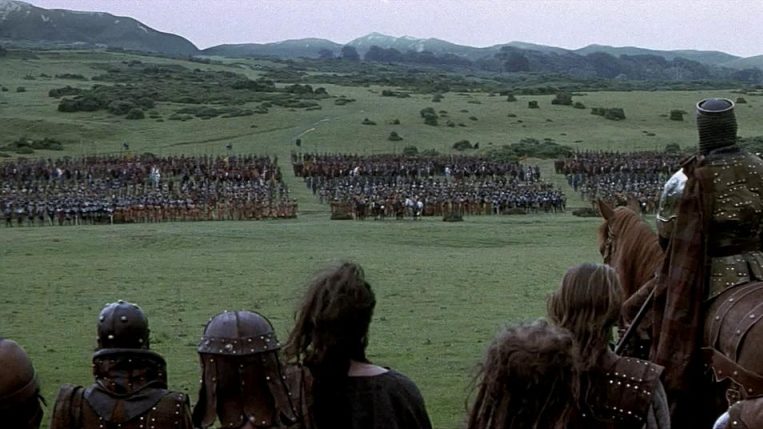
In Braveheart, one of my favorite movies, a Scottish soldier is afraid to fight because “the English are too many!”  Imagine if God had responded that, actually, the Scottish army was too big.  In the story of Gideon, something like that happened.

In a series of posts about hearing our Master’s voice, God speaks to and works through Gideon to rescue Israel from oppression by the Midianites, Amalekites, and others.  After some serious doubts, covered in the last post, Gideon gained enough trust in God to gather an army, although he didn’t know the details of God’s plan.  Judges 7 shows the plan being revealed and implemented and is the subject of coming posts.

Gideon gathered 22,000 soldiers south of the Midianite camp, and it was probably an inexperienced army since Judges 3:2 says many in Israel had yet to learn war.  However, the army was too big: “The LORD said to Gideon, ‘The people with you are too many for me to give the Midianites into their hand, lest Israel boast over me, saying, ‘My own hand has saved me.’[1]  God says the fearful must return home, otherwise the army, and Gideon, would take credit that only God deserves.  Only 10,000 remained, presumably those who trusted God for the victory.

But the Israelites were still too many, so the LORD has Gideon watch how the soldiers drank from the water.  Those who knelt to drink were sent home, leaving only 300 men!  Some suggest the soldiers who knelt showed that they were not ready for battle, probably putting down their weapons to drink, but whatever the reason, God was putting a plan into action, revealing it piece by piece, where Gideon could not possibly take credit and also risked massive failure.  The enemy army was “like locusts in abundance, and their camels were without number, as the sand that is on the seashore in abundance.[2]

Gideon must have been getting nervous, but God was about to show him that “If God is for us, who can be against us?” – Romans 8:31b.  The Midianites were not too many for God to handle.


This post is second in a series that started with this post on His Master’s Voice and continues here.


[1] Judges 7:2
[2] Judges 7:12