“Let Not the Flood Sweep Over Me”

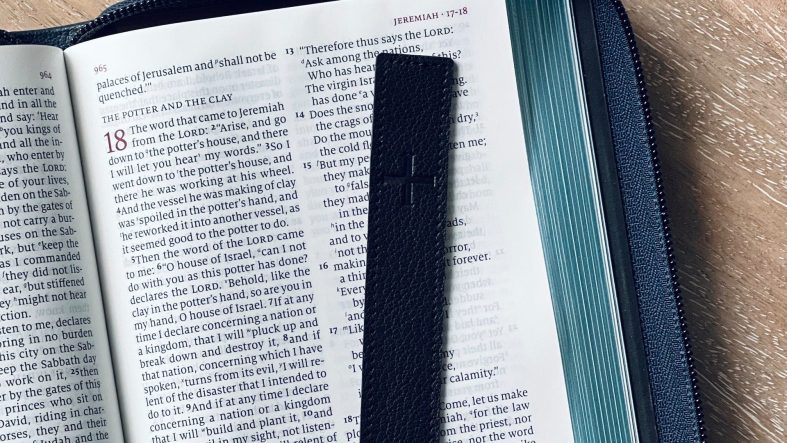
A recent post was about Jeremiah’s comparison of false religion to a broken cistern, with God alternatively being “the fountain of living waters.”[1]  Jeremiah lived when most of God’s people – including most of the priests and prophets – had turned from Him to follow other gods.  As Jeremiah remained faithful, correctly predicting that Jerusalem would fall to Babylon, he was persecuted, including this instance in Jeremiah 38:6, where King Zedekiah’s officials “took Jeremiah and cast him into the cistern of Malchiah, the king’s son, which was in the court of the guard, letting Jeremiah down by ropes. And there was no water in the cistern, but only mud, and Jeremiah sank in the mud.”

Since God is “the fountain of living waters,” the only path to eternal blessing, it’s incredibly ironic that Jeremiah, one of the few remaining faithful prophets and therefore a rare source of God’s “living waters,” should be cast into a cistern with no water.  Perhaps it was broken.  King Zedekiah thought he could silence the “living waters” Jeremiah represented by casting them into a cistern, trading truth for falsehood.

Photo by Mishal Ibrahim on Unsplash

Later, Jeremiah seems to recall the cistern experience in Lamentations 3:52-57, where he said:

I have been hunted like a bird
            by those who were my enemies without cause;
they flung me alive into the pit
            and cast stones on me;
water closed over my head;
            I said, ‘I am lost.’
‘I called on your name, O LORD,
            from the depths of the pit;
you heard my plea, ‘Do not close
            your ear to my cry for help!’
You came near when I called on you;
            you said, ‘Do not fear!’”

Returning to the book of Jeremiah, we read that Ebed-melech, an Ethiopian eunuch, heard of Jeremiah’s situation and pleaded his case: “My lord the king, these men have done evil in all that they did to Jeremiah the prophet by casting him into the cistern, and he will die there of hunger, for there is no bread left in the city.”[2]  This unlikely source – a foreigner – was Jeremiah’s deliverance from God to rescue Jeremiah from the well.  Ebed-melech gathered 30 men, “Then they drew Jeremiah up with ropes and lifted him out of the cistern. And Jeremiah remained in the court of the guard.”

Jeremiah was not the only Old Testament figure to suffer for his faithfulness.  Many years earlier, King David also referred to “sinking in the mire” in the Messianic Psalm 69, verses 14-15:

“Deliver me
            from sinking in the mire;
let me be delivered from my enemies
            and from the deep waters.
Let not the flood sweep over me,
            or the deep swallow me up,
            or the pit close its mouth over me.”

David knew this feeling of sinking came not because of his sin, but when he was faithfully serving his Lord.  David’s “sinking in the mire” happened under these circumstances from verse 9 of the same Psalm:

For zeal for your house has consumed me,
            and the reproaches of those who reproach you have fallen on me.”

In Jeremiah’s case, as well as David’s and that of Jesus, whom Psalm 69 foreshadowed[3], we know that cannot judge our faithfulness based on whether it improves our circumstances.  When we do, we might stop being faithful because it seems we are “sinking in the mire.”  Being reproached by the world and feeling down aren’t the circumstances we prefer, but “Blessed are those who are persecuted for righteousness’ sake, for theirs is the kingdom of heaven.”[4]  Through these and all other circumstances, God develops in us deeper trust in Him.

Therefore, with David may we pray:

But as for me, my prayer is to you, O LORD.
            At an acceptable time, O God,
            in the abundance of your steadfast love answer me in your saving faithfulness.” – Psalm 69:13

And in His time, He will deliver us, perhaps in ways we don’t expect.

Coda

In 1995, Christian rock group Jars of Clay released their self-titled album, and the track “Flood” has similar themes to this post.  The song was also a mainstream hit, charting as high as No. 12 on the Billboard Modern Rock Tracks chart,[5] amazing for a song that is essentially a prayer like David’s in Psalm 69.

You can check out the song’s lyrics here: https://genius.com/Jars-of-clay-flood-lyrics

Or, if you have 3 ½ minutes, watch the music video here:


[1] Jeremiah 3:13
[2] Jeremiah 38:9
[3] John 2:17, 15:25, Acts 1:20, Romans 11:9-10, 15:3
[4] Matthew 5:10
[5] https://en.wikipedia.org/wiki/Flood_(Jars_of_Clay_song)


When We Are Faithful, All Failure is Temporary

Doctor Strange with the Time Stone

In the Marvel movie Avengers: Infinity War, Doctor Strange uses a powerful Time Stone to watch millions of possible future outcomes and find one where the Avengers win.  The solution involves huge, almost unconscionable losses, including giving the villain, Thanos, exactly what he needs to commit genocide.  The movie was part one of two, and the second wasn’t released until a full year later.  Infinity War ends with Thanos victorious, and audiences had to wait to see if Strange’s decisions and sacrifices would work.  Would the trust the Avengers put in him be rewarded and lead to their deliverance?  It didn’t look good at the time, and it was actually a pretty grim movie.

Marvel’s story had cast Strange in the role of a prophet, except that Strange himself saw the future, and decided himself what to report back to the others, who had to trust what he said he saw, his judgement in what to share, and be willing to stick with it no matter what.  In the Old Testament, Jeremiah’s call from God to be a prophet in Jeremiah 1:8-10 has some interesting comparisons with Marvel’s story line.  The verses are:

“Do not be afraid of them,
            for I am with you to deliver you, declares the LORD.
Then the LORD put out his hand and touched my mouth. And the LORD said to me,
            “Behold, I have put my words in your mouth.
See, I have set you this day over nations and over kingdoms,
            to pluck up and to break down,
            to destroy and to overthrow,
            to build and to plant.”

Unlike Doctor Strange, Jeremiah did not have the big picture; he could not pick and choose what to say.  God would “put…words in your mouth,” words specifically chosen from perfect and infinite knowledge to be exactly what was needed.  Strange was able to act on his plan, although the others didn’t understand and resisted.  In Jeremiah’s case, Israel did not listen to him, and God actually told Jeremiah they wouldn’t, but he prophesied anyway.  He was created for that purpose, and in the verses above he was assured to “not be afraid of them.”

While Strange promised that his plan would work, we had to wait for the sequel to see it.  God promised Jeremiah, who also told the people, that his plan would work, and that the words God gave Jeremiah would determine the fates of “nations” and “kingdoms”, who God would “pluck up” and “break down.”  But Jeremiah died waiting for the sequel.  During his lifetime, Israel was plucked up by the Babylonians and sent into exile as punishment for their rejection of God, which was also a rejection of Jeremiah.  His life was like a pretty grim movie, but his story was not finished, as we now know.

In his lifetime Jeremiah may have looked like a failure, but in the years after and in eternity, his work as a prophet and also his personal experience of God has provided invaluable lessons for millions.  God knew this from the beginning because He didn’t have to wait a year to see the sequel.  He has already seen them all.  Therefore, we can trust what He sees, His judgement in what to share, and be willing to stick with it no matter what, because His story and ours does not end in this lifetime.

“It is not your business to succeed, but to do right. When you have done so the rest lies with God.” – C. S. Lewis

(Prior posts on Jeremiah’s call are here and here)

God Equips Those He Calls

When Jeremiah was called to serve as a prophet in the Old Testament, God told him he was literally made for it in Jeremiah 1:5 –

‘Before I formed you in the womb I knew you,
            and before you were born I consecrated you;
            I appointed you a prophet to the nations.’”

However, Jeremiah’s response was not an enthusiastic one.  Jeremiah 1:6-8 records this exchange:

“Then I said, ‘Ah, Lord GOD! Behold, I do not know how to speak, for I am only a youth.’  But the LORD said to me,
            ‘Do not say, ‘I am only a youth’;
            for to all to whom I send you, you shall go,
            and whatever I command you, you shall speak.’”

Photo by Tim Wildsmith on Unsplash

Even though God had just said “Before I formed you in the womb I knew you,” Jeremiah objects that he was too young and did not have the natural ability required for the job.  Maybe he doubted anyone would listen to him, so God must have the wrong guy.  God doesn’t disagree that Jeremiah was young (he already knew that), but knows that God’s ability is what matters, not Jeremiah’s.  God knew that someday you and I would be reading Jeremiah’s words regardless of his own youth or ability.  God never picks the wrong person for the job.

But if “All Scripture is breathed out by God and profitable for teaching, for reproof, for correction, and for training in righteousness,”[1] why does the Scripture tell us that one of its own authors doubted and questioned God Himself?

The answer of course, is “for teaching, for reproof, for correction, and for training in righteousness.”  We should learn not only from Jeremiah’s prophecies to the people of his time, but also from His experience with God.  In hindsight, we think that because Jeremiah is a book of the Bible, of course he was able to do the work God gave him, but in the moment of his call, Jeremiah had no idea.  So, when we think our ability is not enough the job at hand, we should remember Jeremiah’s youth and remember that “God does not call the equipped; He equips the called,” as the saying goes.  Jeremiah learned this from his own experience, and we may learn from it as well because the Bible records it.

Also, God shows us Jeremiah’s flaws to comfort us when we feel inadequate, not only in ability but also in faith.  Even if we know that “God does not call the equipped; He equips the called,” we don’t always act on that knowledge.  Jeremiah doubts not only his call, but there are other examples, including when he questions why he should buy a field the Babylonians were about to seize.[2]  Doubt is not something that only some Christians feel – we are not alone in our weakness.  Even the Bible’s own authors had doubt because they could not see as God sees.

God is patient when we are honest with Him about our doubts, but He is also honest with us when He says we were literally made to serve Him.  No Christian is inadequate for the work God gives them, for in His power He accomplishes what He wants. He has no doubts and is faithful in providing everything we need.

Sometimes God sends us before we think we are ready, so we can learn to put our confidence in the right place like Paul, who wrote: “I can do all things through Him who strengthens me.” – Philippians 4:13


[1] 2 Timothy 3:16
[2] The story is in Jeremiah 32, which I covered in an earlier post, here.

Is Christianity Like Improv Comedy?

The TV show Whose Line is it Anyway? is probably the most-widely-known form of improvisational comedy, and one of my favorites.  Four performers act out short scenes based on a set of rules for each scene or game, spontaneously adding their own creativity and (if successful) humor.  For example, in the “Props” game, pictured, the performers were given two “P” shaped props to make jokes about.  The show wouldn’t be any good if they just showed us the props and explained the rules over and over again.  The show is pointless without spontaneous creativity.  But why am I writing about improv on a Christian blog?  But why am I writing about improv on a Christian blog?  Because today I’m writing about a Bible study that leaves us to ask: Whose Plan is it Anyway?

Whose Pun is it Anyway?

In Judges 6-7, God delivers Israel from the Midianites using Gideon, who thought God couldn’t use him because “my clan is the weakest in Manasseh, and I am the least in my father’s house.”  At times, Gideon doubts God is speaking to him and that He really means what He says, but God patiently answers Gideon’s questions and performs miracles, encouraging Gideon to move forward.

Eventually, Gideon and his 300-man army attacked the enemy army, which was “like locusts in abundance, and their camels were without number, as the sand that is on the seashore in abundance.[1]  After Gideon split his army into three groups, this was the plan of attack:

So Gideon and the hundred men who were with him came to the outskirts of the camp at the beginning of the middle watch, when they had just set the watch. And they blew the trumpets and smashed the jars that were in their hands.  Then the three companies blew the trumpets and broke the jars. They held in their left hands the torches, and in their right hands the trumpets to blow. And they cried out, ‘A sword for the LORD and for Gideon!’”[2]

Whose Plan is it Anyway?
This is where improv comes in: the text does not tell us who came up with this wacky attack plan.  Was it God’s idea or was it Gideons?  Why leave it ambiguous?  I think it is because, either way, it is not a decisive factor in the victory.  The attack plan works because of God’s involvement, no matter whose idea it was.  If it was Gideon’s idea, he was only using the abilities his Maker had given Him for the purpose of glorifying Him.  If it was God’s, Gideon was also only using the abilities God gave him and dedicating them to God’s glory.

What’s amazing is that Gideon went from testing God with fleece to carrying out this attack.  God had Gideon convinced it would work, and that it would work because God would make it work.  Victory didn’t come from any advantage Gideon had or created, and all along God was determined to get the glory.  The plan would have failed if God had not put fear into the camp, and had not let Gideon know about that fear by way of a dream a Midianite soldier had.

Like improv comedy, God’s rules only go so far before the performers need to take over.  God gives us patterns, which are like the rules of an improv skit, not step-by-step instructions in every aspect of our lives.  Adam and Eve were shown a pattern in the Garden of Eden, Moses was given a pattern for the tabernacle on the mountain, and Jesus lived a pattern of how to love the Father and our neighbor.  Beyond the patterns and rules there is so much to do and explore.  His will is for His people to make the world like Eden, to worship Him as He should be worshiped, and to love the world the way Jesus loved.

The Little Things
To hear and obey His voice, we must spend time with Him in prayer and study, diligently learning the patterns He has laid out for us, but He does not expect us to stop there. At some point, we must take the guidance we have and move forward with the wisdom and creativity He has endowed us each with.  When we do we will be like the servant who successfully invested his Master’s resources, and in return “His master said to him, ‘Well done, good and faithful servant. You have been faithful over a little; I will set you over much. Enter into the joy of your master.’”[3]

However, if we either do not diligently seek Him, or if we say He has not given us enough instructions, we may find ourselves cast out from the Master’s presence, hearing: “you ought to have invested my money with the bankers, and at my coming I should have received what was my own with interest.”[4]

In Gideon’s story, we see God’s compassionate understanding toward His people who struggle to hear and obey His voice but keep trying.  We, like Gideon, are not always faithful over the little things such as prayer, study, and regular worship.  But Only He fully knows the depth of our doubts and struggles, and He provides what we need to trust Him and move forward in faith, knowing our doubt is never fully overcome until eternity.

In the story, we also see that we must often act on trust, even when we think we have incomplete information.  Like Gideon, we should be imperfectly persistent, wrestling with God who knows our faith is imperfect.  He can bridge the gap to us in His unlimited grace.

So, where does God’s guiding voice stop, and our God-given creativity begin?  Like a good improv comedy scene, the parts can come together perfectly, glorify God, and encourage His people to come along in faith, as the men of Naphtali, Asher, Manasseh, and Ephraim joined the battle against the Midianites once it was clear God had delivered the victory[5].  When we seek Him and find Him, and in faith move forward to spread His character and creativity in the world, glorifying Him.

God is glorified when His people attempt things that sometimes don’t make sense, then succeed because He provided the way.  It’s always His plan anyway.

Soli Deo Gloria


[1] Judges 7:12
[2] Judges 7:19-20
[3] Matthew 25:21
[4] Matthew 25:27
[5] Judges 7:23-25

Christianity is Not in Decline. Ever.

The tomb is still empty!

Too much of what we hear and read in this world is filled with phrases like “post-Christian world,” or “Christianity’s decline.”  Or we could read that we’re “living in the ruins of Christendom.”  However, because Hebrews 11:1 says, “Now faith is the assurance of things hoped for, the conviction of things not seen,” our hope is not based on any ruin or decline we see in the communities and world around us.  While other things may end up in ruins or in decline, Christianity does not.  It was not in decline on Good Friday when Jesus died on the cross and it is not in decline now.

The best of the kingdom of God is always in the future, never in the past.  His kingdom is advancing daily.

Today, many will hear the good news of the kingdom of Jesus, and some may hear and be saved!  Also today, none will be snatched out of His hand! (See John 10:28)