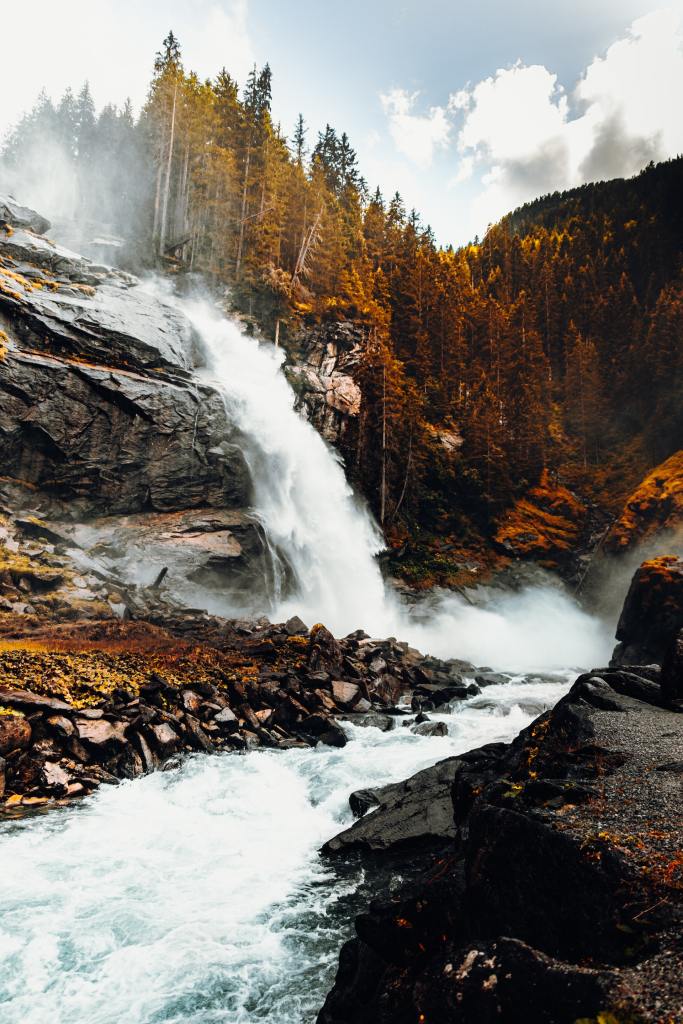
God, Our Eternal River

When comparing Genesis and Revelation, we find similarities between the Paradise man lost and the Paradise to come.  Consider these verses about each:

Genesis 2:8-9: “And the LORD God planted a garden in Eden, in the east, and there he put the man whom he had formed.  And out of the ground the LORD God made to spring up every tree that is pleasant to the sight and good for food. The tree of life was in the midst of the garden, and the tree of the knowledge of good and evil.  A river flowed out of Eden to water the garden, and there it divided and became four rivers.
Revelation 22:1-2: “Then the angel showed me the river of the water of life, bright as crystal, flowing from the throne of God and of the Lamb through the middle of the street of the city; also, on either side of the river, the tree of life with its twelve kinds of fruit, yielding its fruit each month. The leaves of the tree were for the healing of the nations.

A stream in Llanberis, Wales.

In each description is the tree of life, and also a river. Rivers are greatly beneficial to the growth of cities and civilizations, providing benefits for agriculture, trade, travel, etc.  Even today, most large cities that don’t border a large body of water have a navigable river nearby or flowing through it.  A big city without one is rare: in the United States, Dallas, Texas, and Charlotte, North Carolina, may be the only major cities not located near a significant river.

Rivers are mentioned a lot in the Bible, including in this Psalm about God being our refuge and fortress.  An unnamed river in the “city of God” is mentioned:

There is a river whose streams make glad the city of God,
            the holy habitation of the Most High.” (Psalm 46:4)

However, Jerusalem, the place Jews in the Old Testament period would have considered the “city of God” does not have a river.  The Psalmist certainly knew this, so their point is about something else, that the “city of God” has, well, it has God, as described in the next verses:

“God is in the midst of her; she shall not be moved;
            God will help her when morning dawns.
The nations rage, the kingdoms totter;
            he utters his voice, the earth melts.
The LORD of hosts is with us;
            the God of Jacob is our fortress.  Selah” (Psalm 46:5-7)

Jerusalem may not have a river, but it has God who provides all it needs and more.  No river required.  Even though the literal, ancient Jerusalem was eventually destroyed by the Babylonians, and later by the Romans, the eternal City of God will never be moved.  All other nations “rage” and “totter,” but God’s kingdom is forever secured by the One whose voice melts the earth.  Hebrews 1:10-12 (quoting from Psalm 102:25-27):

You, Lord, laid the foundation of the earth in the beginning,
            and the heavens are the work of your hands;
they will perish, but you remain;
            they will all wear out like a garment,
like a robe you will roll them up,
            like a garment they will be changed.
But you are the same,
            and your years will have no end.”

Do you worry that you lack things others have?  Things that would provide benefits for your business, spare time, or other pursuits?  With God as our fortress and refuge, we don’t need a river, but in Paradise He will provide one anyway.

Fret not, for you have God, our eternal river.

“Let Not the Flood Sweep Over Me”

Yesterday’s post was about Jeremiah’s comparison of false religion to a broken cistern, with God alternatively being “the fountain of living waters.”[1]  Jeremiah lived when most of God’s people – including most of the priests and prophets – had turned from Him to follow other gods.  As Jeremiah remained faithful, correctly predicting that Jerusalem would fall to Babylon, he was persecuted, including this instance in Jeremiah 38:6, where King Zedekiah’s officials “took Jeremiah and cast him into the cistern of Malchiah, the king’s son, which was in the court of the guard, letting Jeremiah down by ropes. And there was no water in the cistern, but only mud, and Jeremiah sank in the mud.”

Since God is “the fountain of living waters,” the only path to eternal blessing, it’s incredibly ironic that Jeremiah, one of the few remaining faithful prophets and therefore a rare source of God’s “living waters,” should be cast into a cistern with no water.  Perhaps it was broken.  King Zedekiah thought he could silence the “living waters” Jeremiah represented by casting them into a cistern, trading truth for falsehood.

Photo by Mishal Ibrahim on Unsplash

Later, Jeremiah seems to recall the cistern experience in Lamentations 3:52-57, where he said:

I have been hunted like a bird
            by those who were my enemies without cause;
they flung me alive into the pit
            and cast stones on me;
water closed over my head;
            I said, ‘I am lost.’
‘I called on your name, O LORD,
            from the depths of the pit;
you heard my plea, ‘Do not close
            your ear to my cry for help!’
You came near when I called on you;
            you said, ‘Do not fear!’”

Returning to the book of Jeremiah, we read that Ebed-melech, an Ethiopian eunuch, heard of Jeremiah’s situation and pleaded his case: “My lord the king, these men have done evil in all that they did to Jeremiah the prophet by casting him into the cistern, and he will die there of hunger, for there is no bread left in the city.”[2]  This unlikely source – a foreigner – was Jeremiah’s deliverance from God to rescue Jeremiah from the well.  Ebed-melech gathered 30 men, “Then they drew Jeremiah up with ropes and lifted him out of the cistern. And Jeremiah remained in the court of the guard.”

Jeremiah was not the only Old Testament figure to suffer for his faithfulness.  Many years earlier, King David also referred to “sinking in the mire” in the Messianic Psalm 69, verses 14-15:

“Deliver me
            from sinking in the mire;
let me be delivered from my enemies
            and from the deep waters.
Let not the flood sweep over me,
            or the deep swallow me up,
            or the pit close its mouth over me.”

David knew this feeling of sinking came not because of his sin, but when he was faithfully serving his Lord.  David’s “sinking in the mire” happened under these circumstances from verse 9 of the same Psalm:

For zeal for your house has consumed me,
            and the reproaches of those who reproach you have fallen on me.”

In Jeremiah’s case, as well as David’s and that of Jesus, whom Psalm 69 foreshadowed[3], we know that cannot judge our faithfulness based on whether it improves our circumstances.  When we do, we might stop being faithful because it seems we are “sinking in the mire.”  Being reproached by the world and feeling down aren’t the circumstances we prefer, but “Blessed are those who are persecuted for righteousness’ sake, for theirs is the kingdom of heaven.”[4]  Through these and all other circumstances, God develops in us deeper trust in Him.

Therefore, with David may we pray:

But as for me, my prayer is to you, O LORD.
            At an acceptable time, O God,
            in the abundance of your steadfast love answer me in your saving faithfulness.” – Psalm 69:13

And in His time, He will deliver us, perhaps in ways we don’t expect.

Coda

In 1995, Christian rock group Jars of Clay released their self-titled album, and the track “Flood” has similar themes to this post.  The song was also a mainstream hit, charting as high as No. 12 on the Billboard Modern Rock Tracks chart,[5] amazing for a song that is essentially a prayer like David’s in Psalm 69.

You can check out the song’s lyrics here: https://genius.com/Jars-of-clay-flood-lyrics

Or, if you have 3 ½ minutes, watch the music video here:


[1] Jeremiah 3:13
[2] Jeremiah 38:9
[3] John 2:17, 15:25, Acts 1:20, Romans 11:9-10, 15:3
[4] Matthew 5:10
[5] https://en.wikipedia.org/wiki/Flood_(Jars_of_Clay_song)

Broken Cisterns Can Hold No Water

Sometimes word pictures in the Bible weren’t written for people like me.  In my life I haven’t thought much of cisterns, but the Old Testament prophets Isaiah and Jeremiah refer to them a few times in their prophecies, and Jeremiah ends up thrown into one.  To Jeremiah’s original audience, and others living now, the meaning behind these pictures might be obvious.  But for me, it took a little research.

A cistern-centered comparison in Jeremiah 3:12-13 particularly drew my attention, where broken cisterns are used as a picture of false religion and idolatry:

Be appalled, O heavens, at this;
            be shocked, be utterly desolate,
            declares the LORD,
for my people have committed two evils:
they have forsaken me,
            the fountain of living waters,
and hewed out cisterns for themselves,
            broken cisterns that can hold no water.”

God is the “fountain of living waters,” but how is false religion like “broken cisterns”?

Looking up “cistern” in the American Heritage Dictionary I find it is: “A receptacle for holding water or other liquid, especially a tank for catching and storing rainwater.”  So, a cistern is not a fountain, a source of water, but instead is dependent on another source (usually rain) for its water.  So, Jeremiah’s accusation is that false religion can’t create its own water, which brings us to the second point…

The false religions of Judah in Jeremiah’s day weren’t even good cisterns – they were broken.  While a cistern is a vessel for storing water in reserve when there is no rain, when broken it’s not even that.  Even with another source of water, putting it into a broken cistern was no better than pouring it out into the sand.  Jeremiah’s second accusation is that false religion can’t even store good things from other sources.  The picture here is that if they took parts of true worship and mixed them with other religions, not only were the other religions wasted, but whatever they would have gained from God is also wasted.

Without God, many things are like broken cisterns.  Things that make us happy in this world are temporary and require our Creator God to provide us with more.  A food you like might satisfy you for a while, but eventually you need to find more food.  Rain may satisfy your garden plants, but eventually they will need more water.  Money may seem alluring for its own sake, but it only buys things that are temporary like everything else.

In Jeremiah 2:18, he tells the people not to look anywhere other than the true God of Israel for the source of living water and eternal satisfaction:

And now what do you gain by going to Egypt
            to drink the waters of the Nile?
Or what do you gain by going to Assyria
            to drink the waters of the Euphrates?”

Like a cistern, even the Nile and Euphrates only get their water from some other source.  They can’t make their own, and God can even determine if the rivers are empty or full.  Later, in Jeremiah 14:2-3, he says that because Judah had forsaken God, He had caused a drought, and therefore:

Judah mourns,
            and her gates languish;
her people lament on the ground,
            and the cry of Jerusalem goes up.
Her nobles send their servants for water;
            they come to the cisterns;
they find no water;
            they return with their vessels empty;
they are ashamed and confounded
            and cover their heads.”

The people mourned their earthly problem but did not care about their spiritual problem which is infinitely more important.  No provision – any science, philosophy, or religion – can defend against a drought caused by forsaking God, because false gods – anything we put in His place – cannot deliver rain.  They are but broken cisterns.

Consider that if there is no Creator behind the workings of nature, or if that Creator doesn’t care about us, why should we expect the world to act in ways that predictably bless us, instead of just being completely unpredictable and random?  Why do things seem to work most of the time?  Rain, friction, food, gravity, math, and on and on.  Fortunately, our God “sends rain on the just and on the unjust,”[1] and to His own He gives “a spring of water welling up to eternal life”[2]

He calls all people to know Him as “the fountain of living waters.”  No cistern needed.

Soli Deo Gloria


[1] Matthew 5:45
[2] John 4:14

What If Nature Shows Purpose, Rather Than Randomness?

Headline I just saw in the Facebook news feed: “What if Math Is a Fundamental Part of Nature, Not Something Humans Came Up With?” Reading the article I found that patterns in nature are “staggering”, but no conclusion is made. (Article linked below)

Yeah – What If?

Says CS Lewis, in the book Miracles: “Men became scientific because they expected Law in Nature, and they expected Law in Nature because they believed in a Legislator”

Science Alert Article