To Gain What We Cannot Lose: History for January 8

On January 6, 1956, a group of American missionaries made first contact with a local tribe in Ecuador, trying to reach them with the gospel.  Two days later, on this date, January 8, 1956, five of those missionaries – Jim Elliot, Pete Fleming, Ed McCully, Nate Saint and Roger Youderian – were speared to death by the very Auca tribe they spent years preparing to minister to. But their story was not over.

Jim Elliot and others had been ministering to the Quichua people in Ecuador since 1952, with many coming to faith in Jesus.  However, the nearby Aucas (now called Waodoni) were known to kill any outsiders that entered their area, including Quichua and also oil workers at a site nearby.  Jim “knew the only way to stop the Aucas from killing was to tell them about Jesus”[1] and came up with a plan to reach them.  Working with Nate Saint, a missionary supply pilot, they spent months trying to safely build goodwill with the Waodoni by lowering supplies to them from a plane and speaking friendly Waodoni phrases from a loudspeaker.

On January 6th, they talked to a Waodoni called George, thinking they had gained some trust and they set up a later meeting.  George, however, lied to them about his intentions, and ten members of the tribe were ready in ambush with spears on January 8th.  The unarmed missionaries had no chance.

Jim Elliot

Seeking vengeance or giving up might have been a reasonable response for the other missionaries, but in a miraculous example of forgiveness, persistent faith, and a heart for the lost, Elisabeth and Valerie Elliot (Jim’s wife and young daughter), and Rachel Saint (Nate’s sister) learned the local language and moved into the jungle to live with the Waodoni in 1958.  Elisabeth wrote about serving those who killed her husband: “The deepest things that I have learned in my own life have come from the deepest suffering. And out of the deepest waters and the hottest fires have come the deepest things I know about God.”  Today, the Waodoni are a friendly tribe and many are professing Christians.  Missionaries, including members of the Saint family, still live among them today.  Elisabeth died in 2015 at the age of 88, after a long career as missionary, author, speaker, and radio host.

Jim’s Apparent Failure is God’s Victory
In life, Jim Elliot was sometimes frustrated by his effort, once writing: “No fruit yet. Why is it that I’m so unproductive? I cannot recall leading more than one or two into the kingdom. Surely this is not the manifestation of the power of the Resurrection. I feel as Rachel, ‘Give me children, or else I die.’”[2]  While attending Wheaton College in Illinois in the 1940’s, Jim developed a desire to preach the gospel, including taking the train to Chicago and talking about Jesus with people at the train station, but with little response.

“He is no fool who gives what
he cannot keep to gain
that which he cannot lose.”

– Jim Elliot

But in death, Jim was used by God to inspire many other missionaries, including his own family, through whom God’s love for the lost went out and bore more eternal fruit than Jim may have ever imagined.  His story is a reminder that faithfulness is the Christian’s objective, and God provides the fruit.

Jim wrote what has become a familiar quote to many: “He is no fool who gives what he cannot keep to gain that which he cannot lose.”  In Paradise, Jim, those affected by his ministry, and all other believers, will forever praise God for His steadfast love through the centuries.  Nothing we do for God now can look foolish from that perspective.  We have so much to gain that we cannot lose.

Soli Deo Gloria

Learn More:
This story was dramatized in the 2005 film End of the Spear and in the 2002 documentary Beyond the Gates of Splendor.  A website dedicated to Elisabeth Elliot’s life (https://elisabethelliot.org/) has more on this amazing history of God’s work.


[1] https://www.christianity.com/church/church-history/timeline/1901-2000/jim-elliot-no-fool-11634862.html
[2] https://www.inspirationalchristians.org/evangelists/jim-elliot-biography/

General Washington Crosses the Delaware – History for December 25-26

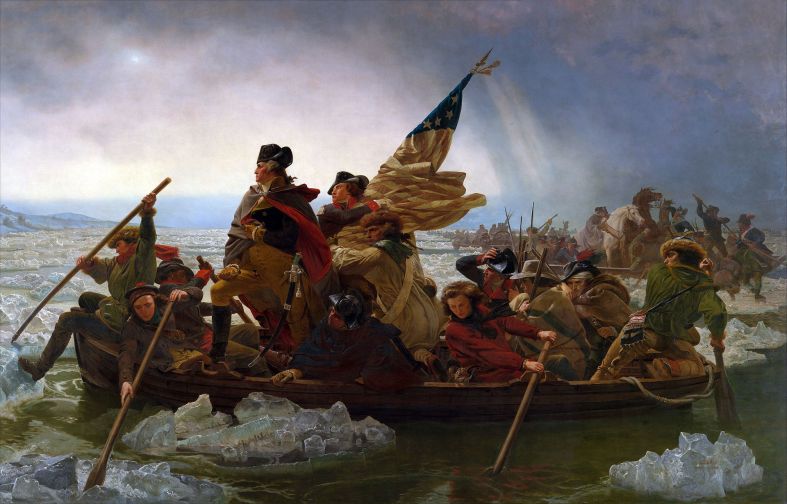
General George Washington leading the Continental Army on small boats across the Delaware River in the middle of the freezing night, surrounded by chunks of ice, is a popular story and image from early American history.  Depicted famously by German-American artist Emanuel Leutze in the painting nearby, this desperate effort was a significant turning point in the war.  The daring crossing was an act of desperation and made necessary (and possible) by a long string of events in 1776.

It had not been a good year for Washington’s army, suffering a string of defeats at Brooklyn, Kips Bay, and White Plains.  With little hope or troops left, Washington retreated with much of his army across the Delaware around November 7th, expecting the British to soon cross and strike Philadelphia, taking full advantage of their momentum and Washington’s weakness.  On November 16, 2,837 Americans surrendered at Fort Washington, after General Washington trusted Nathaniel Greene’s report that the fort could be defended.[1]  Another defeat at Fort Lee left Washington with perhaps 3,500 troops after losses and desertions.[2]  On top of this, many troops’ commitments were due to expire in early December, reminiscent of when the army had massive turnover during the siege of Boston in 1775.

Washington Crossing the Delaware by Emanuel Leutze. Public Domain.

Desperate to defend Philadelphia (where Congress had been held since the First Continental Congress in 1774), Washington expected General Lee to reinforce him soon with more troops.  However, Lee – effectively Washington’s second-in-command – had inexplicably spent the night of December 12th apart from his troops at a tavern.  Lee was ratted out and captured in a raid that took less than 15 minutes on the 13th.  Things looked bleak, but on the same day, Washington learned that Congress had relocated from Philadelphia to Baltimore for safety.

More importantly, continuing a string of possibly Providential, but certainly weather-assisted, events like a storm that allowed Washington to end the British siege of Boston with minimal bloodshed (see this post), and surprise fog that covered Washington’s overnight escape from Brooklyn (see this one), on December 13th, British General William Howe decided to cease military operations for the winter.[3]  Absent this decision, the war may have been over soon, with a British victory, but with this decision, we have the backdrop for the famous crossing of the Delaware.

Seeking opportunity for a decisive move, Washington kept his army as intact as he could manage until the time arrived.  With Christmas approaching and the British ceding the initiative, Washington now had about 6,000 troops and intelligence that about 2,000 Hessian mercenaries (the actual number was probably lower, around 1,500) were defending Trenton.  After the “Long Retreat,” as the string of defeats above came to be known, the Continental Army needed a victory, and got one.  Three separate groups were planned to cross the Delaware, but only Washington’s main force made it.  Regardless, Washington caught Hessian commander Johann Rall unprepared, in spite of warnings Rall received and disregarded.  After all, the sturdy British had closed down for the winter – why wouldn’t everyone do the same?

Just after 8am on December 26th, Washington’s force attacked, killing 21 Hessians, wounding 90, and capturing 900.  500 escaped over a bridge that was supposed to be defended by one of the two forces unable to make the crossing.[4]  Washington went on to another victory at Princeton on January 3, as the British were again caught by surprise, thinking the army was still in Trenton.[5]  The momentum had turned, with the central event being the daring crossing of the Delaware on Christmas night, in freezing weather surrounded by ice.


[1] McCullough, David.  1776  (2005).  P. 234.
[2] McCullough, David.  1776  (2005).  P. 249.
[3] McCullough, David.  1776  (2005).  P. 264-267.
[4] McCullough, David.  1776  (2005).  P. 270-281.
[5] McCullough, David.  1776  (2005).  P. 288.

How December 25 Became Christmas – Sunday Share from Andrew McGowan

Why is Christmas celebrated when it is?  Today’s Sunday Share is an article tracing the history of that decision, and also some background behind Christmas traditions.  Author Andrew McGowan notes that in contrast to some who believe Christmas just hijacked existing pagan holidays, “It’s not until the 12th century that we find the first suggestion that Jesus’ birth celebration was deliberately set at the time of pagan feasts.”  McGowan cites writings from the 2nd and 3rd centuries debating whether December 25th was actually the date of Christ’s birth.  However, McGowan also notes that Christmas was a later development than Easter, and that “most scholars would urge caution about extracting such a precise but incidental detail from a narrative whose focus is theological rather than calendrical.”  I’ve yet to find precise guidance from the Bible describing when, how, or even whether, to celebrate Christmas, but this article is a solid start in getting some facts straight and worth a read!

What Was the ‘Scopes Monkey Trial’ Really About? – History for July 21

Some events in history bring a faint glimmer of memory to many people, but what they remember may not be the most relevant point. One such event was the “Scopes Monkey Trial,” decided on July 21 in 1925. What actually was this trial? Wikipedia’s summary[1] is that “a high school teacher, John T. Scopes, was accused of violating Tennessee’s Butler Act, which had made it unlawful to teach human evolution in any state-funded school. The trial was deliberately staged in order to attract publicity to the small town of Dayton, Tennessee, where it was held.” The trial descended into theatrics and was covered by national news organizations. Time magazine called the trial a “fantastic cross between a circus and a holy war.” Each side had a famous lawyer seeking publicity: the Presbyterian William Jennings Bryan, who ran for president three times, was the prosecuting attorney, and the agnostic Clarence Darrow defended Scopes.

The immediate result of the trial was that Scopes was found guilty and ordered to pay a small fine, but years later, that’s not what people remember.  For some, the lesson of the Scopes trial is simple: “science good; religious fundamentalism bad.”  Another group of people might think the lesson was: “religious fundamentalism good; science bad.”  But did the case conclude either of these things?  It didn’t, so what’s the real issue?

The Culture Behind the Scopes Trial
In the background issues were simmering which still linger today – whether religion should have a voice in how science is used and taught.  Tim Keller notes that “Few people remember…that the textbook Scopes used, Civic Biology by George Hunter, taught not only evolution but also argued that science dictated we should sterilize or even kill those classes of people who weakened the human gene pool by spreading ‘disease, immorality, and crime to all parts of this country.’ This was typical of scientific textbooks of the time.”[2]  Wikipedia notes that “Scopes was unsure whether he had ever actually taught evolution, but he incriminated himself deliberately so the case could have a defendant.”  So, the trial did not hinge on Scopes’ teaching, this textbook, or even eugenics, but the subject of eugenics sheds some light on how over-simplified the take-away of “science good; religious fundamentalism bad” really is.

Geneticist Francis Galton, a cousin of Charles Darwin, popularized the term “eugenics” from the Greek, meaning “good birth,” to describe ways humans could use evolutionary science to improve their condition.  He usually left unspoken that he meant not specific humans, but some abstract sense of humans in aggregate, and also that he meant to improve the condition of those humans in charge, or those humans with a voice among the humans in charge.   These beliefs were not rare, but quite mainstream.  Joseph Loconte, writing of the culture J.R.R. Tolkien and C.S. Lewis lived in[3], notes: “In Britain, the Eugenics Education Society was founded in 1907 to take up the cause.  By 1913, the American Genetic Association was established in the United States to promote the doctrines of racial purity.”  The United States was actually the first country where compulsory sterilization was legalized, and some practices implemented by Nazi Germany were lifted right out of laws used by U.S. States.  U.S. Supreme Court justice Oliver Wendell Holmes wrote “Three generations of imbeciles is enough” in defense of Virginia’s sterilization law.

The church was not entirely immune from the eugenics movement either.  According to Loconte, “Ministers in the Church of England held a Church Congress in 1910 in Cambridge, inviting several members of the Royal Commission on the Feeble-Minded to participate.”  Also, “By the 1920s, hundreds of American churches participated in a national eugenics sermon contest.  As the Rev. Kenneth McArthur, a winner from Sterling, Massachusetts, put it in his sermon: ‘If we take seriously the Christian purpose of realizing on earth the ideal divine society, we shall welcome every help which science affords.’”

This background to the Scopes Trial, often simplified to a “science” vs “fundamentalism” debate, makes us ask: which science and which fundamentalism?  Was eugenics, for a moment, part of “religious fundamentalism” for some of the church?  And is perfecting society on earth truly a fundamental Christian belief?  With a rule of thumb of “science good; religious fundamentalism bad,” or the opposite, what do you do if a scientific idea becomes also central to religious belief?

Also, if you take away science and religion from the equation altogether, which is better: “all humans have dignity and are worthy of care and love” or “some people deserve to be neutered like an ordinary animal”?  If science is the only source of our “fundamentalism,” where do we turn when it insists on destruction for the less favored?  Tim Keller argues that “Secular, scientific reason is a great good, but if taken as the sole basis for human life, it will be discovered that there are too many things we need that it is missing.”  What is missing is a meaningful reason to love your neighbor, regardless of their scientific knowledge, religious belief, disability, economic impact, level of intelligence, or any other characteristic.

It’s Not (Entirely) a Fantasy
Loconte says that although Tolkien and Lewis wrote of fantasy worlds populated not only by men, but also by elves, dwarves, orcs, and many other races, the topics of eugenics and other Progressive Era ideas served as background.  In Tolkien’s epic The Lord of The Rings, the solution to conflict between the races was not for one race to rule the others, or (even worse) to eliminate them.  Instead, the answer is to utterly destroy the Ring of Power, representing the desire of any tribe to use power to rule others “for their own good,” as some say.  While Tolkien insists his story is not a direct allegory, he may have been thinking of the centuries of tribal conflict between the English, Irish, Scots, and Welsh.  Or the conflict between any group of conquerors and the conquered.  By using fictional races, Tolkien was arguing that this lesson applies to everyone, in all places and at all times.

Therefore, when scientific fundamentalism says it’s OK not to love some people, Christians need to respond without exception that every person is a creation of God with innate dignity and should be loved as Christ loved us.  However, as shown on the cross, power is not the answer.  As Jesus told his disciples in Mark 10:42-45 – “You know that those who are considered rulers of the Gentiles lord it over them, and their great ones exercise authority over them.  But it shall not be so among you. But whoever would be great among you must be your servant, and whoever would be first among you must be slave of all.  For even the Son of Man came not to be served but to serve, and to give his life as a ransom for many.

God does not expect us to understand every issue of history, or even in our daily news feed, which is increasingly a “fantastic cross between a circus and a holy war,” but when we all meet our Lord in heaven, He will say “as you did it to one of the least of these my brothers, you did it to me.’” – Matthew 25:40


[1] https://en.wikipedia.org/wiki/Scopes_Trial
[2] Keller, Timothy.  Making Sense of God (2016).  This post draws from pages 12-13.
[3] Loconte, Joseph.  A Hobbit, A Wardrobe, and a Great War: How J.R.R. Tolkien and C.S. Lewis Rediscovered Faith, Friendship, and Heroism in the Cataclysm of 1914-1918 (2015).  This post draws on pages 15-19.

Give Everyone Some Longitude? – History for July 8

On this date in 1714, the British Parliament passed the Longitude Act, offering prizes to anyone who could accurately measure longitude at sea.  Failure to measure longitude was causing massive economic damage from shipwrecks and piracy.  Galileo had established a method using Jupiter’s moons, generally accepted soon after his 1642 death, but it only worked on land.  Use of Galileo’s methods on land led to many maps being redrawn, “shrinking” France on maps and causing King Louis XIV to complain that he was losing more territory to astronomers than to his enemies.  At sea, the tossing of the waves, changes in the weather, and other factors made the problem more difficult, leading to the Longitude Act.  The problem was eventually solved by the chronometer, invented by self-educated carpenter John Harrison, who overcame resistance from multiple fronts, including religious leaders who, like Galileo, were convinced the solution was in the stars of the heavens, sometimes citing Bible verses like Psalm 19:1 – “The heavens declare the glory of God, and the sky above proclaims His handiwork.”  The Board of Longitude paid out over £100,000 for research and in prizes before disbanding in 1828.[1]

Science and religion each have a role to play in improving the lot of mankind on earth, but a lot of unnecessary conflict has come from either claiming a monopoly on worldly progress.  While “the heavens declare the glory of God,” the stars are also “for signs and for seasons, and for days and years.[2]  But that is not all they are for. They also declare that the world is not all there is, and that we are to love others as the Creator of the stars loves us.  Therefore, let’s all give each other some latitude, or even some longitude.


[1] Sobel, Dava.  Longitude (1995).
[2] Genesis 1:14