Finding Port for the Good Ship Ambivalent

From yesterday’s post, you’ll know I am reading King’s X: The Oral History, a book chronicling the history of the rock band King’s X, by Greg Prato.  Yesterday, I dove into one of their more bizarre and unknown songs, but today is about the band’s biggest hit.  “It’s Love” got to “#6 on Billboard’s Mainstream Rock charts and #1 on the FM Radio Airplay charts. It was our highest-ranking single, ever,”[1] according to Ty Tabor, the band’s guitarist and sometimes lead singer, who wrote the song.

I knew both Christianity and King’s X by reputation before becoming a true fan of either, but both were growing at the same time in me during college.  Having heard of King’s X but never actually heard their music, I once saw one of their CDs in a friend’s dorm room.  My friend said it was his roommate’s but that he wasn’t much of a fan.  Before leaving I picked up the CD and looked at it.  The album, called “Faith, Hope, Love” had a cool cover, and included the song “It’s Love.”
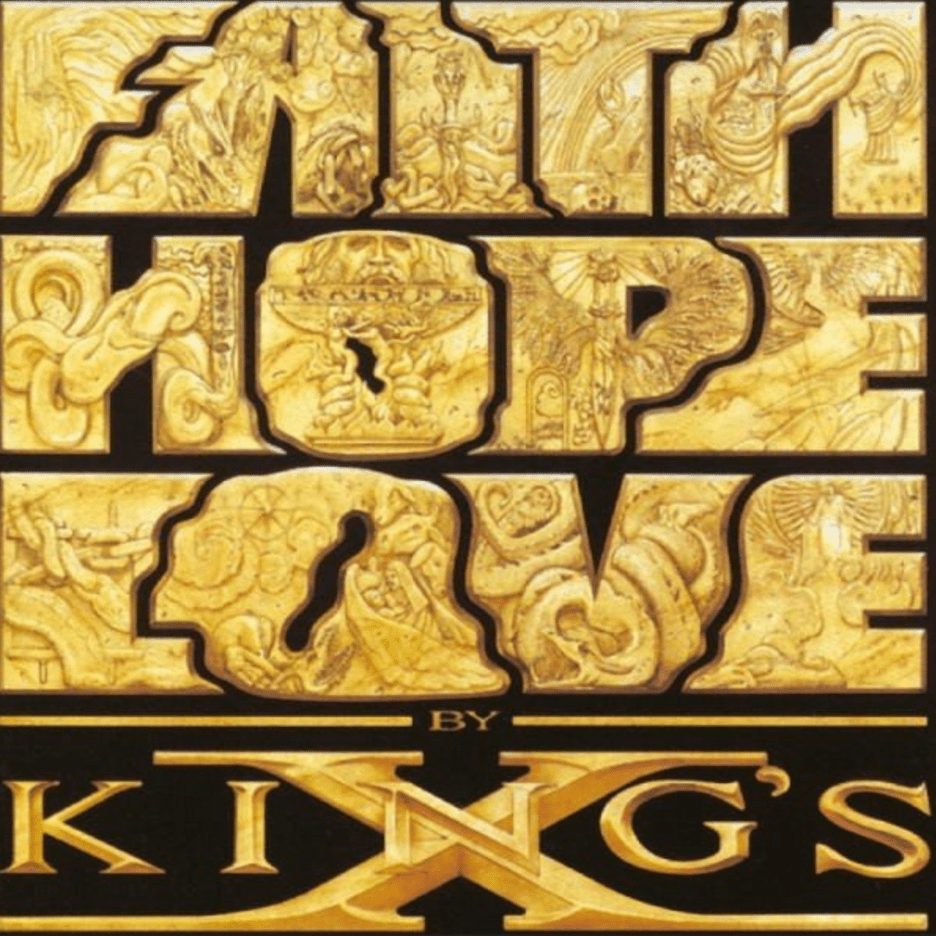
Album cover of “Faith Hope Love” by King’s X

Later, the memory of that album cover made the triad of faith, hope, and love jump out at me whenever I saw it in the Bible, including 1 Corinthians 13:13, which says: “So now faith, hope, and love abide, these three; but the greatest of these is love.”  This triad is all over the place and there are many verses explaining the relationships between them.  Seeing these references also made me come back to the band and give them a listen. The rest, as they say, is history.

Before getting into “It’s Love”, you can find the lyrics here, or listen to the song here.  I promise it’s an easier one to listen to than “Six Broken Soldiers” and also that this post will be shorter than yesterdays.

Overall, the message is fairly simple: Ty says he doesn’t know everything, but the thing he wants to share from his experience is that love is the most important thing in life.  Love both keeps the world from falling apart (“holding back the weather”), but also eventually love is what requires a loving God to bring about a plan to fix what’s wrong with the world (“the same will let it go”).

But there’s one line in the song I didn’t really get until reading about it recently: “There’s a ship on the ocean, and I can’t decide if I like it.”

There Ty is, enjoying good company, the beach, and the ocean, but he wasn’t sure about the ship on the ocean.  There’s an ambivalence about the ship, and a suggestion that maybe it’s an exception to the overall message of “love,” but I couldn’t figure out more than that.  I wasn’t alone in not getting it.

In the book, Ty says his brother didn’t understand the line, so he explained: “my point was, man’s progress is wonderful and everything, but when the ship turns over and poisons all the fish, that’s not so wonderful. So, it was me contemplating all that we do and all that I’m happy with about it, but how much destruction it causes. It’s yet again one of those socially conscious songs. I just had to say it.”[2]  It was almost that Ty was struggling with whether love applied when someone does something that “poisons all the fish.”  In tricky, real-life situations, does love still rule?  Ty doesn’t seem sure.

Contemplating What is Crooked
Yesterday I quoted Romans about Paul’s inner conflict, but later in the same chapter, Paul wrote: “So I find it to be a law that when I want to do right, evil lies close at hand.” (Romans 7:21). This idea that even our best efforts at goodness in this world are tainted is not a new one.  Solomon referred to something similar twice in the Old Testament book of Ecclesiastes, in 1:15 – “What is crooked cannot be made straight, and what is lacking cannot be counted.”  And also in 7:13 – “Consider the work of God: who can make straight what he has made crooked?

What Paul and Solomon are getting at is that there are things in this world, including us, that will remain crooked and unfixed until God’s plan is completed in eternity.  The Bible tells us that all of creation is cursed by God because of our sin.  Some things are wrong because God has made them so.  Until a person establishes this in their own heart and mind, they will chase the wind of worldly utopia until they become hopelessly ambivalent, or continue on, highly motivated but frustrated and angry.  The phrase “under the sun” comes up 28 times in the book of Ecclesiastes (by my quick count) and refers generally to the actions of mankind done without consideration of God’s wisdom or eternal consequences.  Everything done “under the sun” is lacking, and none of it can provide the satisfaction and meaning true wisdom can deliver.

It’s Still Love
Since “under the sun”, even good things come with a cost, what do we do?  We can’t be ambivalent to those costs to the point of not caring, but we also can’t be so committed to removing these costs that our efforts become another cost.  The world is broken, but also people are broken, and how we treat them matters.

Despite any ambivalence about the ship on the ocean, it’s still “love that holds it all together.”  Therefore, the priority is always to focus on obedience and thankfulness to God, who tells us to love, not on utopian alternatives to God that tell us something is more important than loving every one of our fellow humans.  The proverbial ship on the ocean and its problems are seen by God and are part of His plan.  He cares about our conflicts and paradoxes, but still tells us to have faith, hope, and love.

However, rejection of love means prioritizing our own, temporary, interests and decide who we should love and who we should hate based on that.  One side will defend the necessity of the ship – and more ships – at all costs, because it’s good for the economy.  They can make money and enjoy what little time on earth they have.  The other side will condemn those who poison the fish, or might possibly poison fish in the future, because this earth is all they have, and they want to protect it.  “Under the sun” there is no nuance or ambivalence about the ship, but our opinion of the ship determines everything, including whether we can enjoy the beach and the ocean that we do have.

The answer lies not in some abstract move to the center politically, but in knowing that there is more than what exists “under the sun.”  Regardless of the conflicts inherent in living with broken people in a broken world, faith in God to save us, hope in His provision of a perfect future, and the priority of love for God and others, is always the right answer.  We can be a little ambivalent about the ship on the ocean, but we should have no ambivalence about love, nor about its partners, faith and hope.  We should pursue them with everything God has gifted us with and give Him the glory.  We can’t fix all the world’s problems, but we can show the world the character of its Creator and show it the way to a better world.

So now faith, hope, and love abide, these three; but the greatest of these is love.”  Always.


[1] Prato, Greg. King’s X: The Oral History (2019).  P. 105.
[2] Prato, Greg. King’s X: The Oral History (2019).  P. 95.

Do You Have a Caged-Up Gorilla in Your Trunk?

I’ve been a fan of the rock band King’s X for many years and am currently reading King’s X: The Oral History, a book by Greg Prato that chronicles the history of the band entirely through quotes from the band, those who have worked with the band, music journalists, and other musicians.  They have a musical style all their own, combining heavy rock influences with complicated arrangements and Beatle-esque vocal harmonies.  Some even credit them with inventing the “grunge” genre, not just by often tuning their instruments to a lower, heavier tone, but also through their gritty lyrics as a contrast to the “hair metal” that dominated rock in the early and mid 1980s.  On top of the musical style, I also liked that in the late 1980s and early 1990s there were a lot of Christian themes in their lyrics but written around the reality of their struggles with their faith and with aspects of Christian culture and the music industry.  Unfortunately, these struggles continue for them, and only one of the three members seems to still be a Christian.

One of the reasons I bought the book was that it promised to cover “every song” in their catalog, and since some of their lyrics are enigmatic, I wanted more of the story.  The rest of this post is about one of those songs, how the book (understandably) didn’t explain it, and what I was able to get from it anyway.

When I unwrapped the book, the first thing I did was to find the hoped-for explanation of the lyrics for “Six Broken Soldiers.”  Written by the band’s drummer, Jerry Gaskill, it’s a different style than other songs and the lyrics seem intriguingly random.  Flipping through pages, I quickly found Jerry’s only comment on the song:

“It’s always hard for me to talk about lyrics, because I don’t like to say exactly what I’m thinking, because then that takes away from anything that you may get from it. When I write, I put everything I feel and think into each line, so it comes off very ambiguous sometimes, and even unintelligible sometimes. But I have specific things I’m thinking when I wrote that. Basically, it’s just me talking about me.”[1]

Jerry Gaskill

Bummer.  Although I was hoping for more specifics, I definitely understand an artist’s desire to let the audience interpret the work in their own way.  So, if “it’s just me talking about me,” what do I see knowing that, and re-reading the lyrics?  Below I’ll go into some of the lines and my take-aways, but it might be handy to have the lyrics, which you can find here, or if you want to hear the song, click here.  There are parts of it I don’t get, and will skip in my comments, but which meant something to the author and that might mean something to you.

Us Talking About Us
In general, I think the song describes the complexity of human personality, not just Jerry’s, but everyone’s, and how little we understand it.  First, the title of the song says a lot.  Brokenness is right there, but also “six” says we are broken in many ways.  We can all identify with having problems, and more than one of them.  With “soldiers” I think of our struggle against our problems, and that even the “soldiers” we have to fight them with have their own problems.  Our brokenness affects our ability to combat it and there’s no easy fix.

The opening verse suggests that our surrounding culture and heritage are not enough to solve these problems, and often don’t even care about them.  Is all we have an “American library” to deal with our sickness?  How often do you hear something on the news, or something a politician promises, and think – that’s exactly the answer to my specific situation?  Probably rarely, and even rarer if you consider whether they can actually do it, and on time for it to help you.  A lot of what is available to us is too vague and too ineffective to be what we really need.

The next part is series of seemingly random short phrases that are metaphorically part of our personality.  For me the lyrics include these parts:

  • Among the “Six broken soldiers in the trunk of my car”, there are parts of us we share with others (“Two of them speak”) and parts we’d rather not (“four go to bars”).  If this is what it means, then it also implies the parts we hide are much larger than the parts we let others know about.  All of it is baggage we carry with us everywhere we go, as in the trunk of our car.
  • “A caged up gorilla” – There are parts of us we don’t like, that might be harmful, and that we can barely control.
  • “three local bands” – There are parts of us that are experiences that led to where we are now, for good or ill.  King’s X had multiple, earlier versions before the current one, and so do we all.

Lastly, Jerry mentions an internal parrot that speaks multiple languages, all of them unintelligible, while “the audience he scans.”  Parrots repeat what they hear without understanding it so this line could mean there’s a lot that goes on inside ourselves that we don’t understand.  This echoes Paul’s frustration with himself in Romans 7:15 where he says: “For I do not understand my own actions. For I do not do what I want, but I do the very thing I hate.”  Our internal thoughts and motivations aren’t always reliable, and we don’t always know where they come from.

The parrot scanning the audience means he is looking for confirmation from outside that he is doing the right thing.  The irony is that when we don’t understand ourselves, why would we expect others to consistently understand us better and be able to guide us?  Do other people’s internal parrots speak more intelligibly than ours?  If they don’t, is popularity or majority rule a good guide for our decisions?  He has “sixpence and a quarter,” but doesn’t know what to do with it.

Not a very hopeful song, so what to take away from it?

First, that there is far, far more diversity inside of any one individual for even that individual to understand.  How can any society, armed with only an “American library,” hope to truly deal with people as actual individuals?  We can claim to respect the individual and stand for diversity and inclusion, but are such things even possible without vastly oversimplifying the situation?

Second, that there is far, far more brokenness in each individual for anyone other than God to fully diagnose and treat.  From what vantage point can we actually see the truth we each need, know the answers to our problems, and effectively apply them?

Before moving to the last section, I must clarify that I’m not saying human efforts at solving our problems are totally wrong and useless.  Many people manage their problems well enough alone and others manage with a lot of help from different sources.  Good friends, family, and in some cases therapy and medication, are very helpful.  We know a lot more about human psychology and other related topics than we used to.  The “American library” is not a static thing, but grows and changes over time, sometimes improving and becoming more effective, but not always.  Sometimes “progress” creates more, newer, problems before the old ones are solved.   Therefore, when honestly looking at the human condition with eyes wide open, we seem doomed to always fall short of a full solution with the resources we have.  What we have is not sufficient, but we have hope.

Where Does Hope Come From?
While our Six Broken Soldiers seem hopeless, there is an answer from outside our inner confusion and from beyond our material existence.  Members of King’s X are (or were) fans of C.S. Lewis[2], who wrote this description of mankind from Aslan, the fictional kingly lion who represents Jesus, in Prince Caspian, part of the Chronicles of Narnia series:

“You come of the Lord Adam and the Lady Eve. And that is both honor enough to erect the head of the poorest beggar, and shame enough to bow the shoulders of the greatest emperor on earth.  Be content.”[3]

Against our problems, we have far, far more dignity and nobility and talent than could possibly come by some cosmic accident.  We are each individual creatures of a loving God, and we have far more than an “American library” at our disposal.  We have Someone who knows us fully as the complex people we are, who loves us completely, and who was broken so that we might be delivered from our brokenness.

Therefore, come to Jesus, bring your Six Broken Soldiers, and ask Him to heal all of them.  He is an infinite resource.  There’s nothing about you He doesn’t already know and understand, and nothing He does not have a solution for.


If you don’t know how to do that or what that means, read this earlier post about what it means to have a loving, personal relationship with our Maker and Lord Jesus, who guides and empowers us to love as He does.


[1] Prato, Greg. King’s X: The Oral History (2019).  P. 97.
[2] Their first album was titled “Out of the Silent Planet,” and they later released a song referencing a chapter in “That Hideous Strength,” two books written by Lewis.
[3] Lewis, C.S.  Prince Caspian (1951).

Out of Exile into Exile

Many of us cannot wait for the Covid-19 pandemic to be over, so that we can return to normal and get back to doing the things we want to do.  Lessons learned, and let’s move on.  About a week ago, I posted about John the Baptist and what we can learn from his unexpected circumstances.  I also quoted Psalm 90:12 – “So teach us to number our days that we may get a heart of wisdom” – on another blog about learning from sickness.  As if on cue, I got Covid soon after.  Much of this week I’ve been too uncomfortable to sleep, but also without enough energy, physically or mentally, to do much of anything.  And it would appear I still have more to learn from the pandemic.

What do I mean?  Let’s take a look at the Old Testament life of David, and what he learned about trying to get back to normal.

King David’s Lost Decade
David had been anointed king at about age 16 but did not become king until about age 30.  Having already been anointed[1], David was forced into exile by the reigning king Saul, who tried to kill David multiple times.[2]  After this, David was kept by force from the throne he knew he would inherit for about 10 years!  When David says “wait for the LORD” he knows what he means from hard experience.  While David’s behavior in this time was not perfect, he provided some lessons for waiting on God’s deliverance from trials.

First, our timing to receive God’s promises is not God’s timing, and we must trust that His is better.  Warren Wiersbe notes that “It’s likely that David’s fugitive years are reflected in Psalms 7, 11–13, 16–17, 22, 25, 31, 34–35, 52–54, 56–59, 63–64, 142–143.”  These 22 Psalms are full of testimony of David’s faith that God would sustain him through all trials, that God was in still in control, and that God would always be proven faithful and true.  If God had anointed David king, He would get him there when He decided it was the right time.  Because David wrote these Psalms during his exile, Wiersbe says “God’s people today can find strength and courage in their own times of testing. Our Lord quoted Psalms 22:1 and 31:5 when on the cross.”[3]

Second, our power comes from God, and we must trust that He knows what it should and shouldn’t be used for.  On at least two occasions, David was given an opportunity to seize the kingdom from Saul by violent means.  To end his exile on his own terms and timing.  1 Samuel 24:1-7 and 1 Samuel 26:1-11 show Saul completely at David’s mercy, seemingly by God’s Providence, but David knew that if he struck and killed “the Lord’s anointed” he was betraying the Providence sustaining David during his years on the run.  Since David was also “the Lord’s anointed”, could he glorify God for preserving his own life, yet apply a different standard to Saul?  Would God bless David’s future kingdom if David trusted his own power, instead of relying on God’s power and timing?

David eventually rose to the throne and mourned the death of Saul, who took his own life on the battlefield rather than be captured by the opposing Philistine army.  David united the tribes of Israel under his rule, headquartered in Jerusalem, and led the way for the Temple to be built by his son Solomon.  While David’s grievous sins, including adultery and murder, had many consequences for himself, his family, and the nation, David always came back to his God and knew where his strength came from.

When forced back into exile by his son Absalom[4], David returned to the lessons of his earlier exile.  David always knew that salvation belongs to the Lord alone, but also seemed aware that salvation was not done yet.  He wrote in Psalm 17:15 – “As for me, I shall behold your face in righteousness; when I awake, I shall be satisfied with your likeness.”  While the idea of a future, eternal life was vague in the Old Testament, David knew someday he would meet God and know Him more fully.  David knew that as long as he was on earth he was still in exile, awaiting the full salvation of the Lord, which would come in His power and in His timing.

The Lost Pandemic Years
The pandemic seems like an exile from normal life – the life we think we should be living and the life we think we can return to living once the pandemic is over.  God has promised heaven, how can this continue?  I will eventually be over Covid, and the pandemic will end.  However, what we call our normal lives are also lives lived in exile, waiting for the salvation of the Lord.  Our normal lives remain interrupted not only by sickness, but also by our sin: our impatience, our frustrated longing for justice, our temptation to take salvation into our own hands, and our inability to love as we would like to be loved.  It would appear I still have more to learn from the pandemic.

When we leave the exile of the pandemic for the exile of our normal lives, let’s keep Driving Toward Morning: “Let us hold fast the confession of our hope without wavering, for he who promised is faithful. And let us consider how to stir up one another to love and good works, not neglecting to meet together, as is the habit of some, but encouraging one another, and ball the more as you see the Day drawing near.” – Hebrews 10:23-25

What is “the Day”?  It is not the day I get over Covid, or the day when the pandemic is no longer disrupting our everyday lives.  It is the Day where not only is every disease defeated, but also the Day we overcome all of our impatience and division and our longing for things to be set right.  It is the Day all of our desires are perfected, and in Him all of our perfect desires are fulfilled.  The Day we are no longer in exile and see the full salvation of the Lord.


[1] 1 Samuel 16:13
[2] 1 Samuel 19:10-12
[3] Wiersbe, Warren.  Be Successful (1 Samuel) (2001).  P. 135.
[4] See related post on Psalm 3, written by David at this time.

When You’re Stuck in Second Gear – Blessed are the Meek #4

Everybody struggles with maintaining hope in tough times, and also with knowing and doing God’s will when what we feel is right seems irrelevant.  Today I’m going to cover a story of how the Old Testament prophet Jeremiah struggled to understand an idea God gave him to share hope with future generations, including us.  The story also loosely follows the outline of the first three Beatitudes and therefore fits in the “Blessed are the meek, for they shall inherit the earth” series.

If misunderstood, the first two Beatitudes alone can leave us in a place where we’re a mess and the world is a terrible place and there’s nothing we can do about any of it.  It can be a place of depression and despair.  Like in the theme song from the TV show Friends[1], we feel like “It hasn’t been your day, your week, your month, or even your year.”  Where does it end?  But God promises that there is work for each of us to do: “For we are his workmanship, created in Christ Jesus for good works, which God prepared beforehand, that we should walk in them.” (Ephesians 2:10) The third Beatitude, “Blessed are the meek” promises a way forward – for every person in their own way to do whatever He has prepared for them.

The Gearbox of the Beatitudes
As I wrote in the first post on “Blessed are those who mourn” I believe the Beatitudes are an intentional sequence, and here I’ll describe better what I mean.  The Beatitudes are not a chronological path we move through as we mature.  We don’t learn to be fully poor in spirit before we can get any better at mourning or being meek.  The picture is more like gears in a machine that all need to work together for the machine to function in each specific situation.  Weakness in one place affects the entire machine and Jesus was explaining specific parts of becoming more like Him.  God, as our maker, knows how we function, the reasons behind when we fail to function, and the solution.  With the Beatitudes, Jesus encourages us to use the machine for what it was made for – loving God and neighbor in all times and circumstances.  First, being poor in spirit means that we have emptied ourselves of all illusions that our plans are better than God’s.  Second, mourning the state of ourselves and our world means we are emotionally engaged.  That we care.  In the third Beatitude, being meek is where we begin to engage our will, submitting it to God as our benevolent Lord.  If we don’t, “it’s like you’re always stuck in second gear” from the Friends theme song.

The story today (from Jeremiah 32) finds Jeremiah stuck.  The Jews had him imprisoned for speaking the words of their own God, and while he was there, God told him that he should buy a field.  Not only was Jeremiah in prison, but the field he was asked to buy was in enemy territory.  The Babylonians had already conquered much of Judah and were besieging Jerusalem.  Surrounded by despair, we can easily imagine Jeremiah asking: what good will it do?  He might think cutting off Nebuchadnezzar’s ear would be a better idea[2].

Jeremiah Inspects the Gears
As readers of the book of Jeremiah, we are doubly blessed to know that he did buy the field, but also that he recorded his prayer to God as he tried to overcome his reservations.  The prayer is in chapter 32, verses 17-25, and loosely reviews the first two Beatitudes, while he is having trouble engaging the third gear of meekness.  His mind and emotions are engaged, but his will hesitates.

First, Jeremiah reviews the power, character, and history of God to remind him to rely on His Spirit, not on the poverty of his own spirit in verses 17 to 23:

“‘Ah, Lord GOD! It is you who have made the heavens and the earth by your great power and by your outstretched arm! Nothing is too hard for you.  You show steadfast love to thousands, but you repay the guilt of fathers to their children after them, O great and mighty God, whose name is the LORD of hosts, great in counsel and mighty in deed, whose eyes are open to all the ways of the children of man, rewarding each one according to his ways and according to the fruit of his deeds. You have shown signs and wonders in the land of Egypt, and to this day in Israel and among all mankind, and have made a name for yourself, as at this day.  You brought your people Israel out of the land of Egypt with signs and wonders, with a strong hand and outstretched arm, and with great terror.  And you gave them this land, which you swore to their fathers to give them, a land flowing with milk and honey.  And they entered and took possession of it.

Second, Jeremiah mourns the consequences of Judah’s disobedience starting in the middle of verse 23 through verse 24:

But they did not obey your voice or walk in your law. They did nothing of all you commanded them to do. Therefore you have made all this disaster come upon them.  Behold, the siege mounds have come up to the city to take it, and because of sword and famine and pestilence the city is given into the hands of the Chaldeans who are fighting against it. What you spoke has come to pass, and behold, you see it.

Yet the prayer closes with Jeremiah doubting the significance of his own obedience in verse 25:

Yet you, O Lord GOD, have said to me, “Buy the field for money and get witnesses”—though the city is given into the hands of the Chaldeans.

In a book where the main theme is (temporary and partial) judgment on God’s people who had turned away from Him, there are also moments of (eternal) hope.  Jeremiah bought the field – to show God’s people that their exile would be temporary, and their eternal hope was secure. As the Beatitude says, the meek “shall inherit the earth“!   But there are also two notes of hope for us living centuries later: 1) that doubt is not something only “weak” Christians feel.  Jeremiah felt it too.  And 2) that encouragement matters, even if we see it as a meaningless drop in a turbulent ocean.  If God calls us to do it, it is meaningful.  For a lot of people “It hasn’t been their day, their week, their month, or even their year.”  As I write, the Covid-19 pandemic isn’t quite over and many are struggling to return to “normal,” which isn’t what it used to be.  To quote an old friend of mine in a recent Facebook post: “Encouragement. Everyone needs it, and we hardly ever share it. Don’t wait. Spread the love!”

If you still find yourself stuck, hesitant to shine God’s light in the darkness, go before God and follow the pattern of Jeremiah’s prayer – remember the power of His Spirit when yours is weak and the significance of obedience even in small things.  You might find not only yourself getting out of second gear, but also helping someone else move beyond a rut they’ve found themselves in.

Let us encourage one another—and all the more as you see the Day approaching.” – Hebrews 10:25


This post continues a series on the Beatitudes. To start at the beginning, click here.


[1] “I’ll Be There For You” by The Rembrandts (audio here)
[2] See the post “He Who Sits in the Heavens Laughs (Part 2)” for more on the growth in the Apostle Peter from cutting off Malchus’ ear to teaching “So put away all malice and all deceit and hypocrisy and envy and all slander.” (1 Peter 2:1)

Why This is (Mostly) Not a Political Blog

Fellow travelers,

In a world of soundbites in the media and memes on the internet, quotes get passed around regularly – often out of context, attributed to the wrong sources, and re-purposed for whatever the writer wants to say.  I’m not immune.  In an earlier post I used this quote from C.S. Lewis, but had to look up its source for that post’s footnote:

“There are no ordinary people. You have never talked to a mere mortal. Nations, cultures, arts, civilizations – these are mortal, and their life is to ours as the life of a gnat. But it is immortals whom we joke with, work with, marry, snub and exploit – immortal horrors or everlasting splendors.”

During the pandemic, I spent more time reading and decided to continue to read and write more even after the pandemic ended.  Even though “regular” activities would resume, it seemed odd to me to come out of a global calamity like a pandemic the same way I went in, as if the pandemic didn’t matter.  I’m finally reading The Weight of Glory, the source of the above quote, and now I know what comes before it:

“It is a serious thing to live in a society of possible gods and goddesses, to remember that the dullest and most uninteresting person you can talk to may one day be a creature which, if you saw it now, you would be strongly tempted to worship, or else a horror and a corruption such as you now meet, if at all, only in a nightmare…It is in the light of these overwhelming possibilities, it is with the awe and the circumspection proper to them, that we should conduct all our dealings with one another, all friendships, all loves, all play, all politics.” [emphasis mine][1]

According to Vida Health, during the Covid-19 pandemic one in six Americans started therapy for the first time, and nearly 90% of people in the US are experiencing one or more depressive symptoms.  Part of this was directly caused by the pandemic – sickness and death, job loss, etc.  But in addition, the level of disdain people have for each other went hyperbolic.  Many across the political spectrum are treating each other as “existential threats” and mortal enemies.  In the metaphor of my earlier posts on “He Who Sits in the Heavens Laughs”, everybody was screaming Big Monster like the Hulk in the Thor:Ragnarok movie.   In fact, many were accusing each other of being the Big Monster!

There is no shortage of Big Monsters.  There never has been in all of history, and some of them have been real.  James Montgomery Boice said that many “end of the world” scenarios such as atomic holocaust, worldwide famine, rule by machines, or apocalyptic climate change, might actually come to pass.  But he adds: “this will not be the end.  The Bible teaches that there is a future beyond them when the Lord Jesus Christ…will reign in righteousness and will establish a social order in which love and justice prevail.”[2]

On this future hope, the Apostle Peter wrote in 1 Peter 3:15: “in your hearts honor Christ the Lord as holy, always being prepared to make a defense to anyone who asks you for a reason for the hope that is in you; yet do it with gentleness and respect”.  Peter implies that a life truly lived based on eternal hope gets noticed.  People who don’t panic in the face of every Big Monster seem abnormal to this world and it opens the door to sharing Jesus as the Answer.  It was true then and its true now.

The people reading this blog may be reading it today or 20 years from now and may be in favor of any number of political or economic solutions.  I definitely have opinions on politics and economics and if I write honestly here, I can’t avoid them, but why is this blog (mostly) not a political one? 

Because I used to have a more political blog where I screamed “Big Monster!” on a near-daily basis.  It’s still out there, but when I re-read it, I see myself as the impulsive Peter drawing his sword to prevent Jesus from being arrested.[3]  Today, I’d rather write about the progress that turned Peter into the Apostle who wrote: “So put away all malice and all deceit and hypocrisy and envy and all slander.”[4]  In my earlier two-part post on “He Who Sits in the Heavens Laughs” I wrote about Peter’s progress, and I recommend re-reading those posts in light of this one.  Part 1 is at this link and Part 2 is here.

Economic and political systems do matter, and if we don’t care about them, we disregard our responsibilities as citizens of the places where we live, ignoring the words of Jeremiah 29:7 – “But seek the welfare of the city where I have sent you into exile, and pray to the LORD on its behalf, for in its welfare you will find your welfare.”  But eternity matters more, in all places and times.  If we disregard it, we ignore that in all times and all places we “live in a society of possible gods and goddesses” who our Father asks us to treat with the love His Son demonstrated on the cross.

So, back to the now-in-better-context C.S. Lewis quote:

“There are no ordinary people. You have never talked to a mere mortal. Nations, cultures, arts, civilizations – these are mortal, and their life is to ours as the life of a gnat. But it is immortals whom we joke with, work with, marry, snub and exploit – immortal horrors or everlasting splendors.”

I pray that this blog is a reminder that eternity matters.  That the work of Christ changes everything – no matter your circumstances when you read this.  That the 24-hour news cycle is not unimportant but is less important.

Jesus said to them, ‘Render to Caesar the things that are Caesar’s, and to God the things that are God’s.’ And they marveled at him.” – Mark 12:17

Coming up: a History Bit for March 5th from early American history, a weekend thought on the “Psalms of Ascent”, and a return to “Blessed are the meek.”


[1] Lewis, C.S.  The Weight of Glory (1941).  P. 45-46.
[2] From “May 12.” James Montgomery Boice and Marion Clark. Come to the Waters: Daily Bible Devotions for Spiritual Refreshment.  (2017).
[3] John 18:1-11
[4] 1 Peter 2:1