Hypocritical Bread

One of the reasons Jesus encountered so much opposition was that He could see many of the religious leaders of His time as they really were – sinners condemned by the law and in need of a Savior – and was not afraid to call them out on it. Once when some scribes and Pharisees were crowding Him, trying to catch Him in an error, Jesus said to His disciples:

Beware of the leaven of the Pharisees, which is hypocrisy.  Nothing is covered up that will not be revealed, or hidden that will not be known.”[1]

Jesus calls the Pharisees hypocrites, which means someone deceitfully playing a part, using leaven as a metaphor.  Leaven is yeast, but how is yeast like hypocrisy?
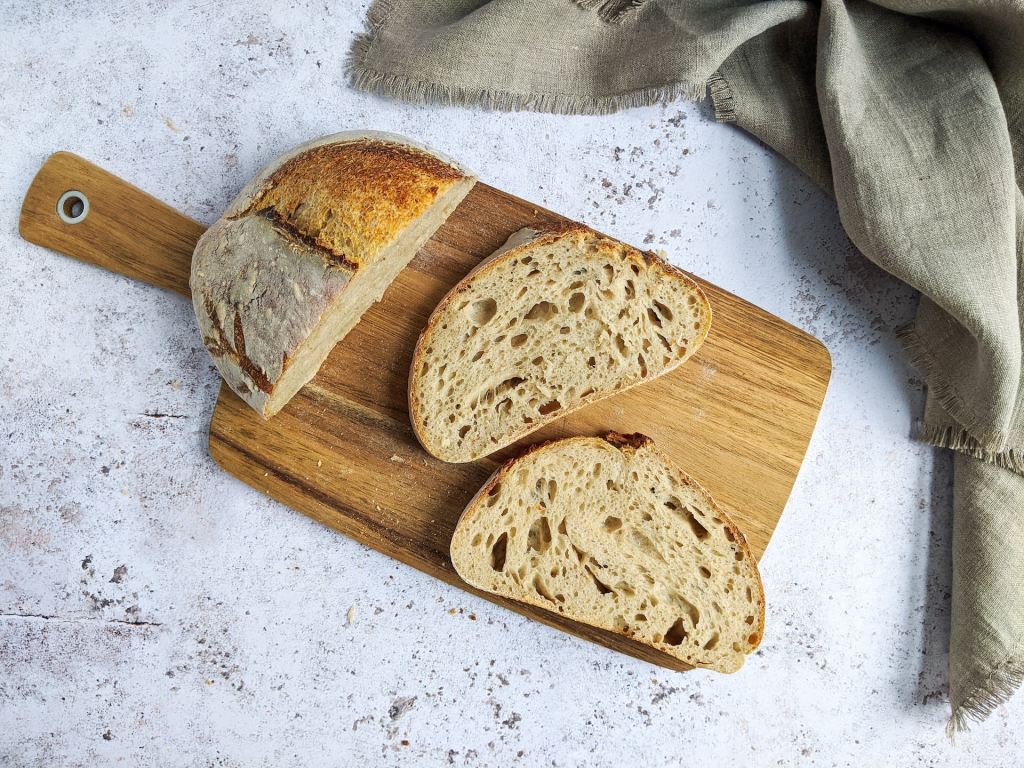
Beware the nooks and crannies of the Pharisees! Photo by Debbie Widjaja on Unsplash

Looking at leavened bread and unleavened bread from the outside, they might look the same: they both look like solid loaves of bread.  However, in the process of making bread rise, yeast creates gas bubbles that form holes inside the bread (or “nooks and crannies” as in an old English muffin ad).  So, when you break or cut open a piece of leavened bread, it does not look solid on the inside like it does from the outside.  It is full of holes.  On the other hand, unleavened bread tends to be more solid, such as many flatbreads or tortillas.

Yeast is like hypocrisy because the hypocrite is not the same on the inside as they are on the outside.  The image they carefully craft for themselves fails inspection to One who can see inside.  In the case of the Pharisees, who wanted to appear superior in their knowledge of, and observance of, Jewish law, Jesus revealed that they were “like whitewashed tombs, which outwardly appear beautiful, but within are full of dead people’s bones and all uncleanness.”[2]

Later in the New Testament, in 1 Corinthians 8:1, the apostle Paul wrote: “we know that ‘all of us possess knowledge.’ This ‘knowledge’ puffs up, but love builds up.”  Paul’s warning was that knowledge, if not used in love, puffs us up as yeast puffs up bread, making it full of air bubbles, and hollow inside.  Knowledge can make us proud and inflate our own sense of importance if we aren’t careful.  Love, on the other hand, seeks to build up others in humility.

Therefore, whose who seek to walk in integrity before God, to live an unleavened life, must reach out to the only One who can see all of our inner nooks and crannies, yet still loves us.  Though we are still sinners, by His blood we are justified in His sight and being made whole by our Maker.  We should pray as David prayed in Psalm 139:23 –

Search me, O God, and know my heart!
            Try me and know my thoughts!
And see if there be any grievous way in me,
            and lead me in the way everlasting!”

He can supply everything we lack.


[1] Luke 12:1b-2
[2] Matthew 23:27

The Scope of Our Need

Today is part 4 of a series on the first Beatitude from Matthew 5:3 – “Blessed are the poor in spirit, for theirs is the kingdom of heaven.

In this post, we begin later in the same chapter as the Beatitudes, where Jesus includes as sin matters of the soul’s inclination, which are entirely internal:

You have heard that it was said to those of old, ‘You shall not murder; and whoever murders will be liable to judgment.’  But I say to you that everyone who is angry with his brother will be liable to judgment; whoever insults his brother will be liable to the council; and whoever says, ‘You fool!’ will be liable to the hell of fire.” – Matthew 5:21-22
You have heard that it was said, ‘You shall not commit adultery.’ But I say to you that everyone who looks at a woman with lustful intent has already committed adultery with her in his heart.” – Matthew 5:27-28

Some people say that what is done in private, either alone or with other “consenting” people, is none of our business.  “Who does it hurt?” they say.  In the Sermon on the Mount, Jesus tells everyone that He cares about what they do, in public and in private.  Even within themselves.  He is not saying this to embarrass anyone, but to break down their spiritual pride and lead them to depend on Him.  To Jesus, intent makes us spiritually poor as much as action does.  Sin is not a matter of consequence; it is a matter of conscience.  It includes not only the action, but the inclination to the action.

But who does it hurt; some might ask?  When excluding from our definition of sin things that other people don’t see, we may be tempted to turn faith into performance art, like the scribes and Pharisees, who “do all their deeds to be seen by others. For they make their phylacteries broad and their fringes long, and they love the place of honor at feasts and the best seats in the synagogues and greetings in the marketplaces and being called rabbi by others.”[1]  Those “ashamed” from Monday’s post who come to church looking for compassion will only feel alienated unless they join in the performance.

If only public righteousness matters, the pressure of keeping up appearances can mean that internal sins – though just as important as external sins that have obvious consequences – remain private and un-dealt with, keeping us from relying on Jesus to restore the joy of our salvation!  Compensating for guilt, and the pressure of managing expectations, become primary drivers of action rather than the guidance of the Spirit, and the fruit of the Spirit is nowhere to be found.    When we know we are not really changed and are failing, we may try to hide it to keep up appearances.  We harbor guilt and bitterness and become unable to accept ourselves and love others.

Instead, testimony of our brokenness is an essential part of Christian witness.  In his letters, the Apostle Paul repeatedly mentions his own past because it highlights the grace of God and power of Christ in redeeming him.  Likewise, those connected to Christ must confess their brokenness openly and ask His help.  Hiding our brokenness – keeping it private (sometimes even trying to keep it from Him) – obscures the power and necessity of the gospel from those who need to hear and understand it, and also keeps us from experiencing its power in our souls.  If we do not count as brokenness things where we do not see the consequence, we keep Jesus at a distance and the kingdom of heaven will not rule us.  Who does it hurt?  Well, us to begin, but also those around us who we love less as a result of hidden, secret sin.

Humanity’s need is spiritual, and our brokenness comes from the inside, not the outside.  From conscience, not consequence.  When humanity denies that brokenness is an internal, sometimes hidden, problem, it will face only the symptoms of the problem, and with the wrong prescriptions.  External forces cannot fix our internal inclinations and will tend toward the original sin of Adam and Eve, seeking the tree of wisdom in the garden that seems to offer an alternate way of governing ourselves.  Any laws, including some forms of religion, or systems of coercion will not fundamentally change us, but may provide an appearance of doing so, or worse, an incentive for a harsher system of coercion.  When coercion isn’t working, and spiritual solutions are denied, greater coercion often follows.  Unless we know we are broken, and how we are broken, we refuse the solution offered by the kingdom of heaven and remain lost looking for an alternative that does not exist[2].

We must not accept anything less than Christ’s righteousness.  But we must accept Christ’s righteousness at our very core.  Only the power of the gospel – the good news of the kingdom of God – can make straight what is crooked at its very internal, often secret, root[3].

And there is salvation in no one else, for there is no other name under heaven given among men by which we must be saved.” – Acts 4:12 “Blessed are the poor in spirit, for theirs is the kingdom of heaven.” – Matthew 5:3


[1] Matthew 23:5-7
[2] I’m not advocating for anarchy or libertarianism or any particular form of government but pointing out that what a society thinks its government can, and should, do reflects that society’s view on what it expects government to solve.
[3] Ecclesiastes 1:15 and 7:13