The Scope of Our Need

Today is part 4 of a series on the first Beatitude from Matthew 5:3 – “Blessed are the poor in spirit, for theirs is the kingdom of heaven.

In this post, we begin later in the same chapter as the Beatitudes, where Jesus includes as sin matters of the soul’s inclination, which are entirely internal:

You have heard that it was said to those of old, ‘You shall not murder; and whoever murders will be liable to judgment.’  But I say to you that everyone who is angry with his brother will be liable to judgment; whoever insults his brother will be liable to the council; and whoever says, ‘You fool!’ will be liable to the hell of fire.” – Matthew 5:21-22
You have heard that it was said, ‘You shall not commit adultery.’ But I say to you that everyone who looks at a woman with lustful intent has already committed adultery with her in his heart.” – Matthew 5:27-28

Some people say that what is done in private, either alone or with other “consenting” people, is none of our business.  “Who does it hurt?” they say.  In the Sermon on the Mount, Jesus tells everyone that He cares about what they do, in public and in private.  Even within themselves.  He is not saying this to embarrass anyone, but to break down their spiritual pride and lead them to depend on Him.  To Jesus, intent makes us spiritually poor as much as action does.  Sin is not a matter of consequence; it is a matter of conscience.  It includes not only the action, but the inclination to the action.

But who does it hurt; some might ask?  When excluding from our definition of sin things that other people don’t see, we may be tempted to turn faith into performance art, like the scribes and Pharisees, who “do all their deeds to be seen by others. For they make their phylacteries broad and their fringes long, and they love the place of honor at feasts and the best seats in the synagogues and greetings in the marketplaces and being called rabbi by others.”[1]  Those “ashamed” from Monday’s post who come to church looking for compassion will only feel alienated unless they join in the performance.

If only public righteousness matters, the pressure of keeping up appearances can mean that internal sins – though just as important as external sins that have obvious consequences – remain private and un-dealt with, keeping us from relying on Jesus to restore the joy of our salvation!  Compensating for guilt, and the pressure of managing expectations, become primary drivers of action rather than the guidance of the Spirit, and the fruit of the Spirit is nowhere to be found.    When we know we are not really changed and are failing, we may try to hide it to keep up appearances.  We harbor guilt and bitterness and become unable to accept ourselves and love others.

Instead, testimony of our brokenness is an essential part of Christian witness.  In his letters, the Apostle Paul repeatedly mentions his own past because it highlights the grace of God and power of Christ in redeeming him.  Likewise, those connected to Christ must confess their brokenness openly and ask His help.  Hiding our brokenness – keeping it private (sometimes even trying to keep it from Him) – obscures the power and necessity of the gospel from those who need to hear and understand it, and also keeps us from experiencing its power in our souls.  If we do not count as brokenness things where we do not see the consequence, we keep Jesus at a distance and the kingdom of heaven will not rule us.  Who does it hurt?  Well, us to begin, but also those around us who we love less as a result of hidden, secret sin.

Humanity’s need is spiritual, and our brokenness comes from the inside, not the outside.  From conscience, not consequence.  When humanity denies that brokenness is an internal, sometimes hidden, problem, it will face only the symptoms of the problem, and with the wrong prescriptions.  External forces cannot fix our internal inclinations and will tend toward the original sin of Adam and Eve, seeking the tree of wisdom in the garden that seems to offer an alternate way of governing ourselves.  Any laws, including some forms of religion, or systems of coercion will not fundamentally change us, but may provide an appearance of doing so, or worse, an incentive for a harsher system of coercion.  When coercion isn’t working, and spiritual solutions are denied, greater coercion often follows.  Unless we know we are broken, and how we are broken, we refuse the solution offered by the kingdom of heaven and remain lost looking for an alternative that does not exist[2].

We must not accept anything less than Christ’s righteousness.  But we must accept Christ’s righteousness at our very core.  Only the power of the gospel – the good news of the kingdom of God – can make straight what is crooked at its very internal, often secret, root[3].

And there is salvation in no one else, for there is no other name under heaven given among men by which we must be saved.” – Acts 4:12 “Blessed are the poor in spirit, for theirs is the kingdom of heaven.” – Matthew 5:3


[1] Matthew 23:5-7
[2] I’m not advocating for anarchy or libertarianism or any particular form of government but pointing out that what a society thinks its government can, and should, do reflects that society’s view on what it expects government to solve.
[3] Ecclesiastes 1:15 and 7:13

Help! There’s a Log in My Eye! (Part 2)

Dear fellow travelers,

Yesterday’s post started to discuss Jesus’ words in Matthew 7:3-5 – “Why do you see the speck that is in your brother’s eye, but do not notice the log that is in your own eye?  Or how can you say to your brother, ‘Let me take the speck out of your eye,’ when there is the log in your own eye?  You hypocrite, first take the log out of your own eye, and then you will see clearly to take the speck out of your brother’s eye.

Jesus was telling His followers that they should help each other move closer to God, but only to remove specks from others’ eyes after dealing with their own logs.  The first lesson, covered yesterday, was to make sure our motive is right.  The second (today’s topic) is to learn from our own experience fighting the logs in our own eyes.  When I think about these logs, and really try to remove them, I realize it’s a lot harder than I might assume about specks in other people’s eyes.

First, being told I have a log in my eye might be counterproductive.  The hardest logs to get rid of are the ones we already know are wrong, and possibly because we know they are wrong.  Paul gives an example in Romans 7:7b-8a, saying “For I would not have known what it is to covet if the law had not said, ‘You shall not covet.’  But sin, seizing an opportunity through the commandment, produced in me all kinds of covetousness.”  Being told my log is a sin isn’t necessarily going to get it out of my eye.  It might make things worse.

Second, the most stubborn logs might be there because I’ve decided, at least subconsciously, that I am better off with the log than I am without it.  Until we are perfected in heaven, part of us wants to listen to “the woman Folly,” who cries out that “Stolen water is sweet, and bread eaten in secret is pleasant” in Proverbs 9:17.  Even though Wisdom offered a feast of meat and wine in Proverbs 9:2, our flesh is drawn to the bread and water because they are “stolen” in “secret.”  Whatever “bad” the log does to me, I sometimes prefer it to the “good” represented by the alternative.    Being told my log is bad for me might not overcome that.

Third, I know that Jesus said, “You hypocrite, first take the log out of your own eye, and then you will see clearly to take the speck out of your brother’s eye,” and I’m tempted to think the log in other people’s eyes give them no right to be judgmental.  As noted yesterday, for some, the lesson of Jesus’ words is about how to identify a hypocrite.  For others, the lesson may be that people should mind their own business.  Of course, once I think that, I’m trying to remove a speck from their eye, judging them and saying their behavior should be changed.  Maybe in writing this, I’m being judgmental myself.  Avoiding being judgmental is perhaps the hardest thing for a person to do, while graciously accepting the imperfect love of a brother can sometimes be harder.

Who do you trust with your eyes? Photo by Brands&People on Unsplash

So, what’s the solution?  There may not be a magic formula, but in examining our own logs, we learn to approach others in loving service, not judgment, understanding what Paul said at the beginning of 1 Corinthians 10:13, that “No temptation has overtaken you that is not common to man.”    Fighting sin is hard.  For all of us.  It requires overcoming our natural response to rules, requires trust that His way is better than ours (proof isn’t always possible), and requires relationships that nurture meaningful involvement – even around the parts of our lives that, like our eyes, we fiercely protect.  We won’t often let anyone near the speck in our eye who hasn’t proven their love by tangible acts.  People can tell when (or imagine that) our motivation is our own anxiety, envy, or anger.

Me First (Redux)
Immediately after the version of the speck and log story in Luke’s gospel, Luke records Jesus saying: “For no good tree bears bad fruit, nor again does a bad tree bear good fruit, for each tree is known by its own fruit. For figs are not gathered from thornbushes, nor are grapes picked from a bramble bush.  The good person out of the good treasure of his heart produces good, and the evil person out of his evil treasure produces evil, for out of the abundance of the heart his mouth speaks.[1]

I believe Luke puts this here because removing our own logs makes us more like a good tree that can produce good fruit.  Only by knowing and relying on God can we approach the specks in our brother’s eyes inspired by grace not legalism, concern not unwelcome intrusiveness, and love not judgment.

God, the only righteous judge, forgave us our sins by taking the judgment we deserved upon Himself on the cross.  Instead of fretting over evildoers, He sought to save them.  Knowing our Lord and how He approaches us in our sin as our Savior helps us see more clearly to help our brothers remove the specks from their eyes.  Only He can heal us, but sometimes He wants us to participate in His work.

“…first take the log out of your own eye, and then you will see clearly to take the speck out of your brother’s eye.


[1] Luke 6:43-45

Help! There’s a Log in My Eye! (Part 1)

Until we get to heaven, none of us can fully understand what God is telling us in the Bible, but I believe one particularly tricky passage is this one: “Why do you see the speck that is in your brother’s eye, but do not notice the log that is in your own eye?  Or how can you say to your brother, ‘Let me take the speck out of your eye,’ when there is the log in your own eye?  You hypocrite, first take the log out of your own eye, and then you will see clearly to take the speck out of your brother’s eye.” – Matthew 7:3-5

For some, the lesson is about how to identify a hypocrite.  For others, the lesson may be that people should mind their own business.  Some might think it has applications for the church’s role toward the sinners of the world.

While there might be good points to be made about those lessons, here I want to focus on what Jesus told those listening to actually do: 1) “take the log out of your own eye,” and 2) “take the speck out of your brother’s eye.”  Jesus is definitely not saying His people should always ignore every speck and log.  His mission is to make His church holy, and we participate in that work.  Christians are supposed to help each other move closer to God.  However, there are right ways, and very wrong ways, to remove specks and logs.  He says do (1), then only do (2) afterward.

When saying “first take the log out of your own eye,” I think Jesus is offering two bits of advice.  First, be more concerned about your own sin first before dealing with the sin of others.  Second, take what you learn about overcoming your own logs of sin and apply it to ministering to others with their specks.  The cure for hypocrisy here is not to do nothing about the brother’s speck.  It is to remove our own log first, so we “will see clearly.”

This is a huge topic, but today’s post will briefly cover the first point, and tomorrows will cover the second point.  There’s definitely a lot more that has been, and can be, said.

Me First
By focusing on our own problems first, we might avoid three problems, the first being putting ourselves through endless anxiety about the sins of the world.  Psalm 37:1 advises “Fret not yourself because of evildoers; be not envious of wrongdoers!”  When God chose to love the world, He did so knowing that the world contained nothing but evildoers, and therefore advises not to fret about evil.  He has a plan, and that plan is not that we need to address or fix every problem.

Later in the same Psalm, verse 8 advises: “Refrain from anger, and forsake wrath! Fret not yourself; it tends only to evil.”  This means that fretting over the sins of others leads us to wrong emotions and motives, particularly envy and wrath.  Referring back to verse 1, “be not envious of wrongdoers”, because we may be tempted to participate in their wrongdoing.  If we think they’ve done well by sinning, and that there was no negative consequence, we might persuade ourselves to join in out of envy for their “success”.  So, we add the speck in their eye to the log in our own, and everyone is worse off.

Third, if we see that wrongdoers are not punished, and are frustrated by it, we can be tempted to take it into our own hands to “correct” their situation by removing their speck.  In this case, we’re motivated by wrath, instead of a loving desire to do the best for our brother.  Also, others might see that we did this, got away with it, and be tempted to join in (envy again?), and so these 2nd and 3rd points can become a vicious cultural cycle within a community of believers.

In another post, The Desires He Delights to Give, I wrote about verses 4-6 of Psalm 37 and it would a good read for context here, but the summary is that when we seek to please God, we will learn to be less anxious about evildoers, and also feel less envy and wrath.

So, Jesus’ first advice before removing a speck from someone else’s eye seems to be to make sure we have the right motive – love.  Tomorrow, part 2 will briefly talk about how hard it is to remove the real logs in our own eyes.

Caught in the Act

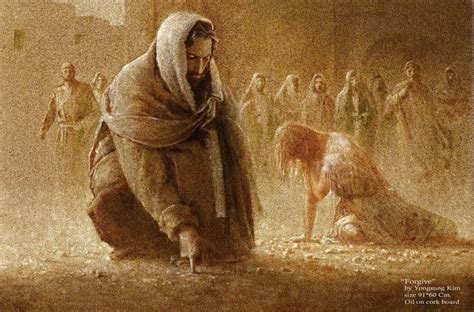
The beginning of John chapter 8 has quite an enigmatic and controversial story about a woman caught in adultery.  The basics of the story are: Jesus was teaching in the temple in Jerusalem, and some Pharisees brought Him a woman they caught in the act of committing adultery.  They asked Jesus whether they should stone her, and the first thing Jesus does is write something on the ground with His finger (the only recorded instance of Jesus writing I believe).  Then Jesus stands and says, “Let him who is without sin among you be the first to throw a stone at her.”[1]  Then He goes back to writing on the ground, and the woman’s accusers end up walking away.  Jesus then tells the woman He does not condemn her, but that she should “sin no more.”[2]

One problem with the story is that it is not included in the earliest manuscripts of John’s gospel, and so it’s questionable whether it should be in the Bible at all.  Another part of the story commentators talk about is what Jesus was writing on the ground.  From what John (or someone else) wrote, we don’t know.  We can only suspect that what was written had something to do with why the accusers went away.

I don’t like to speculate on what Scripture left out, especially on verses that may not even be inspired, but if this story actually happened, I do have my own guess at what Jesus wrote.  He probably wrote more than one thing, but part of what He wrote may have been “where is the man?”

See, Old Testament law said that both parties in the adultery (it always takes 2 people to commit adultery) should be stoned (see Leviticus 20:10 and Deuteronomy 22:22).  If these Pharisees truly caught the woman in the act, the man must have been present at the time or she wasn’t “in the act”.  Why wasn’t he being brought before Jesus?  We know the Pharisees were desperate to catch Jesus saying something wrong, so maybe, perhaps[3], the “guilty” man was in conspiracy with the Pharisees to embarrass Jesus?  In a male-dominated society, did the Pharisees think it was ok for the man to get away with it, especially if it led to a situation where the Pharisees could make Jesus look bad?  They may have been tired of losing arguments with Him.

In this situation, if Jesus wrote “where is the man?” on the ground it would let the Pharisees know that He was on to their scheme and knew they were being hypocritical.  Jesus always knows.

My handy dandy study Bibles warn not to make doctrine from this story that may not have actually happened, but I think there’s a lesson to be learned anyway, and it is that every one of us is “caught in the act” by Jesus.  Jesus knew that, under the law, both the woman that the Pharisees brought forward, and the unseen man were both guilty of adultery.  Likewise, whether our own sins are brought to public attention or whether they happen in secret, Jesus knows about them.  Also, not all of our sins are physical.  Some may be spiritual, where we put something else in the place of God in our hearts and minds.  Nothing escapes His notice.  Knowing this should terrify us, except…

I read a devotional by James Boice where he said that the person we want to be in this story is the woman caught in the act of adultery.  Why?  Because although her sins were revealed, she was forgiven and was alone left standing with Jesus when everyone else went away.  We may be too proud to admit we belong in her place, but maybe that’s because we aren’t aware enough of our won sins.  See, from Jesus’ perspective we are all “caught in the act.”  Not just once or twice, but many times over.  We may not be physical adulterers, but we are all spiritual adulterers.  Therefore, we need His grace and mercy, which He freely grants.  The cross paid for all our sins.

However, the story also teaches that grace is not license.  Christ died that He may give us grace and we must not scorn His sacrifice.  This woman’s forgiveness was free for her, but not for Him.  Our forgiveness is free to us, but not for Him.  It required the ultimate sacrifice, but He was willing and able to make it.

Jesus may have done a “gotcha” with the hypocritical Pharisees, and 1 John 1:10 says “If we say we have not sinned, we make him a liar, and his word is not in us,” but the verse right before that says “If we confess our sins, he is faithful and just to forgive us our sins and to cleanse us from all unrighteousness.”  As long as we admit our guilt (which He already knows about), the grace He makes available to us is endless and eternal.

Let us then with confidence draw near to the throne of grace, that we may receive mercy and find grace to help in time of need.” – Hebrews 4:16


[1] John 8:7
[2] John 8:11
[3] Maybe and perhaps are two words I hate to use when referring to Scripture, but maybe, perhaps, today is an exception.

When Our Seeds Only Grow Thorns

Sometimes we feel like we’re putting in a lot of effort but getting no results from it.  We’re sowing good seeds but not reaping any harvest.  At times, it seems disappointment is our only reward.  Often this can just be the way things are at the time – we’re doing nothing wrong but it’s just not obvious what God is doing at that time.  We don’t need to change anything.  But there may be times where we’re not reaping good things because we’re deceived that what we’re sowing is what we’re supposed to be sowing.

According to the prophet Jeremiah, the nation of Judah had this problem and as a result they ended up in exile.  In the first half of Jeremiah 12:13, the prophet says of Judah:

They have sown wheat and have reaped thorns;
            they have tired themselves out but profit nothing.

The nation of Judah thought they were sowing good seeds, but they weren’t and there are several examples in Jeremiah’s book.

First, Judah thought they were on the right side politically, with powerful friends and therefore secure.

The nation of Judah allied itself alternately with Egypt and Assyria, who they thought could protect them from Babylon.  Surely these powerful nations could keep Judah from doom at Babylon’s hands.  However, in Jeremiah 3:36 the prophet says:

How much you go about,
            changing your way!
You shall be put to shame by Egypt
            as you were put to shame by Assyria.

Because Judah had trusted these nations, other than God, for their salvation God would put them to shame by His own hand, from which there is no escape.  While there are many good ways to work with others, we should never trust anyone with the help that only God can provide.

Next, Judah thought they had the right cultural heritage.

The people of Judah wouldn’t listen to Jeremiah’s prophesies of doom for the nation because they thought God wouldn’t destroy what they saw as His own nation.  Israel had been taken into captivity by Assyria, but Judah thought it could never happen to them because they were the heirs of Jewish culture.  The people would repeat the phrase, “This is the temple of the LORD, the temple of the LORD, the temple of the LORD,” to remind themselves that they were special because they had the temple, but Jeremiah says in Jeremiah 7:4,

Do not trust in these deceptive words: ‘This is the temple of the LORD, the temple of the LORD, the temple of the LORD.’

The temple was provided as a way to approach God, but Judah thought of it like a magical talisman that would keep God happy so they could do their own thing.  However, God doesn’t want us to follow a checklist – He wants us.  All cultural and political institutions – including ones provided by God – are useless outside of God’s purpose for them.  What He provides He can take away if we abuse it.  When Judah was taken into captivity by Babylon, the temple was torn down and burned.

Last, Judah thought they had the right religion and were diligently practicing it

Judah’s religious leaders and people were diligent in observing the practices laid out in God’s ceremonial law.  They faithfully made the morning and evening sacrifices, observed the three main Jewish festivals, and followed many other ordinances, but in Jeremiah 7:22-23, the prophet said:

For in the day that I brought them out of the land of Egypt, I did not speak to your fathers or command them concerning burnt offerings and sacrifices.  But this command I gave them: ‘Obey my voice, and I will be your God, and you shall be my people. And walk in all the way that I command you, that it may be well with you.’

Because Judah was putting observance above obedience to God, He would therefore discipline them.  The sacrifices were not the objective – the relationship was the objective, but the people made their religion about the sacrifices themselves, not the relationship they were designed to restore.

Do we sometimes practice similar things in the modern church?  Of course we do.

The modern-day equivalent of Judah’s first mistake is when we expect from a political party what only God can give.  Our expectations of them become idolatrous, and we become more likely to compromise God’s principles to support them.  We commit the second mistake when we are convinced our denomination has it all right – the right history, traditions and doctrine – and therefore God will always favor us.  The last mistake happens when we put external religious observances ahead of internal devotion to God.  We may be executing the acts and rituals our religion requires of us, and our peers expect from us, but not giving ourselves fully to God.  We may go to church, but when we leave the church building we don’t take Jesus with us.

Sometimes we think through our political, cultural, and religious activities we should reap wheat, but what is happening when we keep reaping thorns?  Sometimes we need to check that we aren’t repeating Judah’s mistakes.

They have sown wheat and have reaped thorns;
            they have tired themselves out but profit nothing.
They shall be ashamed of their harvests
            because of the fierce anger of the LORD.