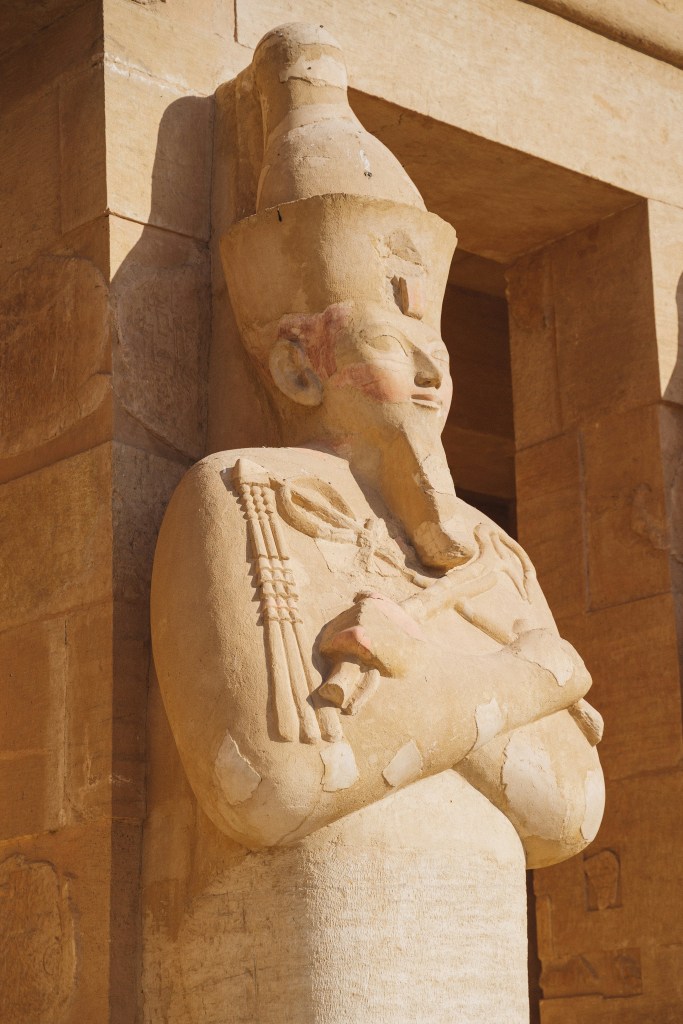
We’re All Little Pharaohs

Anyone who knows the story of the Exodus knows who the bad guy is: Pharaoh.  As the leader of Egypt, he is primarily to blame for the enslavement of Israel.  Eventually, through Moses and Aaron, God tells Pharaoh to free the Israelites from slavery, and time and again Pharaoh refuses.  Clearly, Pharaoh is God’s enemy.  However, in his resistance to God, I think Pharaoh fell into some habits any of us could fall into.

First, Pharaoh admitted his need for God only when things were going wrong but shut God out when things were going well.  In Exodus 8:8, Pharaoh asked Moses to “Plead with the LORD to take away the frogs from me and from my people” but once the frogs were gone, Exodus 8:15 tells us that “when Pharaoh saw that there was a respite, he hardened his heart” and refused to do God’s will.  The same thing happens in chapter 9, during the plague of the hail.  Seeing the destruction caused by the hail, Pharaoh says “Plead with the LORD, for there has been enough of God’s thunder and hail” in verse 28, but in verse 34, “when Pharaoh saw that the rain and the hail and the thunder had ceased, he sinned yet again and hardened his heart.

Photo by Alex Azabache on Unsplash

Next, Pharaoh repeatedly negotiated with God to define the scope of His influence.  Faced with the plague of flies, Pharoah said to Moses and Aaron “Go, sacrifice to your God within the land.”[1]  But staying “in the land” was not what God wanted His people to do.  In response to the plague of locusts, Pharoah said “the men among you” could leave and worship God, but he wouldn’t let the “little ones[2] go.  Also, after the plague of darkness, Pharoah said “Go, serve the LORD; your little ones also may go with you; only let your flocks and your herds remain behind.”[3]  In these 3 responses, Pharaoh insisted on limits to where the people should worship, which people should worship, and what they could (and couldn’t) use in worship.

Third, Pharaoh also tried to limit the scope of his own sin, and which sins he would be accountable to God for.  In Exodus 9:27, Pharaoh said, “this time I have sinned” and in 10:17 said “forgive my sin, please, only this once.”  In reality Pharaoh was sinning every time he refused to listen to God, but he wasn’t willing to admit that.  He only admitted a minority of the times he disobeyed.

If you’re like me, this all might sound familiar.  Often our prayers are more fervent and sincere when we need help than they are when we have something to praise God for, or when times are good.  Often, we allow God to govern some parts of our life, but we keep other parts for ourselves, to do what we want with.  Also, we often only admit some of our sins and choose which ones to care about.  We’re all a bit like Pharaoh, the bad guy in the Exodus story.

Fortunately for us, we have something else in common with Pharaoh: the true, Almighty God will defeat all of the “gods” we follow.  Every single one.  Behind the battle between Moses and Pharaoh was a contest between our God and Pharaoh’s gods.  As the Life Application Study Bible notes: “As each gloomy plague descended upon the land, the Egyptian people realized how powerless their own gods were to stop it. Hapi, the god of the Nile River, could not prevent the waters from turning to blood. Hathor, the crafty cow-goddess, was helpless as Egyptian livestock died in droves. Amon-Re, the sun-god and chief of the Egyptian gods, could not stop an eerie darkness from covering the land for three full days.”

When we choose not to obey God, we harden our hearts against Him and follow the “gods” we choose for ourselves, but God will ultimately defeat them all.  God’s purpose in saving us is to deliver us from all other gods, as He delivered Israel from Egypt.  He will deliver us from our slavery to every sin that binds us and make us not follow Him wholeheartedly.

We may be more like Pharaoh than we’d like to admit, but the Pharaoh in us has been killed, nailed to the cross with Jesus. When we reach heaven, all of our other “gods” will be gone and we will be perfected in our obedience to the one, true God, for our good and for His glory!

That’s a deliverance worth looking forward to and praising God for!

Amen.


[1] Exodus 8:25
[2] Exodus 10:10-11
[3] Exodus 10:24

Sometimes Life is Hard on Purpose

Photo by ål nik on Unsplash

Joshua, Moses’ hand-picked successor, was very aware of the consequences of failing to trust God.  After being delivered from Egypt, Israel was led to Canaan – their promised land – and God had Moses “Send men to spy out the land of Canaan, which I am giving to the people of Israel.[1]  The purpose of the spy mission was not to decide whether or not to move into the land.  God promised to give it to them.  However, when the 12 spies returned, 10 of them said “We are not able to go up against the people, for they are stronger than we are.[2]  Only Joshua and Caleb said they should take the land anyway, because God’s promise and strength was enough for them.  Because the people rebelled, trusting 10 disloyal spies rather than Him, God said Israel must wander the wilderness for years and only Joshua and Caleb would live long enough to enter the land.

After taking 40 years to make what could have been an 11-day journey[3] to the Jordan River where Israel would enter the land, God knew, and Joshua knew, that divided loyalties could doom everyone to another 40-year wilderness adventure.

Arriving at the flooded Jordan River, some people may have doubted whether Joshua get them across.  Joshua had just become their leader, and perhaps the failure of Moses, who recently died, meant the failure of their dreams of the promised land.  After all, they saw the Red Sea part for Moses.  Could Joshua get them over this river?

Then in Joshua 3:15 we find this note: “(now the Jordan overflows all its banks throughout the time of harvest)”.  Why is this phrase important?  Israel arrived at the Jordan at the most difficult time to cross.  The river would be as deep and as wide as ever, and likely the current would be stronger as well.  A sensible person would avoid crossing at this time, but God chose the most “difficult” time to perform this miracle to show that nothing is difficult for Him.  This phrase is there because entering the promised land should glorify God and God alone.

By coming to the Jordan specifically when it “overflows all its banks” God wanted to remind His people that only He can and will deliver them.  The Red Sea wasn’t parted because of Moses; it was parted because of God.  God could deliver Israel without Moses, but Moses couldn’t deliver Israel without God.  It was never about Moses.  Likewise, Joshua wasn’t going to get them to their land; God was.  The flood gave the people no reason to credit Joshua for their success.

As instructed, this is how they crossed the flooded river: “as soon as those bearing the ark had come as far as the Jordan, and the feet of the priests bearing the ark were dipped in the brink of the water (now the Jordan overflows all its banks throughout the time of harvest), the waters coming down from above stood and rose up in a heap very far away, at Adam, the city that is beside Zarethan, and those flowing down toward the Sea of the Arabah, the Salt Sea, were completely cut off. And the people passed over opposite Jericho.  Now the priests bearing the ark of the covenant of the LORD stood firmly on dry ground in the midst of the Jordan, and all Israel was passing over on dry ground until all the nation finished passing over the Jordan.” – Joshua 3:15-17

Joshua was very clear about giving God credit, and it’s a lesson for Christians in all times and places.  When God raises up leaders, He also reminds us that they are but men and tools in His hand.  They are also profoundly fallible.  10 out of 12 human leaders being wrong left Israel wandering for 40 years.  Only God leads anyone to salvation and only when they trust Him alone for it.  He often works through fallen human leaders, raising them up to lead His people, not because He prefers sinful leaders over virtuous ones, but because there is no other kind of person and because He is jealous for His own glory.

Is there a flooded river God wants you to cross?  When we attempt things that only make sense because God told us to do them, we may be more likely to do or witness something that glorifies God and God alone, because only He could do it.

Are there rivers you have crossed in the past?  Like God told Joshua after this crossing to lay memorial stones so they would never forget (see Joshua 4), make sure to keep a record of God’s power and faithfulness in your life.

Sometimes life is hard on purpose.
Sometimes the river is flooded because God wants to show you something awesome.

Therefore, “Be strong and courageous.  Do not be frightened, and do not be dismayed, for the LORD your God is with you wherever you go.” – Joshua 1:9b

[1] Numbers 13:1
[2] Numbers 13:31
[3] Deuteronomy 1:2

The Sovereign Over Our Blessings

40 years after God first made a covenant with Israel, promising to be their God and bless them if they would love and obey Him, the covenant had to be renewed.  Israel had been led through wilderness for decades after refusing to enter the Promised Land, but Moses eventually gathered them again to finally cross the Jordan River and take the Land.  Moses prepared them by renewing the covenant, but before that, Moses reviewed blessings and curses from God that would come with obedience or disobedience.

We know that “all have sinned and fall short of the glory of God,[1] and therefore any blessing is an act of grace because only Jesus lived a life of full obedience.  However, the choices of the ancient Israelites, and modern people, have consequences, and these blessings and curses carry a lesson about God’s sovereignty.  God would not make promises or threats that He is unable to carry out and therefore He must have the power and control to deliver on all of them.  Consider these parallel verses in Deuteronomy 28 showing God’s control over…

…all places, rural or urban:
Blessed shall you be in the city, and blessed shall you be in the field.” (verse 3)
Cursed shall you be in the city, and cursed shall you be in the field.”  (verse 16)

…reproductive and agricultural success:
Blessed shall be the fruit of your womb and the fruit of your ground and the fruit of your cattle, the increase of your herds and the young of your flock.”  (verse 4)
Cursed shall be the fruit of your womb and the fruit of your ground, the increase of your herds and the young of your flock.”  (verse 18)

…military success:
The LORD will cause your enemies who rise against you to be defeated before you. They shall come out against you one way and flee before you seven ways.”  (verse 7)
The LORD will cause you to be defeated before your enemies. You shall go out one way against them and flee seven ways before them. And you shall be a horror to all the kingdoms of the earth.”  (verse 25)

…the weather and its related benefits:
The LORD will open to you his good treasury, the heavens, to give the rain to your land in its season and to bless all the work of your hands.”  (verse 12a)
And the heavens over your head shall be bronze, and the earth under you shall be iron.  The LORD will make the rain of your land powder. From heaven dust shall come down on you until you are destroyed.”  (verse 23-24)

There are further curses, without parallel blessings, where God is declared as sovereign over…

…disease:
The LORD will make the pestilence stick to you until he has consumed you off the land that you are entering to take possession of it.  The LORD will strike you with wasting disease and with fever, inflammation and fiery heat, and with drought and with blight and with mildew. They shall pursue you until you perish.”  (verse 21-22)

…human psychology:
The LORD will strike you with madness and blindness and confusion of mind.” (verse 28)

…nature, including the smallest worms and crickets:
You shall plant vineyards and dress them, but you shall neither drink of the wine nor gather the grapes, for the worm shall eat them.”  (verse 39)
The cricket shall possess all your trees and the fruit of your ground.”  (verse 42)

…and even over the fates of nations:
The LORD will bring a nation against you from far away, from the end of the earth, swooping down like the eagle, a nation whose language you do not understand.” (verse 49)

As we know, Israel was eventually carried away into captivity by Assyria in 722 B.C., and Judah to Babylonia in 586 B.C. because of their ongoing unfaithfulness to God, however God fulfilled His covenant through Jesus Christ, descended from the tribe of Judah, centuries after they returned from Babylonian exile.  In Christ, people from all nations can be His people, and He will be their God.

We are all in exile, sojourning on this earth, but our God, sovereign over all, has Promised a new Land, a new heaven and a new earth, and we know He is faithful, even if it takes centuries.  Therefore, praise God for the blessings He gives His people in all of the areas under His control, which is everything!

Nothing escapes His notice and nothing is beneath Him to be concerned about.  Pray for His blessings in all areas of life, no matter how large or small.

Amen.


[1] Romans 3:23

The Work of Our Hands

Psalm 90 is the only one out of 150 that was written by Moses.  Psalm 90 is also the first in book 4 of the Psalms, which some say carries many of the themes and ideas from the 4th book of the Pentateuch, the book of Numbers.  That book tells of the consequences of Israel’s disobedience and grumbling on their journey to the Promised Land.  The nation of Israel spent 40 years wandering, seemingly aimlessly, in the wilderness and only Joshua and Caleb from the prior generation actually entered the Promised Land.

As noted in a recent post, the Psalm begins by saying we are only home when we are with God, but the Psalm ends with this petition to God for us:

Let your work be shown to your servants,
            and your glorious power to their children.
Let the favor of the Lord our God be upon us,
            and establish the work of our hands upon us;
            yes, establish the work of our hands!

Photo by Jamie Street on Unsplash

It may seem easy, or even natural, to just go with the flow of our surrounding cultures while in this world, but that would really be like wandering in the wilderness instead of getting God’s promised blessing.  Instead, do we seek that God’s “work be shown to your servants,” and that He “establish the work of our hands upon us”?  Do we seek “the favor of the Lord,” and experience His “glorious power”?  This is what Moses asks for in this prayer, that we find our purpose in Him by doing His work.  We all have “worldly” responsibilities we need to take care of in this world, but none of them are the ultimate goal.

In other words, the best way to spend our short lives here is to do work that matters in eternity, which God has laid out for us to do:

For we are his workmanship, created in Christ Jesus for good works, which God prepared beforehand, that we should walk in them.” – Ephesians 2:10
So teach us to number our days
            that we may get a heart of wisdom.” – Moses, in Psalm 90:12

The Exodus of Jesus

Bible translators have a tough job, otherwise one English translation would be all we have or need.  Translation isn’t a straight-forward process. There are many trade-offs, including between ease of reading in contemporary settings, and depth of meaning in the original context, but sometimes I wish different choices were made.

One example is Luke 9:30-31, which says: “And behold, two men were talking with him, Moses and Elijah, who appeared in glory and spoke of his departure, which he was about to accomplish at Jerusalem” (from ESV, emphasis mine). This happened during an event known as the Transfiguration, when Jesus took His disciples Peter, James, and John up a mountain for a vision of His future glory.  Matthew records in his gospel that Jesus “was transfigured before them, and his face shone like the sun, and his clothes became white as light.”[1]

While on that mountain, the 3 lucky disciples also witnessed a conversation about something: Jesus’ “departure.”  In a recent sermon I learned that the word translated “departure” is “exodos” in the original Greek.  For ease of reading purposes, “departure” is a more familiar word and makes a lot of sense to a modern reader, because Jesus was soon to depart the world temporarily through death, then more permanently after His resurrection.  On the other hand, “exodos” literally means an exit, or figuratively a death, but to the original audience and those familiar with Old Testament history, the word “exodos” carries other meanings as well.

So, why would Moses and Elijah be talking to Jesus about His “exodos”?  Because they both had history with such “departures.”

As told in the Old Testament book of Exodus, Moses was called by God while the descendants of Israel (Jacob) were slaves in Egypt.  After performing many miracles in God’s power, Moses led the new nation of Israel on an exodus out of literal slavery in Egypt.

Elijah performed many miracles, and prophesied that the nation of Israel, unless they repent of their disobedience, would be taken back into exile, but later be freed from Assyrian rule in that generation’s exodus.

Again, why would Moses and Elijah be talking to Jesus about His “exodos”?  Because Jesus was going to lead spiritual Israel out of slavery to sin around the entire world, from each nation, in every generation’s Exodus.  Moses, Elijah, and Jesus would have had a lot to talk about.

And behold, two men were talking with him, Moses and Elijah, who appeared in glory and spoke of his exodos, which he was about to accomplish at Jerusalem.


[1] Matthew 17:2