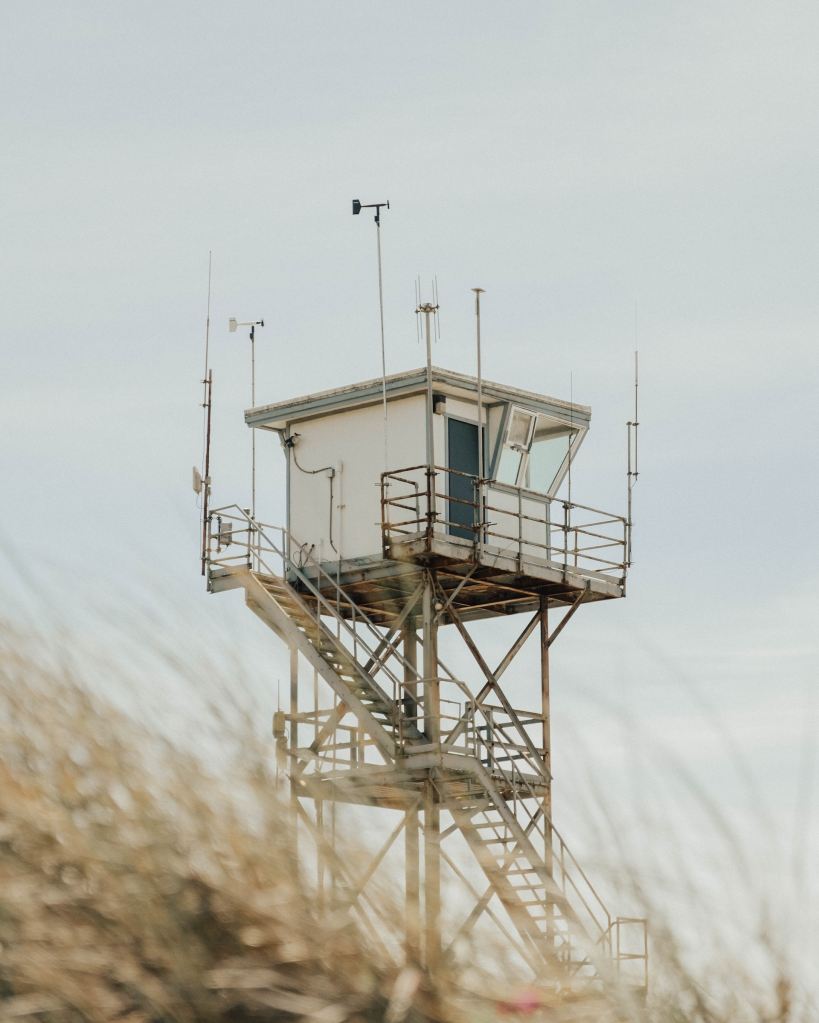
Manning the Watchtower

 “I will take my stand at my watchpost
            and station myself on the tower,
and look out to see what he will say to me,
            and what I will answer concerning my complaint.” – Habakkuk 2:1

Photo by Casey Olsen on Unsplash

People like to look for patterns and predictability in the world, and even in God’s behavior.  But in Habakkuk’s case, he saw a situation that didn’t make sense to him, that God would use Babylon to brutally punish His people in Judah.  God knew it wouldn’t make sense to Habakkuk, saying “I am doing a work in your days that you would not believe if told.[1]

Habakkuk would have gone into a private corner to sulk, but instead he brought it to God and was willing to be patient and wait to see how He would answer.

Is there something that doesn’t make sense right now in your life?  In my experience, there almost always is.  Therefore, be as vigilant and patient as Habakkuk.  Take your place in watchful hope on the watchtower and see what God will do.


[1] Habakkuk 1:5b

The Desires He Delights to Give

Does God give us what we desire, or does He decide what we desire?  Some of my earliest prayers I remember (I was probably about 6) are ones asking to wake up the next day with my room full of all the toys I wanted.  Naturally, I never woke up to a room full of toys.  God probably knew I would only ask for more, and if I kept up that attitude toward prayer, there would never be enough.  That doesn’t mean I only prayed that prayer once…I learn slowly, but He is patient.

This sort of prayer isn’t limited to minor things like toys, nor do I think it is unusual.  While his mother was suffering from cancer, a nine-year-old C.S. Lewis prayed earnestly for her to be healed.  When she wasn’t, and cancer took her from him, his faith was shaken for years.

In my case, in later life, after understanding Christianity somewhat better, one of the first Bible verses I set out to memorize was Psalm 37:4, which says:

Delight yourself in the LORD,
       and he will give you the desires of your heart.

But I still wondered: are the desires what He gives us, or is the fulfillment of desires what He gives us?  I now believe it is both.  In the times I genuinely seek Him, I find that He molds my desires, so they become more aligned with His character.  I also find that He directs those desires toward what will fulfill them.  While that fulfillment is not always immediate, I learn to trust from what He does fulfill that all will be made right in eternity, and I also learn patience and peace.

When we truly delight in Him, we end up finding out that what we desire is righteousness; we also find out that He provides all the righteousness we desire and need.  We find those desires fulfilling rather than frustrating, we find that fulfillment durable rather than fleeting, and therefore find ourselves content rather than anxious.

However, we don’t always delight in Him, or seek to desire what He desires, and we find ourselves conflicted and unfulfilled.  Reflecting on his prayers for his mother’s healing, C.S. Lewis later wrote what he had wrong:

“I had approached God, or my idea of God, without love, without awe, even without fear. He was, in my mental picture of this miracle, to appear neither as Savior nor as Judge, but merely as a magician; and when He had done what was required of Him I supposed He would simply – well, go away.”[1]

Elsewhere Lewis wrote: “God allows us to experience the low points of life in order to teach us lessons that we could learn in no other way.”  By experiencing disappointment and death in this world, perhaps He is teaching us that death and disappointment are all that this world has to offer.  Sometimes this is the only way to get us to let go of the world and embrace eternity with Him, even while we sojourn here. Sometimes He lets us down easy when the toys do not appear; sometimes He lets us experience significant pain.  All in His wisdom.

Therefore, since He is both Savior and Judge, as well as all-wise:

“Commit your way to the LORD;
         trust in him, and he will act.
He will bring forth your righteousness as the light,
         and your justice as the noonday.” – Psalm 37:5-6

Keep Driving Toward Morning, dear fellow travelers, and today, pray we will find our delight in Him.

[Version 1.0 of this was posted 4/19/22]


[1] Lewis, C.S.  Surprised by Joy (1955).  P. 21

The Lord Cares Even for Your Wilderness

If you are like me, some days feel very eventful and productive, but other days remind me of the saying: “If a tree falls in a forest and no one is around to hear it, does it make a sound?”  There are times when we all wonder: Who cares about what I did today?  Did today matter?  Did anyone notice?

When recently reading Psalm 29, verse 8 struck me, which says: “The voice of the Lord shakes the wilderness; the Lord shakes the wilderness of Kadesh.”  Why is this verse here?  Earlier in the Psalm, the voice of the Lord thunders, shatters the tall cedars of Lebanon, and flashes like fire.  Who cares about the wilderness?  It reminded me of the tree falling with nobody around.  Why does it matter?

It matters because the Psalmist (David) wants us to know that God’s power exists even where we can’t see it and in ways we may see as inconsequential.  However, to Him, nothing is inconsequential, and no detail is too small.  Jesus tells us in Matthew 10:30 that “even the hairs of your head are all numbered.”  If a tree falls in the wilderness, God cares about it even if nobody else does.

Psalm 29 closes with “May the LORD give strength to his people!  May the LORD bless his people with peace!”  His strength and peace are available on good days and bad.  On days we feel motivated and days we don’t.  On eventful days and on days we feel we are in the wilderness with nobody to hear.

Today, God will notice you, and will work in ways that you may only know when you look back on them from eternity.  No tree falls without His knowing about it.

May His strength and peace be with you always.

“God is always doing 10,000 things in your life, and you may be aware of three of them.” – John Piper

Letting God Pick Our Battles II

Photo by Andrey Grinkevich on Unsplash

The Apostle Paul wrote in Philippians 4:13 “I can do all things through him who strengthens me,” yet he also wrote in 2 Corinthians 12:7-9 that “to keep me from becoming conceited,” a “thorn was given me in the flesh.”  He writes: “Three times I pleaded with the Lord about this, that it should leave me.  But he said to me, ‘My grace is sufficient for you, for my power is made perfect in weakness.’  Therefore I will boast all the more gladly of my weaknesses, so that the power of Christ may rest upon me.”

The nature of Paul’s “thorn” has been disputed for centuries, but Galatians 4:13 suggests it was a physical problem, a “bodily ailment” rather than a moral shortcoming.  So, the lesson of the “thorn” is not that God prevented Paul from overcoming some specific sin to keep him humble – He wants Paul (and us) to be satisfied with nothing less than righteousness.

However, one lesson of the “thorn” is that Paul didn’t mean by “I can do all things” that he could do whatever he wanted and succeed.  Instead, the “thorn” is an example of a battle Paul would not win, because this “thorn” had a purpose in bringing Paul closer to God’s grace and power.  In God’s wisdom, Paul was better off with this ailment than without it.

Yesterday’s post said “Picking your battles, rather than trying to fight and win every fight that comes your way, is a good piece of advice.  However, who should pick which battles to fight?”  In the case of the “thorn”, God picked a battle for Paul not to fight, telling him instead to focus on growing in faith.  The thorn had a purpose in Paul’s striving toward righteousness, which was more important than any physical ailment.  Had Paul continued to insist to God that the thorn should be removed, he would still have the thorn, but he would also not grow in his relationship with his Lord.

Sometimes there are battles He wants us to fight in His strength for His glory, and sometimes there are battles He tells us not to fight so we can focus on His grace and power while in this life, in light of His promises to heal our physical ailments in Paradise.

Today’s post closes the same way as yesterdays: “Sometimes life is hard on purpose, so that God alone may be glorified in victory, and also so that we may grow in our faith in His strength.  When we let Him pick our battles, we learn that His righteousness is the only thing that will satisfy us.  Nothing less will do.”

Peter Walks on Water

After a frantic period where Jesus learned of John the Baptist’s death, then was crowded by over 5,000 hungry people in the wilderness who wanted to make Him king after He miraculously fed them, He sought some time alone.  Jesus told his disciples to get on a boat without Him and begin heading across the sea so He could spend time on the mountain that evening. Jesus always found time to be with His Father.  This is the background for a small group study of the apostle Peter I recently led focused on Matthew 14:22-36, the story of Jesus, and then Peter, walking on water.

At night, probably shortly before dawn, the disciples were still rowing against the wind, being “beaten by the waves.”  They should have been across by this time.  In an earlier storm, recorded in Matthew 8:23-27, Jesus had been with the disciples on a boat in a storm, and He woke from a nap to quiet the storm that was terrifying them.  This time, they were exactly where He had sent them: in the boat to cross ahead of Him.  Even though Jesus was not with them, He knew they would be fighting a storm again, and He had taught them He is the Lord of the storms.

Amid the rain and wind and waves, the disciples saw something on the water and cried out in fear: “It is a ghost!”  This was the only explanation they could come up with for something traveling over the water without sinking.  But Jesus said “Take heart; it is I. Do not be afraid,” and they knew it was Him, walking on the water.  He was still Lord of the storms.

In response, Peter (acting boldly as usual) exercised faith 3 times in this story.  First, he believed Jesus was who He said He was.  The initial shock and fear of what looked like a ghost passed when Peter heard His voice.  Second, he knew Jesus was capable of walking on water, so why couldn’t He enable Peter to do it too?  Third, when Peter “saw the wind, he was afraid, and beginning to sink,” he kept faith that Jesus could and would save him from drowning.

But why did Peter begin to sink?  The text says he was distracted when he “saw the wind.”  In that wind, he saw circumstances that he feared were more powerful than Jesus.  Peter could believe Jesus could make him walk on water when he was in a boat, but when wind and waves started hitting him it was harder to trust.  There’s a conflict here between faith and circumstances, doubt and trust.  Faith can raise us above our circumstances, but only when we focus on Jesus to overcome our doubt.  When we look away from Him, our circumstances can overwhelm us.

Peter learned that he could walk on water, but also that it was only possible by focusing his gaze on Jesus, not by relying on his own strength and ability.  Only by relying on Him can we thrive.  When walking by faith, hearing and obeying His Spirit, it can feel like walking on water, because “the fruit of the Spirit is love, joy, peace, patience, kindness, goodness, faithfulness, gentleness, self-control.” – Galatians 5:22-23a

Do you sometimes feel like you’re in a stormy sea, and getting across is taking longer than it should?  Is there a stormy situation in your life that requires stepping out in faith?  Are there circumstances you’re focusing on that make you feel you are sinking?

God sometimes knowingly sends us into storms to test our faith, just like Jesus sent the disciples into this storm to help them learn to trust Him.  If you’re in a storm, seek Him and go to Him.  Turn your eyes upon Jesus; He can make you walk above your circumstances.