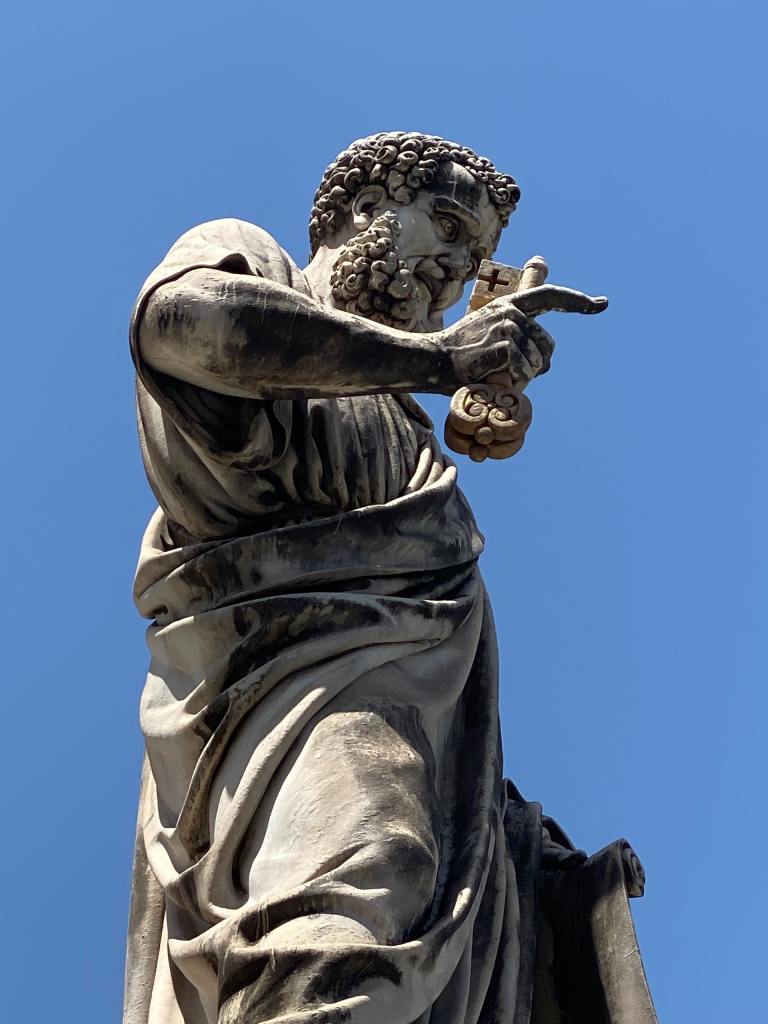
Peter Learns to Report for Duty

In a small group study of the apostle Peter, we studied Mark 1:29-39, where Jesus heals Simon’s mother-in-law, then “That evening at sundown they brought to him all who were sick or oppressed by demons.  And the whole city was gathered together at the door.  And he healed many who were sick with various diseases, and cast out many demons.”  Jesus was certainly up most of the night ministering to the crowds that showed up.  But “rising very early in the morning, while it was still dark, he departed and went out to a desolate place, and there he prayed.”

Simon Peter had to look for Him, since he wasn’t up early enough to see Jesus go to pray.  Peter was exhausted.  This is one of the subtle ways Jesus discipled Peter – by His example of being in constant contact with God the Father, even when it was hard or inconvenient.  Even Jesus needed to report to the Father regularly.  He put the Father first.  Every day, even when He was up most of the night.  Peter didn’t just witness many miracles, but he witnessed the relationship of Son to Father, and the dependence of the Son on the Father.  Peter had to learn that we can’t minister to others solely on our own knowledge and strength.

Photo by Jakub Kapusnak on Unsplash

The study then moved on to Luke 5:1-11, which is a story of Peter and other fishermen hauling in a miraculous catch of fish.  Jesus finds these fishermen washing their nets, after a long, frustrating night of catching nothing.  Jesus tells Simon “Put out into the deep and let down your nets for a catch.”  Peter protests: “Master, we toiled all night and took nothing! But at your word I will let down the nets.”  Imagine how Peter (a professional fisherman) would feel about a rabbi (not a professional fisherman) giving fishing advice!  But soon their nets caught so many fish that “their nets were breaking.”

What made the difference?  Sometimes what determines whether nothing happens, or something amazing happens is our willingness to listen and to obey.  Our ability to keep in constant contact with the Father, through Jesus His Son.  Jesus made time for the Father even after a long night of ministry, and Peter saw Him do it.  Shortly after, Jesus showed Peter that even small changes in our routines and lives, done in obedience to Him, can make a big difference, but how can we know how to follow Jesus if we aren’t showing up to listen?

Trust in the LORD with all your heart,
and do not lean on your own understanding.
In all your ways acknowledge him,
and he will make straight your paths.
Be not wise in your own eyes;
fear the LORD, and turn away from evil.
It will be healing to your flesh and refreshment to your bones.” – Proverbs 3:5-8


Peter Decides to Follow Jesus

In a small group study of the apostle Peter, we brainstormed whatever words and phrases came to mind when thinking of Peter, and the first one that came up for multiple people was “impulsive.”  We covered one example of Peter’s impulsiveness in the second part of the study, which comes from the use of the word “immediately” near the end of Matthew 4:18-20:

While walking by the Sea of Galilee, [Jesus] saw two brothers, Simon (who is called Peter) and Andrew his brother, casting a net into the sea, for they were fishermen.  And he said to them, “Follow me, and I will make you fishers of men.”  Immediately they left their nets and followed him.

Taken on their own, these verses make it look like Peter dropped everything “immediately” the first time he met Jesus.  Very impulsive!  However, there is some important background found earlier in John 1:35-41:

The next day again John was standing with two of his disciples, and he looked at Jesus as he walked by and said, “Behold, the Lamb of God!”  The two disciples heard him say this, and they followed Jesus.  Jesus turned and saw them following and said to them, “What are you seeking?” And they said to him, “Rabbi” (which means Teacher), “where are you staying?”  He said to them, “Come and you will see.” So they came and saw where he was staying, and they stayed with him that day, for it was about the tenth hour.  One of the two who heard John speak and followed Jesus was Andrew, Simon Peter’s brother.  He first found his own brother Simon and said to him, “We have found the Messiah” (which means Christ).”

From this we know that Andrew was Peter’s brother, and that Andrew was a disciple of John the Baptist.  Andrew began to follow Jesus, partly based on John’s testimony then, believing that Jesus was the Messiah, testified to his brother Simon, who is soon re-named, in John 1:42 –

[Andrew] brought [Peter] to Jesus. Jesus looked at him and said, “You are Simon the son of John? You shall be called Cephas” (which means Peter).”

Another bit of important context is the verse leading up to Peter’s call in Matthew, chapter 4, verse 17: “From that time Jesus began to preach, saying, ‘Repent, for the kingdom of heaven is at hand.’”  Mark also prefaces the story of Peter’s call by Jesus with a call to repentance (Mark 1:15).  Both gospel writers are implying that Peter’s response to Jesus is an example of repentance for us to learn from.

But what is repentance and how does Peter’s call illustrate it?  The word repent means to think differently about something.  I’ve heard repentance defined as “a U-turn on the road of life” which includes both a turning away from sin, and a turning toward God in thankful obedience.  Peter, in following Jesus, was thinking differently about the best way to live his life.  He turned to Jesus as the best answer to his life’s meaning and purpose.

This decision is not one to be taken lightly, and while Peter followed “immediately,” he was not as impulsive as we might think.

For which of you, desiring to build a tower, does not first sit down and count the cost, whether he has enough to complete it?” – Luke 14:28

Who is the Apostle Peter?

Dear fellow travelers,

Recently, I began facilitating a study of the apostle Peter with a small group at my church.  In the first meeting, we brainstormed whatever words or phrases came to mind when we thought of Peter.  No right or wrong answers, just whatever came to mind.  Here’s what ended up on the whiteboard:

ImpulsiveDenied Jesus 3 times
Man of actionBold
FishermanMarried
RockAndrew’s brother
Author of 2 EpistlesApostle to the Jews
Jesus’ right-hand manTight with John and James
Seen as commonPrejudiced
Rebuked as “Satan” by JesusFearless
Preached at PentecostBoastful
Walked on waterHelped write Mark
FaithfulHumble
Vocal & Decisive, often before thinkingConfident
Cut off Malchus’ earLearns from mistakes

One of the reasons Peter is so interesting to study is that he’s clearly as full of contradictions and spiritual immaturity as anyone is.  There are plenty of struggles and times of growth for us to identify with.  Few New Testament personalities, other than Jesus, are so fully revealed for all to see.  He’s a fellow traveler along with us as we strive to follow Jesus.

What words or phrases would you use to describe Peter?  What do you identify with from the above list?

As our study of Peter progresses, I’ll be summarizing some of it here, with the next one covering Jesus’ call of Simon, who became Peter.

The Transfiguration: A Preview of Glory and Delight

Yesterday I posted about Psalm 36:8, where David thanks God that His people may “drink from the river of your delights.”   Since the word for “delights” is the plural of Eden, these occasional sips God provides us point to a past and future paradise.  These delights strengthen our hope of heaven and strengthen us to live in this world for Him.  Jesus provided such a moment for His disciples in the event known as the Transfiguration, when Jesus took His disciples Peter, James, and John up a mountain for a vision of His future glory.  Matthew records in his gospel that Jesus “was transfigured before them, and his face shone like the sun, and his clothes became white as light.”[1]

Moses and Elijah also appeared and spoke with Jesus, perhaps representing the law and the prophets of the Old Testament and how it all pointed to Jesus.  Peter wanted to make this moment last, and offered to “make three tents here, one for you and one for Moses and one for Elijah.[2]  But it was not intended to last long, yet.

The Transfiguration was a preview of heaven, a sneak peek into what eternity will be like, a promise of future blessing under Jesus, the glorified King.  The fulfillment of everything the law and prophets hinted at will be realized.  However, Moses and Elijah soon disappeared, Jesus and His disciples descended from the mountain, and the disciples very soon struggled as we all do, but they persevered as we also must. Pray that God will make eternity real to His people today, even if for only a moment, giving a “drink from the river of your delights” and strengthen us to live for Him.


[1] Matthew 17:2
[2] Matthew 17:4

How Shall Christians Be Known?

The mark of a relationship with Christ has taken many forms over the ages, but with one common factor: a self-sacrificing love.

In the book of Genesis, Joseph, son of Jacob, has a fascinating story.  Joseph was favored by his father, despised by his brothers, sold into slavery in Egypt, but eventually rose to a position of prominence under Pharaoh.  In Genesis 41, Pharaoh learns that Joseph has interpreted dreams and calls for his help with Pharaoh’s own distressing series of dreams.  Joseph interprets Pharaoh’s dreams as a prophecy of seven years of famine and recommends a plan to get through it.  After this interpretation comes Genesis 41:38, where “Pharaoh said to his servants, ‘Can we find a man like this, in whom is the Spirit of God?’”  We connect Pharoah’s recognition of God’s Spirit in Joseph to the correct interpretation of dreams, but there is more to it:  Joseph also cared for the people of Egypt and oversaw the plan to survive the famine.

In the book of Acts, after Peter’s proclamation of the gospel of Jesus Christ to many “rulers and elders and scribes gathered together in Jerusalem,[1] Acts 4:13 records that “when they saw the boldness of Peter and John, and perceived that they were uneducated, common men, they were astonished. And they recognized that they had been with Jesus.”  These crowds knew that Peter and John had been with Jesus, that they had a similar spirit.  They had something that comes not from this world’s schools or from what it holds in distinguished, high regard.  Instead, “they were uneducated, common men,” but they carried the mark of Jesus.  They had a connection to an unknown source of boldness and were concerned for the spiritual needs of all people.

In the Psalms, a Psalmist (probably David) wrote in Psalm 119:97-98:

Oh how I love your law!
            It is my meditation all the day.
Your commandment makes me wiser than my enemies,
            for it is ever with me.”

The Psalmist praises God’s commandment as a source of wisdom better than anything available to his enemies.  By meditating on God’s commandments, the Psalmist is “wiser than my enemies,” because he has a wisdom from an unworldly source.  He carries the mark of Christ, but what is this commandment and what is this wisdom?

In Matthew 22:37-40, Jesus says the greatest commandments are: “You shall love the Lord your God with all your heart and with all your soul and with all your mind.  This is the great and first commandment.  And a second is like it: You shall love your neighbor as yourself.  On these two commandments depend all the Law and the Prophets.”  In other words, any and all commands of God are subordinated to the command to love God and neighbor, including our enemies.

In John 13:34-35, Jesus reiterates the rule, telling His disciples: “A new commandment I give to you, that you love one another: just as I have loved you, you also are to love one another.  By this all people will know that you are my disciples, if you have love for one another.”  Therefore, how can all people “find a man…in whom is the Spirit of God?”  Where will the world find astonishing boldness and good news among even “uneducated, common men”?  They will find it in those who have the fruit of the Spirit, which begins with “love,” but also includes “joy, peace, patience, kindness, goodness, faithfulness, gentleness, self-control.”[2]

So, does someone have a physical need like those impacted by the famine in Joseph’s day?  Does someone have a spiritual need for hope that only the gospel can provide?  Love provides the answer to both needs, and by love will the world know Christ’s disciples.

Therefore, make Christ known today by loving someone as Christ would.


[1] Acts 4:5
[2] Galatians 5:22-23