Jesus was Born to Overthrow King Herod, but How?

The story of Herod and the three wise men is familiar to most who celebrate Christmas.  After the birth of Jesus in Bethlehem, the wise men came looking for Him, having seen a star they believed signaled His coming.  Arriving in Jerusalem, they asked “Where is he who has been born king of the Jews? For we saw his star when it rose and have come to worship him.[1]  Word of this search made it to Herod, the then-current king of that region under Rome’s authority, and his first instinct was to eliminate what he saw as a threat to his own power.  In Herod’s eyes, only he was king of the Jews.

Herod came up with a simple plan: to use the wise men to help him find this threat.  “And he sent them to Bethlehem, saying, ‘Go and search diligently for the child, and when you have found him, bring me word, that I too may come and worship him.’”[2]  However, the wise men were warned in a dream not to return to Herod, so they went home after visiting Jesus.  “Then Herod, when he saw that he had been tricked by the wise men, became furious, and he sent and killed all the male children in Bethlehem and in all that region who were two years old or under, according to the time that he had ascertained from the wise men.”[3]

Herod believed so strongly in the necessity of the power of Rome and of his place in it that he was willing to commit mass murder.  If he couldn’t find the one child he wanted, he’d just kill them all.  He feared Jesus (or His followers) would overthrow him as king, and he was right but in the wrong sense.  Jesus would overthrow Rome.  He was born to overthrow every earthly kingdom – that is inevitable.
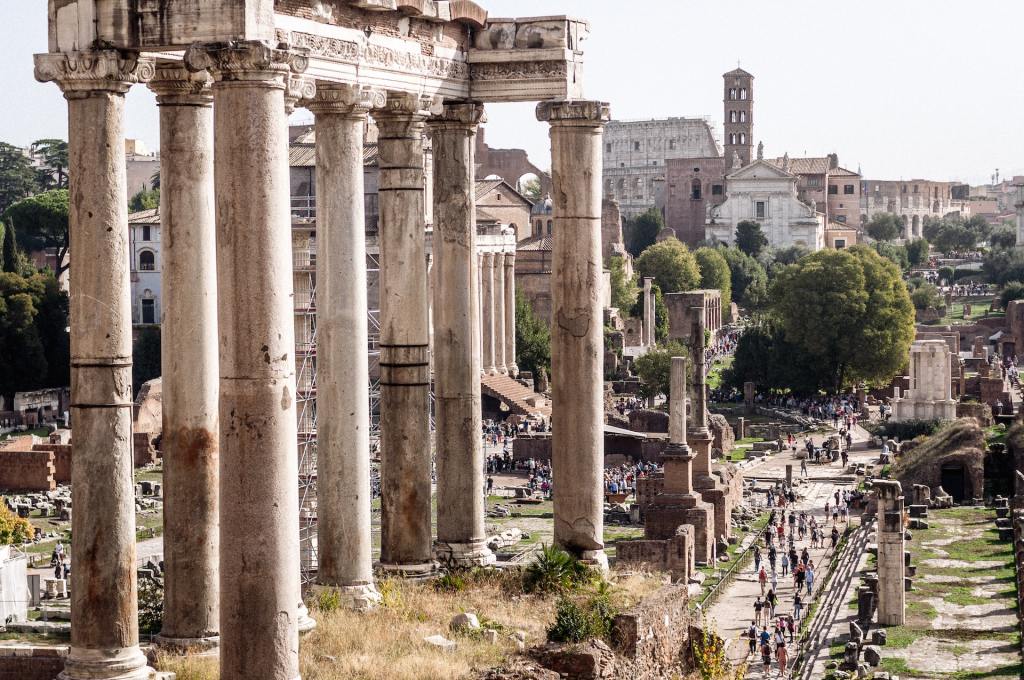
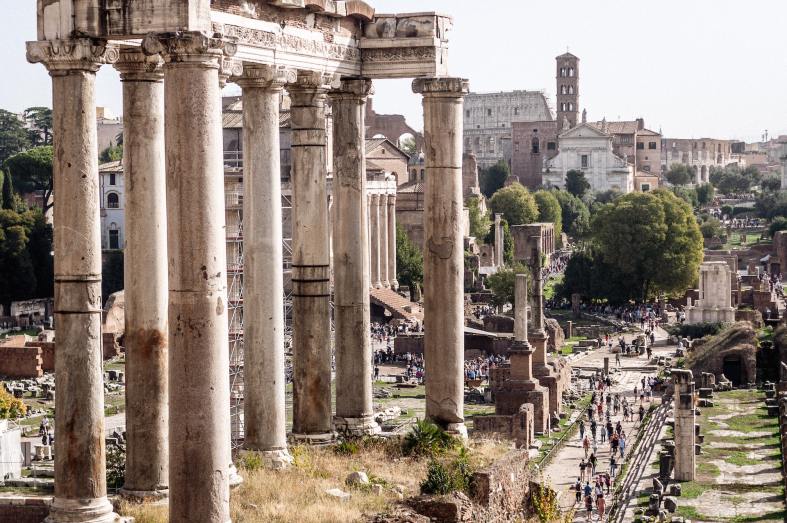
Much of Rome is already in ruins. Photo by Giu Vicente on Unsplash

Isaiah 40:17 proclaims that “All the nations are as nothing before him, they are accounted by him as less than nothing and emptiness.”  The word “emptiness” here is the Hebrew “bohu,” part of the phrase “tohu va’bohu” translated as “without form and void” in Genesis 1:2.  This phrase represents empty things with no eternal value or purpose.  So, while Isaiah doesn’t use the whole phrase from Genesis, he uses “less than” for emphasis instead.  When compared to God’s eternal purposes, all that every nation has ever devised and achieved is less than useless.  God has nothing to learn from our political and economic visions – He transcends them all.  No nation can or will accomplish what God has accomplished and will accomplish.

Therefore, Jesus’ other mission was to overthrow Herod’s dominion over Herod.  But Herod was determined to resist.  His heart was so hard that he preferred to hang on to a government willing to commit mass murder to preserve its own self-centered ways.  He thought he could preserve the façade of “Pax Romana,” the idea that worldly government can solve all of our problems, even while he, as an agent of Rome, was killing innocent children.  Herod saw it as in his own best interest, and in the interest of Rome, but this is one of many examples of “a way that seems right to a man, but its end is the way to death.”[4]

Jesus can overcome death only by overthrowing our views of our own “best interest” and what “seems right.”  He was not born and did not die and rise again just to overthrow Rome, but He came so we would have a way to overthrow ourselves and death itself.  Jesus will establish the only government that will matter in eternity: His Kingdom.  The soul of Herod, and of all of us, will outlive every society that ever existed, and ever will, on this earth.  The nations are all “accounted by him as less than nothing and emptiness.”  While Herod could find hope in Jesus if he wanted to, Rome itself never had any hope.

Therefore, the question Jesus asks all people is: Will we let Jesus overthrow us or will we, like Herod, go to great lengths to resist Jesus and try to preserve a world that is doomed to fail?

Isaiah 9:6 says “and the government shall be upon his shoulder.”  His Kingdom will be the only government we need, and He alone is uniquely qualified to establish and rule it.

For to us a child is born,
            to us a son is given;
and the government shall be upon his shoulder,
            and his name shall be called
Wonderful Counselor, Mighty God,
            Everlasting Father, Prince of Peace.”


[1] Matthew 2:2
[2] Matthew 2:8
[3] Matthew 2:16
[4] Proverbs 14:12, 16:25

Is Money the Root of All Evil?

Everyone has probably heard the phrase “money is the root of all evil” or some variation of it.  The phrase is usually directed at someone who has a lot of money by someone who doesn’t, with the implication being that the rich person is evil in some way, or many ways.  It’s a phrase that might make the ones with less money feel better about themselves.  At least they’re not “evil.”

However, while the phrase actually comes from the Bible (sort of), it isn’t biblical at all.  The source of the phrase is 1 Timothy 6:10 but notice some important differences in the wording in the ESV translation (the NIV, NKJV, NASB, and other translations are very similar):

For the love of money is a root of all kinds of evils. It is through this craving that some have wandered away from the faith and pierced themselves with many pangs.”

The first thing to note is that in 1 Timothy, it’s “love of money” that is the problem, not just “money.”  This means that it’s possible to have a lot of money and for that not to be a moral problem.  As Voddie Baucham said, “Let me clear up something…God is not against you having things.  He’s against things having you.”  There are a lot of very generous rich people and there are a lot of good things that wouldn’t get done, in the church or otherwise, without the monetary contributions of these people.  Those who have money, but don’t love it (money doesn’t have them) often put large amounts of what they have to work for God’s kingdom in many different ways.  Having money doesn’t make them evil.  The root of all evil is therefore something else other than money.

Also notice 1 Timothy says, “a root,” not “the root.”  One means evil has one root, and the other means that there is more than one root.  The wording from 1 Timothy tells us that “all kinds of evil” can grow from things other than the “love of money.”  Money and the love of it are not required to make someone evil.  Many things can be the “root” or source of evil in people, including in some cases the lack of money, ironically.

Lastly, 1 Timothy says, “all kinds of evils” not “all evil.”  So, the “love of money” isn’t the source of all evil, but it can cause many different types of evil.  Greed, covetousness, and haughtiness are some that come to mind.  But also consider that the dislike of people who have money, whether they love it or not, can be the source of jealousy, envy, covetousness (which can come from having or not having money) and other “kinds of evils.”

So, what’s wrong with the saying that “money is the root of all evil”?  It can have the effect of elevating greed and related sins to a higher (worse) level of sin than other sins.  It can become a weapon in the hands of economic and political activists.  But the 1 Timothy version doesn’t do either of these things.  Instead of creating an “us vs. them” situation, with the poor on one side and the rich on the other, the Biblical text shows us that sin comes in many forms, has many causes, and that nobody is immune from sin.

Sin itself is the ultimate problem of humanity, not “love of money,” although that is one kind of sin.  If “money is the root of all evil” then those who don’t love money wouldn’t need Jesus.  But those who hate money are sinners too.  Poor people are sinners too.  They just have different faults.  In the eyes of a holy God, no fault can be tolerated, because His purpose is to have a perfect humanity.  The solution to our economic and political problems is not to eliminate money or the rich, but the solution is that we need a way to remove all sin so we can be reconciled to God and have a path to a sinless life.  “Money is the root of all evil” may cry out for revolution, but “For the love of money is a root of all kinds of evils” cries out that Jesus is the only solution.

Jesus’ sacrifice for our sins is the only thing that will satisfy the requirements of our holy God, bringing us into His family and providing a way that “love of money” and all other sins can be destroyed forever.

For the love of money is a root of all kinds of evils,” but “God so loved the world, that he gave his only Son, that whoever believes in him should not perish but have eternal life.”

Praying for Our Leaders

King David was known as a man who sought God’s will in all things, even though he often failed.  The Psalms record many of his prayers for God to guide him and make him a good leader.  Psalm 26 is one of these prayers, and verses 8-10 include good objectives for any leader:

O LORD, I love the habitation of your house
            and the place where your glory dwells.
Do not sweep my soul away with sinners,
            nor my life with bloodthirsty men,
in whose hands are evil devices,
            and whose right hands are full of bribes.”

Sometimes we may not know how to pray “for kings and all who are in high positions,[1] as Paul suggests, but in this cry to God, David gives us at least 3 things to pray about.  He lists qualities he wanted to pursue, and some he wanted to avoid, but which are good for any leader.  Therefore, on the model of Psalm 26, we can pray for the leaders of our countries and communities today.

We can pray for political leaders who:

  • worship God (who “love the habitation of your house”)
  • do not seek violence and vengeance (who are not “bloodthirsty men”), and
  • are not corrupted by money (whose hands are not “full of bribes”)

All leaders can use our prayers today!


[1] 1 Timothy 2:2

The Law of the Medes and Persians Has Been Revoked

During the Old Testament book of Daniel, God’s people were in exile in Babylon, and a group of Babylonian officials really wanted to make a point.  They wanted to do this so badly, that it’s recorded several times in just a few verses of the book of Daniel, chapter 6:

Verse 8: “Now, O king, establish the injunction and sign the document, so that it cannot be changed, according to the law of the Medes and the Persians, which cannot be revoked.”
Verse 12: “Then they came near and said before the king, concerning the injunction, “O king! Did you not sign an injunction, that anyone who makes petition to any god or man within thirty days except to you, O king, shall be cast into the den of lions?” The king answered and said, “The thing stands fast, according to the law of the Medes and Persians, which cannot be revoked.
Verse 15: “Then these men came by agreement to the king and said to the king, “Know, O king, that it is a law of the Medes and Persians that no injunction or ordinance that the king establishes can be changed.”
Verse 17: “And a stone was brought and laid on the mouth of the den, and the king sealed it with his own signet and with the signet of his lords, that nothing might be changed concerning Daniel.” [bold emphasis mine]

What provoked them to insist on this law that “cannot be revoked”?

They decided Daniel (of the book’s name) needed to be persecuted for successfully contributing to the welfare of Babylon, while humbly giving God the glory for all his gifts, abilities, and success.  He was making them, and their gods, look bad.  It is remarkably similar to the reasons Jesus saw opposition.  Daniel, a Jewish exile, was about to get a big promotion and they wanted to sabotage it.  Knowing Daniel openly prayed three times a day, the officials conspired and convinced the king to sign a law “that whoever makes petition to any god or man for thirty days, except to you, O king, shall be cast into the den of lions.” (Verse 7).  Either Daniel gives glory to Babylon, or he dies.  Forcing Daniel to change his worship would prove that an unjust law was more important to him than his God.

What did Daniel do in response?  Nothing new.  He continued his standard practice of worship, praying in front of his open windows, probably including prayers for the welfare of Babylon[1].  Verse 10 says Daniel acted “as he had done previously,” which indicates he wasn’t snubbing his nose at his government or its new rule.  His faithfulness was more important to him than an unjust law, even when he didn’t know God would deliver him from the lions.  Daniel didn’t just come to God when he thought he needed God; he knew he needed God at all times.

Therefore, when the officials were provoked, it was an outcome of Daniel’s success and prayer, not Daniel’s intent.  Basic, consistent faithfulness to a higher power can sometimes irritate people, especially lower powers who think their rule “cannot be revoked,” even when it’s not very effective.

Following the law, the king had Daniel thrown into the den of lions, but “God sent his angel and shut the lions’ mouths.”  Daniel said he was saved because he had faithfully served his God and the king (verse 22), not because he was a provocative protester.

Seeing Daniel delivered by God, King Darius tore up the law that “cannot be revoked,” but even if Daniel had not been rescued from the lions, the laws would still have been revoked.  The kingdom of the Medes and Persians no longer exists.  Likewise at the end of time every law of every Babylon will be no more.  However, God’s promise of blessing for all who will worship Him and seek His will still stands.  On this promise Daniel stood, or rather, kneeled, and served his God and his countrymen, even in exile.

The law of loving service to neighbor will never be revoked, wherever and whenever you live, and even in heaven!  In the words of G.K. Chesterton, “Men did not love Rome because she was great. She was great because they had loved her.”[2]


[1] Jeremiah 29:7 says: “But seek the welfare of the city where I have sent you into exile, and pray to the LORD on its behalf, for in its welfare you will find your welfare,” referring to Babylon.
[2] Chesterton, G.K. Orthodoxy (1908).  P. 103.

Memorial Day Meditation

In an essay in The Weight of Glory[1], C.S. Lewis wrote: “the sun looks down on nothing half so good as a household laughing together over a meal, or two friends talking over a pint of beer, or a man alone reading a book that interests him.”  As we celebrate Memorial Day here in the United States, I pray you can enjoy what matters most to you and give thanks for others who sacrificed to made it possible.

In the same essay, Lewis says “all economies, politics, laws, armies, and institutions, save insofar as they prolong and multiply such scenes, are a mere ploughing the sand and sowing the ocean.”  These cannot deliver our salvation, yet they are absolutely necessary in this life.  These institutions have “no higher end than to facilitate and safeguard the family, and friendship, and solitude.”  Therefore, give thanks whenever peace and fellowship are possible, and pray for those living in places where they are not.

The essay also includes this quote: “do not let us mistake necessary evils for good.”  What did Lewis mean?  That when things that exist to provide “family, and friendship, and solitude” become an end in themselves “what was undertaken for the sake of health has become itself a new and deadly disease.”  While these things are absolutely needed, we should think of them “only in order to be able to think of something else.”  On the other hand, “a sick society must think much about politics.”  Therefore, give thanks for those who faithfully serve, and for preservation of the freedoms you enjoy.

Most importantly on Memorial Day, give thanks for those who gave up their lives so those they left behind could enjoy “family, and friendship, and solitude.”  Without their sacrifice, we could not celebrate Memorial Day, or any other day.  “Great sacrifices of this private happiness by those who have it may be necessary in order that it may be more widely distributed.”

Jesus said: “Greater love has no one than this, that someone lay down his life for his friends.” (John 15:13) As He gave His life for you, pray also for the ability, willingness, and freedom to sacrifice your own time and talents for others.


[1] Lewis, C.S.  The Weight of Glory (1941).  P. 161-162.