Slow to Anger: A Quint of Verses

Dear fellow travelers,

Instead of my usual “quint of quotes” here are 5 Bible verses (a quint of verses doesn’t sound as good), one from James and the others from Proverbs that expand on the idea from James.  Thanks to the ESV Study Bible notes for the idea.

Know this, my beloved brothers: let every person be quick to hear, slow to speak, slow to anger; for the anger of man does not produce the righteousness of God.” – James 1:19-20

When words are many, transgression is not lacking,
            but whoever restrains his lips is prudent.” – Proverbs 10:19

Whoever belittles his neighbor lacks sense,
            but a man of understanding remains silent.” – Proverbs 11:12

A soft answer turns away wrath,
            but a harsh word stirs up anger.” – Proverbs 15:1

Even a fool who keeps silent is considered wise;
            when he closes his lips, he is deemed intelligent.” – Proverbs 17:28

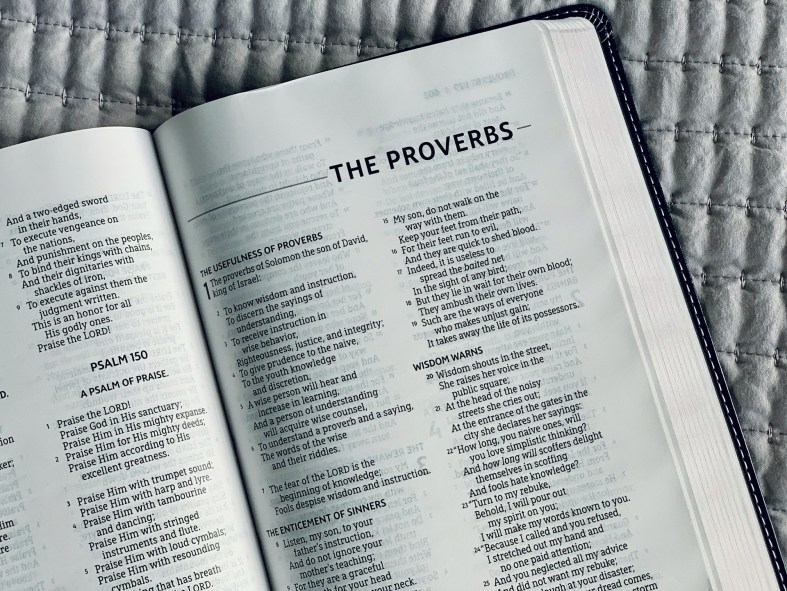
Photo by Tim Wildsmith on Unsplash

The Way of Escape

Reliable knowledge of good and evil is hard to come by, and the wisdom to follow it even harder.  A well-known and oft-quoted Proverb is 1:7, which says:

The fear of the LORD is the beginning of knowledge;
            fools despise wisdom and instruction.

This Proverb tells us that we only gain useful knowledge, wisdom and instruction when we have an attitude of reverent respect for God, and that we are fools if we do otherwise.  Fear of the Lord should be the rudder that guides us through the waves and storms that buffet us in this world.  Every decision we make should have as its foundation: does this honor God?  No other foundation is good enough for our lives to rest upon.

What’s left unsaid here in Proverbs is that we can’t expect this to come easy.  We are constantly tempted to not fear the Lord in our minute-by-minute, hour-by-hour, and day-by-day decisions.  It’s hard, and not just because we aren’t perfect.

Photo by Nathan Dumlao on Unsplash

In the account of the serpent’s confrontation with Eve in the garden in Genesis 3, the serpent’s whole objective was to get Eve to make one decision that wasn’t based on fear of the Lord.  “He said to the woman, “Did God actually say, ‘You shall not eat of any tree in the garden’?”[1]  “The serpent said to the woman, ‘You will not surely die.’[2]  Eventually he wore her down and she ate from the tree God told her not to eat from, all because her reverence for God had been worn down by constant criticism of God by the serpent.  He wanted her to decide for any reason other than the fear of the Lord, to become a fool, and thus bring down humanity.

When we make decisions, are we always being guided by the fear of the Lord, or do we sometimes think “He didn’t really mean that”?  If you’re like me, you find yourself constantly confronted by influences that oppose God.  Are we foolish when we follow these influences?  Yes.  Do we do it anyway?  Yes.  Could there be a hostile spiritual influence pulling us in that direction?  Sure, but it could also just be our own broken wills, prone to go our own way.

However, in 1 Corinthians 10:13, Paul assures us that “No temptation has overtaken you that is not common to man. God is faithful, and he will not let you be tempted beyond your ability, but with the temptation he will also provide the way of escape, that you may be able to endure it.”  And if we fear the Lord, we will believe it.

If we fear the Lord, when we’re tempted, we will know that “he will also provide the way of escape.”  We need to look for it and pray for it until we find it.  When we do, God will remain in the driving seat of our decisions and knowledge and wisdom will be ours.  He can overcome any of our temptations if we let Him and we fear Him.

Let the fear of the Lord be your guide.  There is always a “way of escape.


[1] Genesis 3:1b
[2] Genesis 3:4

Courage to Change: A Quint of Quotes

Fellow travelers,

Here is another “Quint of Quotes” from my collection, on the theme of personal responsibility and development.  Please don’t take the last one literally.

When a man’s folly brings his way to ruin, his heart rages against the LORD.” – Proverbs 19:3

“People could survive their natural trouble all right if it weren’t for the trouble they make for themselves.” – Ogden Nash

“God, grant me the serenity to accept the things I cannot change,
the courage to change the things I can,
and the wisdom to know the difference.” – Common prayer adapted from Reinhold Niebuhr

“Millions of people die every year of something they could cure themselves: lack of wisdom and lack of ability to control their impulses.” -Irving Kahn, investor who died at 109 of natural causes in 2015

And if your hand or your foot causes you to sin, cut it off and throw it away. It is better for you to enter life crippled or lame than with two hands or two feet to be thrown into the eternal fire.” – Matthew 18:8

We Will Not Live in Tents Forever

The apostle Paul was likely one of the finest Old Testament scholars of his day, and sometimes draws on existing imagery to make a point.  One example might be Proverbs 14:11-12, where the second verse is more widely known than the first, but not unrelated:

The house of the wicked will be destroyed,
            but the tent of the upright will flourish.
There is a way that seems right to a man,
            but its end is the way to death.

Physically, it seems obvious that a house is far more durable than a tent, but both of these Proverbs tell us not to judge by appearances.  Looks and reputation may suggest otherwise, but it is righteousness that determines eternal destiny, specifically acceptance of Jesus’ righteousness.

In 2 Corinthians 5:1-3, Paul gives an example of why we should focus not on what “seems right”, but instead focus on the unseen things that matter for eternity, drawing on the tent image:

For we know that if the tent that is our earthly home is destroyed, we have a building from God, a house not made with hands, eternal in the heavens.  For in this tent we groan, longing to put on our heavenly dwelling, if indeed by putting it on we may not be found naked.”

Photo by Hendrik Morkel on Unsplash

Paul, defending his apostleship to the Corinthians amidst his suffering while other false apostles lived in ease, knew that an upright tent was better than a wicked house in God’s eyes, and therefore being less comfortable was entirely worth it, since there was an eternal reward waiting in heaven.

Commenting on 2 Corinthians 5, Warren Wiersbe notes that “Heaven was not simply a destination for Paul: it was a motivation.  Like the heroes of faith in Hebrews 11, he looked for the heavenly city and governed his life by eternal values.”[1]

When frustrated by your earthly limitations, or frustrated by discomfort in this world, know that we will not live in these tents forever.  For His faithful, God is preparing an eternal dwelling for us.  While it “seems right to a man” to think a house is better than a tent, every tent and house in this world is temporary.  Hebrews 1:12 says of all creation, the earth and all the heavens, that:

like a robe you will roll them up,
            like a garment they will be changed.
But you are the same,
            and your years will have no end.

Do we long for our new, eternal heavenly dwelling?  Does this longing motivate us to live for God?  Let us keep Driving Toward Morning today!


[1] Wiersbe, Warren.  Be Encouraged (2 Corinthians) (1994).  P. 69.

Ebenezer in the Wilderness

In the ESV Bible, the phrase “but God” appears 43 times, changing the direction of the story.  An Ebenezer is a “stone of help,” or reminder of God’s benefit to His people in the past, providing strength for the present and future.  Ebenezer the squirrel, this blog’s mascot, represents these “but God” memorials the Bible records of God’s intervention in the world and in our lives.  As a squirrel can unexpectedly draw our attention, I write about these moments to draw our attention to God as a reminder that adding God to our circumstances can change everything.  One of these instances comes at a key point in David’s life.

Prior to becoming Israel’s second king, David may have spent a decade in exile, running from Saul, Israel’s first king.  Saul was extremely insecure and jealous of David and sought to kill him for years.  In 1 Samuel 23 there is a story about Keilah, a border town in Judah that was near the Philistine city of Gath.  Bands of Philistines were stealing grain from Keilah and David heard of it.  This small border town may not have interested Saul, but David prayed to God about whether to rescue it.  After getting affirmation from God, David and his men rescued the town.

Saul, with spies everywhere, heard that David was staying in Keilah and planned to besiege the town, probably to starve the people until they gave David up.  In other words, Saul hated David so much and wanted him dead that he would attack a town in his own territory.  Saul was persistent and not interested in seeking (or following) God’s guidance.

David, informed by God that the people of Keilah would give him up to Saul, fled into the wilderness again, then we get to verse 14 of the chapter:

And David remained in the strongholds in the wilderness, in the hill country of the wilderness of Ziph. And Saul sought him every day, but God did not give him into his hand.” (emphasis added)

Saul sought David “every day, but God” was on David’s side, and “did not give him into his hand.”  It wouldn’t matter how hard Saul tried – hunting David while he should have been minding his kingdom – David would not be caught unless God allowed it.

As the story continues, Saul is informed that David is hiding in the wilderness of Maon (verse 25).  Then, “As Saul and his men were closing in on David and his men to capture them, a messenger came to Saul, saying, ‘Hurry and come, for the Philistines have made a raid against the land.’  So Saul returned from pursuing after David and went against the Philistines. Therefore that place was called the Rock of Escape.” (verses 26b-28)

While the news of this Philistine raid may seem like mere coincidence, I don’t believe it was.  First, the timing worked out just right, as David seemed cornered by Saul and his men.  Second, Saul was not concerned about raids on Keilah – why is he concerned this time?  “The king’s heart is a stream of water in the hand of the LORD; he turns it wherever he will,” says Proverbs 21:1.  Perhaps this was one of God’s ways to “not give him into his hand.” While Ebenezer means “stone of help,” David found a “Rock of Escape,” and God can be our escape as well.  When we feel threatened by enemies – physical or spiritual – remember that God watches over His people.  Those enemies may seem overwhelming, “but God” will not give us into their hand unless He knows it will benefit us and our faith, for “we know that for those who love God all things work together for good, for those who are called according to his purpose” (Romans 8:28).  God changes every story for the betterment of His people.

Amen.