A Psalm of God’s Strength and Power

The Bible software I use (Accordance) has the ability to highlight text, but so far I’ve only used it once, for Psalm 21.  In just 13 verses, David wrote “you” or “your” 25 times, referring to God as the source of his success and blessings, past, present, and future.  The short 13 verses of Psalm 21 provide a plethora of praises we can offer to confess that God is powerful, faithful and just.  Here is the entire Psalm, and I’ve bolded all the “you”s and “your”s, which I highlighted in Accordance:

“To the choirmaster. A Psalm of David.

O LORD, in your strength the king rejoices,
            and in your salvation how greatly he exults!
You have given him his heart’s desire
            and have not withheld the request of his lips. Selah
For you meet him with rich blessings;
            you set a crown of fine gold upon his head.
He asked life of you; you gave it to him,
            length of days forever and ever.
His glory is great through your salvation;
            splendor and majesty you bestow on him.
For you make him most blessed forever;
            you make him glad with the joy of your presence.
For the king trusts in the LORD,
            and through the steadfast love of the Most High he shall not be moved.

Your hand will find out all your enemies;
            your right hand will find out those who hate you.
You will make them as a blazing oven
            when you appear.
The LORD will swallow them up in his wrath,
            and fire will consume them.
You will destroy their descendants from the earth,
            and their offspring from among the children of man.
Though they plan evil against you,
            though they devise mischief, they will not succeed.
For you will put them to flight;
            you will aim at their faces with your bows.

Be exalted, O LORD, in your strength!
            We will sing and praise your power.”

What statements did you focus on while reading this?  Did you take the time to think about all 25 “you” statements (and the rest of the Psalm)?  Read it again.

The first section in this Psalm describes how our God is “faithful” in some ways, and the second describes “just.”  The first may come easier, with David giving God credit for all of his strength and success, but the middle section on justice may come across as harsh and harder to swallow.  However, it reminds us that only He knows for sure who His (and our) enemies are.  “Your hand will find out all your enemies.”  Only He determines the fates of others, including some who look like enemies now, but will come to faith in Him later.  With any enemy we can “wait upon the Lord”, as David often urges us, knowing God will either save them, or their plans will come to ruin by His design.

Yet, for those in Christ, “he is faithful and just to forgive us our sins and to cleanse us from all unrighteousness.”  Therefore, we echo David:

“Be exalted, O LORD, in your strength!
            We will sing and praise your power.”

We’re All Little Pharaohs

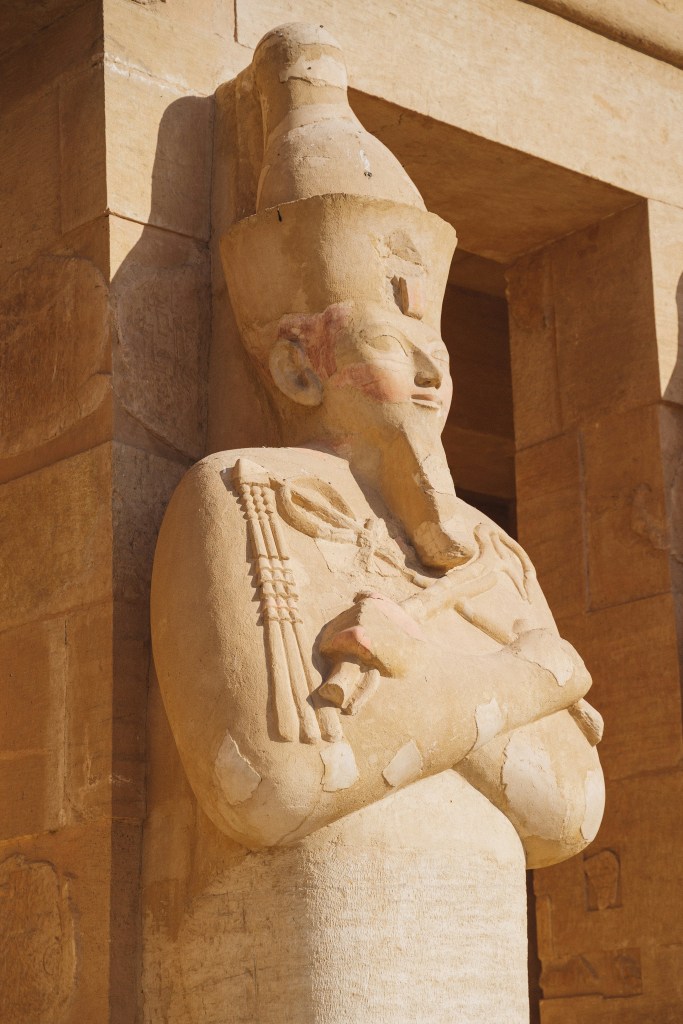
Anyone who knows the story of the Exodus knows who the bad guy is: Pharaoh.  As the leader of Egypt, he is primarily to blame for the enslavement of Israel.  Eventually, through Moses and Aaron, God tells Pharaoh to free the Israelites from slavery, and time and again Pharaoh refuses.  Clearly, Pharaoh is God’s enemy.  However, in his resistance to God, I think Pharaoh fell into some habits any of us could fall into.

First, Pharaoh admitted his need for God only when things were going wrong but shut God out when things were going well.  In Exodus 8:8, Pharaoh asked Moses to “Plead with the LORD to take away the frogs from me and from my people” but once the frogs were gone, Exodus 8:15 tells us that “when Pharaoh saw that there was a respite, he hardened his heart” and refused to do God’s will.  The same thing happens in chapter 9, during the plague of the hail.  Seeing the destruction caused by the hail, Pharaoh says “Plead with the LORD, for there has been enough of God’s thunder and hail” in verse 28, but in verse 34, “when Pharaoh saw that the rain and the hail and the thunder had ceased, he sinned yet again and hardened his heart.

Photo by Alex Azabache on Unsplash

Next, Pharaoh repeatedly negotiated with God to define the scope of His influence.  Faced with the plague of flies, Pharoah said to Moses and Aaron “Go, sacrifice to your God within the land.”[1]  But staying “in the land” was not what God wanted His people to do.  In response to the plague of locusts, Pharoah said “the men among you” could leave and worship God, but he wouldn’t let the “little ones[2] go.  Also, after the plague of darkness, Pharoah said “Go, serve the LORD; your little ones also may go with you; only let your flocks and your herds remain behind.”[3]  In these 3 responses, Pharaoh insisted on limits to where the people should worship, which people should worship, and what they could (and couldn’t) use in worship.

Third, Pharaoh also tried to limit the scope of his own sin, and which sins he would be accountable to God for.  In Exodus 9:27, Pharaoh said, “this time I have sinned” and in 10:17 said “forgive my sin, please, only this once.”  In reality Pharaoh was sinning every time he refused to listen to God, but he wasn’t willing to admit that.  He only admitted a minority of the times he disobeyed.

If you’re like me, this all might sound familiar.  Often our prayers are more fervent and sincere when we need help than they are when we have something to praise God for, or when times are good.  Often, we allow God to govern some parts of our life, but we keep other parts for ourselves, to do what we want with.  Also, we often only admit some of our sins and choose which ones to care about.  We’re all a bit like Pharaoh, the bad guy in the Exodus story.

Fortunately for us, we have something else in common with Pharaoh: the true, Almighty God will defeat all of the “gods” we follow.  Every single one.  Behind the battle between Moses and Pharaoh was a contest between our God and Pharaoh’s gods.  As the Life Application Study Bible notes: “As each gloomy plague descended upon the land, the Egyptian people realized how powerless their own gods were to stop it. Hapi, the god of the Nile River, could not prevent the waters from turning to blood. Hathor, the crafty cow-goddess, was helpless as Egyptian livestock died in droves. Amon-Re, the sun-god and chief of the Egyptian gods, could not stop an eerie darkness from covering the land for three full days.”

When we choose not to obey God, we harden our hearts against Him and follow the “gods” we choose for ourselves, but God will ultimately defeat them all.  God’s purpose in saving us is to deliver us from all other gods, as He delivered Israel from Egypt.  He will deliver us from our slavery to every sin that binds us and make us not follow Him wholeheartedly.

We may be more like Pharaoh than we’d like to admit, but the Pharaoh in us has been killed, nailed to the cross with Jesus. When we reach heaven, all of our other “gods” will be gone and we will be perfected in our obedience to the one, true God, for our good and for His glory!

That’s a deliverance worth looking forward to and praising God for!

Amen.


[1] Exodus 8:25
[2] Exodus 10:10-11
[3] Exodus 10:24

There’s a Place for Us – Psalms of Ascent #3

Fellow travelers,

Today we come back to a weekly series on the Psalms of Ascent, a group of 15 Psalms used as a liturgy for Jews in ancient Israel traveling to Jerusalem for feasts.  Previously I wrote: “To today’s Christian, the Psalms of Ascent remind us not only of our need for salvation apart from law, but they prepare us to regularly contemplate His provision to accomplish that salvation.”  Psalm 119 praises God’s law, but the following Psalms let us know that the law cannot deliver salvation.

The first Psalm of Ascent, Psalm 120, picks up from verse 136 of Psalm 119: “My eyes shed streams of tears, because people do not keep your law,” but it also starts where the pilgrimage starts geographically.  The full Psalm 120 is:

“A Song of Ascents.

In my distress I called to the LORD,
            and he answered me.
Deliver me, O LORD,
            from lying lips,
            from a deceitful tongue.

What shall be given to you,
            and what more shall be done to you,
            you deceitful tongue?
A warrior’s sharp arrows,
            with glowing coals of the broom tree!

Woe to me, that I sojourn in Meshech,
            that I dwell among the tents of Kedar!
Too long have I had my dwelling
            among those who hate peace.
I am for peace,
            but when I speak, they are for war!”

Each person traveling to Jerusalem came from a different place.  Meshech was in the far north; Kedar in the far southeast.  The Psalmist does not live in either place, but the picture is that the same problems exist everywhere.  Everyone lives among people with lying lips, a deceitful tongue, and who hate peace.  Each of us in our own way are such people.  In verse 3 the Psalmist is frustrated about what to do about this: “what more shall be done to you, you deceitful tongue?”  The next verse says that force or coercion won’t solve the problem.  It must be solved internally because mankind is fundamentally broken.  Society isn’t the cause of the problem, but an outcome of the problem, and we are frustrated with it.

However, those following the familiar liturgy of these Psalms would know that this frustration is only the beginning of their preparation to worship in Jerusalem.  The place we all live – this entire creation – is groaning for a solution, a way out, and struggling to find it.  All of mankind is in this boat together, but we’re “gonna need a bigger boat.”  The pilgrimage begins with knowing we have a need that we can’t satisfy ourselves.

On their days- or weeks-long journeys to Jerusalem these pilgrims had to bring the baggage from their home lives with them – literally and figuratively.  They certainly lied to and fought with each other on the way.  The trip lasted too long for them to pretend.  Their baggage was visible to all, and they couldn’t make the trip without it.  But they went.  In today’s church, do we go to a place that is full of “good” people, however we define that?  No, we go to a place with people just like us.  We begin as sinners among sinners, from Meshech to Kedar, but we long for a better place.

If you are in distress, call out to the LORD for a place of peace, not just for eternity but for your journey to it.  The church is “called out” to both places.  The journey is worth it.

Coda
The title of this post, if you haven’t already guessed, comes from the musical West Side Story.  The song is about the love between Tony and Maria, members of rival ethnic groups that insist on fighting even though they aren’t sure why.  Therefore, Tony and Maria long for a place where the world’s hate doesn’t tear them apart.

In more ways than one, the sentiments of the song echo the last verses of today’s Psalm:

“Too long have I had my dwelling among those who hate peace.
I am for peace, but when I speak, they are for war!”

Here is the song from the 1961 West Side Story film:


This post continues a series on the Psalms of Ascent. To start at the beginning, click here, and for the next post click here.

Minding Our Own Business

Have you heard the term “virtue signaling”?  The Merriam-Webster dictionary defines it as “the act or practice of conspicuously displaying one’s awareness of and attentiveness to political issues, matters of social and racial justice, etc., especially instead of taking effective action.”  The phrase seems like it’s been around a long time, but the first use of it may have been as recent as 2013.[1]

Maybe the words “virtue signaling” are new, but the idea is at least as old as the Bible.  In chapter 26, verses 6-13 of Matthew’s gospel, he tells the story of a woman who came to Jesus with “an alabaster flask of very expensive ointment” which she poured on Jesus’ head in front of the disciples.  In Jesus’ view “she has done a beautiful thing to me…to prepare me for burial.”  But the disciples didn’t see it the same way Jesus did.  They indignantly said “Why this waste?  For this [ointment] could have been sold for a large sum and given to the poor.

Jesus responded how it was “a beautiful thing”, but also made another comment that made it clear the disciples were virtue signaling.  He told them not to “trouble the woman.”  “For you always have the poor with you, but you will not always have me.”  I think Jesus had at least 3 points in this phrase, related to virtue signaling.

The first is that knowing what to do isn’t enough.  In fact, it just increases our responsibility.  James 4:17 says: “So whoever knows the right thing to do and fails to do it, for him it is sin.”  Although the disciples knew that giving to the poor was good, in this case were more concerned about sharing that knowledge than about using it.  Today, we might call such people virtue signalers, but the Bible calls them “busybodies” and “meddlers[2]  People who go from person to person evaluating and criticizing their work instead of minding their own responsibilities.  These people are common on social media.

Second, that there is always an opportunity to help the poor – they always will exist and aren’t hard to find – and each disciple surely missed opportunities every day.  On what basis could they pick on someone else’s failure to help the poor?  By criticizing the woman, they revealed that virtue signaling was more important to them than actually being virtuous.

The last point is that service flows from worship, not the other way around.  When we worship Jesus, the ultimate servant, our own ability to sincerely serve others increases as a result.  The woman with the ointment knew this may be the only opportunity to anoint Jesus for burial, and knew she shouldn’t miss it.  On the other hand, the disciples wanted Jesus to punish the woman when they should have been minding their own business.  An internal posture of worship may be the best antidote to hypocrisy and the temptation to merely signal virtue.

The phrase “mind your own business” usually is said to someone we want to leave us alone, but the words actually mean that we should consider our own activities and motives more important than the policing of other people’s activities and motives.  We “always have the poor” with us and fall far short of the standard we need to meet to judge other people’s use of resources.

When we all stand before God in judgment, Jesus will tell the blessed: “I was hungry and you gave me food, I was thirsty and you gave me drink, I was a stranger and you welcomed me, I was naked and you clothed me, I was sick and you visited me, I was in prison and you came to me.’”  In other words, the blessed minded their own business instead of just criticizing others (virtue signaling).  Jesus notices when we take effective action and doesn’t care much about our opinions of others’ effectiveness.

Therefore, pray that we can all mind our own business, in worshipful service, “for you always have the poor with you,” and thank God for His forgiveness, because I know I don’t mind my own business nearly as often as I should.  Sometimes I just blog about it.


[1] https://www.merriam-webster.com/dictionary/virtue signaling
[2] 1 Timothy 5:13; 1 Peter 4:15

The Traps of the Wicked

The world is, unfortunately, full of people who seek to get other people in trouble, and this has been true for millennia.  Far back in Old Testament history, King David wrote in Psalm 140:4-5:

Guard me, O LORD, from the hands of the wicked;
            preserve me from violent men,
            who have planned to trip up my feet.
The arrogant have hidden a trap for me,
            and with cords they have spread a net;
            beside the way they have set snares for me. Selah

When David wrote this, he was probably describing immediate, physical threats against him, but when I read verse 5 it sounds like many obstacles Christians currently face.  Every day, we encounter traps put in front of us, and David’s Psalm has many applications.

What about irresponsible news coverage, which too often includes inappropriate opinions and suggestions about how we should think or act?  We could pray, “Guard me, O LORD, against putting my faith in falsehoods.”  Or “Guard me, O LORD, against temptation to hate my enemy.”  Or “Guard me, O LORD, from putting aside the work you have for me to do to fight battles that aren’t mine.”

Also, the internet is a dangerous place.  Many websites use sexual images to get our attention, and in some cases if we even stop for a second to stop scrolling and look, those websites take that as interest and show us more of the same.  We could pray “Guard me, O LORD, when websites ‘have hidden a trap for me, and with cords they have spread a net’”. Other websites use misleading and provocative headlines to pull us away from what we intended to look at.  “Guard me, O LORD, against click bait that leads me where I should not go, and that makes me spend my time unwisely.”

Back to the Psalm, note that in verse 5 David describes threats as being “beside the way,” meaning they are off the main path we should travel.  The traps may be hidden off the side of the road with bait trying to lure us aside to an ambush.  Therefore, the key is to stay on the road.  Proverbs 1:17 says “For in vain is a net spread in the sight of any bird.”  Even birds, if they see a trap, will know to avoid it.  Yet people don’t seem to be as wise, or else they wouldn’t fall for click bait and other temptations.

One of the best ways to stay away from those who “have planned to trip up my feet” is to stay busy doing good things.  Samuel Johnson wrote: “If you are idle, be not solitary; if you are solitary, be not idle.”  He knew temptation is most powerful when we are alone with nothing to do, which applies to much of our time online.  I try to use writing as a way to stay busy when solitary, but that doesn’t always work for me and might not work at all for others.

Staying on the right path, we avoid snares and traps, which are near, but not on, the true way.  Once we allow temptation to move us a little, we often find it has moved us a lot, and into a trap.

What can we all do to avoid the traps of the wicked?

Guard me, O LORD, from the hands of the wicked;
            preserve me from violent men,
            who have planned to trip up my feet.