Minding Our Own Business

Have you heard the term “virtue signaling”?  The Merriam-Webster dictionary defines it as “the act or practice of conspicuously displaying one’s awareness of and attentiveness to political issues, matters of social and racial justice, etc., especially instead of taking effective action.”  The phrase seems like it’s been around a long time, but the first use of it may have been as recent as 2013.[1]

Maybe the words “virtue signaling” are new, but the idea is at least as old as the Bible.  In chapter 26, verses 6-13 of Matthew’s gospel, he tells the story of a woman who came to Jesus with “an alabaster flask of very expensive ointment” which she poured on Jesus’ head in front of the disciples.  In Jesus’ view “she has done a beautiful thing to me…to prepare me for burial.”  But the disciples didn’t see it the same way Jesus did.  They indignantly said “Why this waste?  For this [ointment] could have been sold for a large sum and given to the poor.

Jesus responded how it was “a beautiful thing”, but also made another comment that made it clear the disciples were virtue signaling.  He told them not to “trouble the woman.”  “For you always have the poor with you, but you will not always have me.”  I think Jesus had at least 3 points in this phrase, related to virtue signaling.

The first is that knowing what to do isn’t enough.  In fact, it just increases our responsibility.  James 4:17 says: “So whoever knows the right thing to do and fails to do it, for him it is sin.”  Although the disciples knew that giving to the poor was good, in this case were more concerned about sharing that knowledge than about using it.  Today, we might call such people virtue signalers, but the Bible calls them “busybodies” and “meddlers[2]  People who go from person to person evaluating and criticizing their work instead of minding their own responsibilities.  These people are common on social media.

Second, that there is always an opportunity to help the poor – they always will exist and aren’t hard to find – and each disciple surely missed opportunities every day.  On what basis could they pick on someone else’s failure to help the poor?  By criticizing the woman, they revealed that virtue signaling was more important to them than actually being virtuous.

The last point is that service flows from worship, not the other way around.  When we worship Jesus, the ultimate servant, our own ability to sincerely serve others increases as a result.  The woman with the ointment knew this may be the only opportunity to anoint Jesus for burial, and knew she shouldn’t miss it.  On the other hand, the disciples wanted Jesus to punish the woman when they should have been minding their own business.  An internal posture of worship may be the best antidote to hypocrisy and the temptation to merely signal virtue.

The phrase “mind your own business” usually is said to someone we want to leave us alone, but the words actually mean that we should consider our own activities and motives more important than the policing of other people’s activities and motives.  We “always have the poor” with us and fall far short of the standard we need to meet to judge other people’s use of resources.

When we all stand before God in judgment, Jesus will tell the blessed: “I was hungry and you gave me food, I was thirsty and you gave me drink, I was a stranger and you welcomed me, I was naked and you clothed me, I was sick and you visited me, I was in prison and you came to me.’”  In other words, the blessed minded their own business instead of just criticizing others (virtue signaling).  Jesus notices when we take effective action and doesn’t care much about our opinions of others’ effectiveness.

Therefore, pray that we can all mind our own business, in worshipful service, “for you always have the poor with you,” and thank God for His forgiveness, because I know I don’t mind my own business nearly as often as I should.  Sometimes I just blog about it.


[1] https://www.merriam-webster.com/dictionary/virtue signaling
[2] 1 Timothy 5:13; 1 Peter 4:15

The Traps of the Wicked

The world is, unfortunately, full of people who seek to get other people in trouble, and this has been true for millennia.  Far back in Old Testament history, King David wrote in Psalm 140:4-5:

Guard me, O LORD, from the hands of the wicked;
            preserve me from violent men,
            who have planned to trip up my feet.
The arrogant have hidden a trap for me,
            and with cords they have spread a net;
            beside the way they have set snares for me. Selah

When David wrote this, he was probably describing immediate, physical threats against him, but when I read verse 5 it sounds like many obstacles Christians currently face.  Every day, we encounter traps put in front of us, and David’s Psalm has many applications.

What about irresponsible news coverage, which too often includes inappropriate opinions and suggestions about how we should think or act?  We could pray, “Guard me, O LORD, against putting my faith in falsehoods.”  Or “Guard me, O LORD, against temptation to hate my enemy.”  Or “Guard me, O LORD, from putting aside the work you have for me to do to fight battles that aren’t mine.”

Also, the internet is a dangerous place.  Many websites use sexual images to get our attention, and in some cases if we even stop for a second to stop scrolling and look, those websites take that as interest and show us more of the same.  We could pray “Guard me, O LORD, when websites ‘have hidden a trap for me, and with cords they have spread a net’”. Other websites use misleading and provocative headlines to pull us away from what we intended to look at.  “Guard me, O LORD, against click bait that leads me where I should not go, and that makes me spend my time unwisely.”

Back to the Psalm, note that in verse 5 David describes threats as being “beside the way,” meaning they are off the main path we should travel.  The traps may be hidden off the side of the road with bait trying to lure us aside to an ambush.  Therefore, the key is to stay on the road.  Proverbs 1:17 says “For in vain is a net spread in the sight of any bird.”  Even birds, if they see a trap, will know to avoid it.  Yet people don’t seem to be as wise, or else they wouldn’t fall for click bait and other temptations.

One of the best ways to stay away from those who “have planned to trip up my feet” is to stay busy doing good things.  Samuel Johnson wrote: “If you are idle, be not solitary; if you are solitary, be not idle.”  He knew temptation is most powerful when we are alone with nothing to do, which applies to much of our time online.  I try to use writing as a way to stay busy when solitary, but that doesn’t always work for me and might not work at all for others.

Staying on the right path, we avoid snares and traps, which are near, but not on, the true way.  Once we allow temptation to move us a little, we often find it has moved us a lot, and into a trap.

What can we all do to avoid the traps of the wicked?

Guard me, O LORD, from the hands of the wicked;
            preserve me from violent men,
            who have planned to trip up my feet.

God is at Hand

The Old Testament prophet Jeremiah lived in a time full of false prophets, where the true word of God was rarely heard.  It was also a time where idolatry and sin ran wild among the people of Judah, Jeremiah’s audience, a nation headed for destruction by Babylon, God’s chosen agent to discipline them.  Yet the false prophets told the people: “You shall not see the sword, nor shall you have famine, but I will give you assured peace in this place.’[1]  Later, “They say continually to those who despise the word of the LORD, ‘It shall be well with you’; and to everyone who stubbornly follows his own heart, they say, ‘No disaster shall come upon you.’”[2]

These false prophets were essentially telling the people they can do whatever they want, so they don’t need a savior since God was not going to judge them.   The false prophets also said that the people don’t need God as Lord, since there would be no negative consequences no matter what they chose to do.

Jeremiah fearlessly confronts these prophets and worked hard to get the people to take him seriously.  At one point, God tells Jeremiah to proclaim: “Am I a God at hand, declares the LORD, and not a God far away?[3]  With this question, the LORD lets the people know that they can’t just set him aside as if He doesn’t exist.  While God is a God of love, He is also a God of justice, and sin will not be ignored.

Both the Old and New Testaments warn that those who ignore God can infect the broader population.  In Deuteronomy 29:18-19, Moses wrote: “Beware lest there be among you a man or woman or clan or tribe whose heart is turning away today from the LORD our God to go and serve the gods of those nations. Beware lest there be among you a root bearing poisonous and bitter fruit, one who, when he hears the words of this sworn covenant, blesses himself in his heart, saying, ‘I shall be safe, though I walk in the stubbornness of my heart.’ This will lead to the sweeping away of moist and dry alike.”  [emphasis mine]. The whole church, the “moist and dry alike” can suffer from the influence of members who cast God aside as irrelevant or inconvenient.  People who stubbornly insist on their own way.

The New Testament picks up the “root” image from Deuteronomy in Hebrews 12:15 – “See to it that no one fails to obtain the grace of God; that no “root of bitterness” springs up and causes trouble, and by it many become defiled”. This verse is in the context of God’s discipline, of understanding that when He judges His own people, it is not a final judgement, but one that is meant to refine them and make them holy.  But it is also a reminder that we need to accept God as Lord, by His grace, in order for Him to be our Savior.

Like the false prophets of Jeremiah’s day, modern preachers can also teach that we don’t need Jesus as Lord and Savior.  Some of them declare that we are free to do whatever we want because He is a God of love and therefore will never judge us no matter what.  These ministers fail to see God’s loving, disciplining hand in our difficulties, feeding the “root of bitterness”.

Other preachers declare that God is a God of love, and therefore if we follow Him, we will be showered with blessings.  These ministers see suffering not as discipline, but as a failure on our part to love God, thus making God’s love conditional.  This also feeds the “root of bitterness” because there is no way we can meet God’s standard.  We will always fall short and without grace all we can experience is frustration.  There will never be enough material blessing to keep us satisfied under this theology.

However, we do need Jesus as Savior, and we do need Jesus as Lord, and we also have Jesus as Savior and Lord.  We need to live like God is “at hand” and not “far away.”  R.C. Sproul used to say Christians need to live “coram Deo” which means “before the face of God” in Latin.  Always knowing that we live in God’s presence, that He is “at hand” reminds us not only of our need for Him as Lord and Savior, but also that He more than meets our need because He is a perfect Lord and Savior.

So, when Jeremiah tells us that God asks, “Am I a God at hand, declares the LORD, and not a God far away?” we can reply that we know we always live coram Deo because He is near.  Only then can we pull up bitterness by its roots and experience true joy in His presence.

Live coram Deo today.

Amen.


[1] Jeremiah 14:13b
[2] Jeremiah 23:17
[3] Jeremiah 23:23

The Beautiful Letdown

While this blog got its name from an old twenty øne piløts song called “Taxi Cab,” my second choice would be to use something from “The Beautiful Letdown” by Switchfoot.  The line – “set sail for the Kingdom come” – would have been a good blog title!

The theme of “The Beautiful Letdown” is that while we don’t like being let down or disappointed, it’s a beautiful and blessed thing when we are let down by the things of this world, because that is when we can find God.  In Jeremiah 3:21-23, God calls His people to turn back to Him from the many temptations of the world in striking language:

A voice on the bare heights is heard,
            the weeping and pleading of Israel’s sons
because they have perverted their way;
            they have forgotten the LORD their God.
“Return, O faithless sons;
            I will heal your faithlessness.”
“Behold, we come to you,
            for you are the LORD our God.
Truly the hills are a delusion,
            the orgies on the mountains.
Truly in the LORD our God
            is the salvation of Israel.

The language is striking because we don’t like being told that the things we worship are a delusion, and we don’t like being accused of spiritual adultery, but regardless, being let down from the delusions of the world is a beautiful thing, because it’s a requirement for knowing God more deeply.  Back to the Switchfoot song, the lyrics say it’s beautiful when we find out that “all the riches this world had to offer me would never do,” but that “we’re still chasing our tails and the rising sun.”  It also says its ok to be “painfully uncool” by the world’s standards because those are the wrong standards.  We are “the church of the dropouts, the losers, the sinners, the failures and the fools.”

But perhaps my favorite part of the song is the bridge:

“Easy living, you’re not much like your name
Easy dying
Hey, you look just about the same
Won’t you please take me off your list
Easy living, please come on and let me down”

Wouldn’t it be nice to be “off the list” of messages from the world lying about how amazing it is, and how easy things would be if we just bought the right products and had the right lifestyle?  If only we floated along with the world’s idea of progress?  However, as C. S. Lewis wrote: “We all want progress…but if you’re on the wrong road, progress means doing an about-turn and walking back to the right road; in that case, the man who turns back soonest is the most progressive.”  Being let down by the world is a good thing.

To listen to the full song, click on the video below.
To just read the full lyrics on genius.com, use this link: https://genius.com/Switchfoot-the-beautiful-letdown-lyrics

But whatever gain I had, I counted as loss for the sake of Christ.  Indeed, I count everything as loss because of the surpassing worth of knowing Christ Jesus my Lord. For his sake I have suffered the loss of all things and count them as rubbish, in order that I may gain Christ” – Philippians 3:7-8

The Rebellion at Babel

The story of the Tower of Babel, recorded in just 9 verses in Genesis 11, has a lot more to say than its length might suggest.  It’s not just the story of a tower being built, or a story about the origin of different languages.  It is also a story of why the tower was built and what it meant about the builders’ relationship with God.

The Tower of Babel was mankind’s best effort at achieving salvation, a path to heaven, based on their own works.  In the tower we see man declaring his independence from God, his lack of need for the God, or any god.  This act of rebellion was similar to Adam and Eve’s sinful desire to know good and evil for themselves in the garden of Eden, because the builders of the tower were saying that they know better than God.  “We’ll get to perfection on our own,” they thought.  They were the progressives of their day, believing in the infinite potential of mankind.

Also, verse 4 tells us that part of the motivation for building the tower was to prevent man from being “dispersed over the face of the whole earth,” but God had told His people to “fill the earth,”[1] not to settle down in one spot.  In the next chapter God would tell Abraham that he would become a nation, and that through that nation, “all the families of the earth shall be blessed.[2]  God’s people are not meant to hide in their own dwellings, but to bless the world by telling it of God’s love and by living out that love to “all the families of the earth.”  Babel’s builders had the wrong priorities.

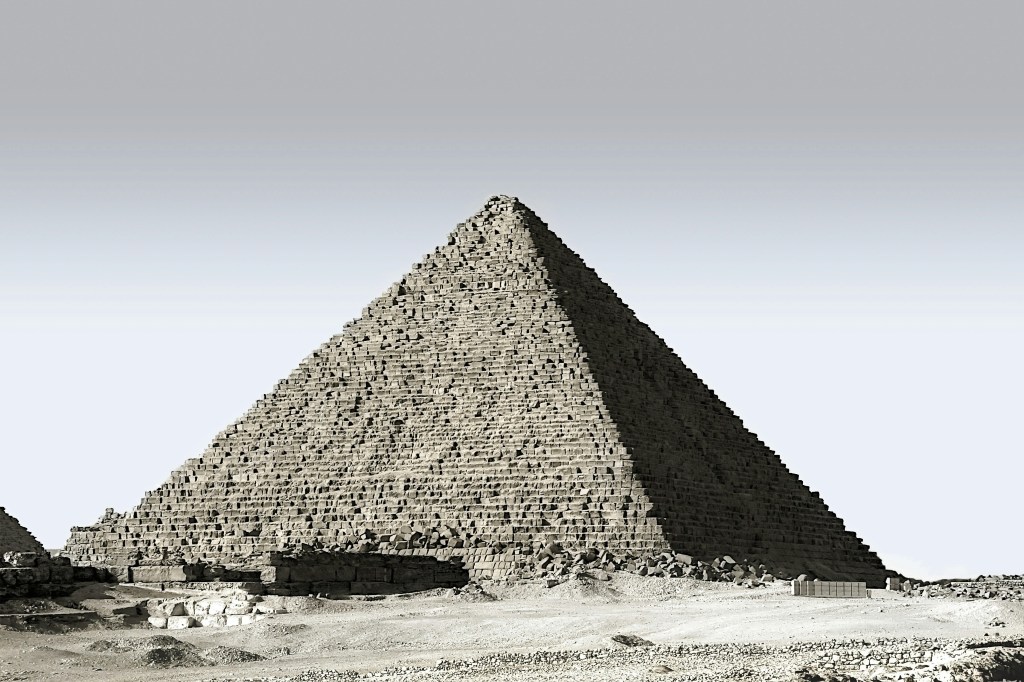
Photo by Simon Berger on Unsplash. The Tower of Babel may have been a ziggurat or a pyramid.

The story of the Tower also tells us that our best efforts will always fall short.  In the story, note that “the LORD came down to see the city and the tower.”  Mankind intended for this tower to reach heaven, but God had to “come down” to see it.  Our best efforts fall way below God’s standards and intention for us.  While we might achieve a lot and take pride in it, but it’s never as good as what God can do for us, and we know that “God opposes the proud but gives grace to the humble.”[3]  Later in history, He would show us that only He, in Christ Jesus, could be the path that gets us to heaven.  There is no other way no matter how hard we try.

Another subtle point from the story is that the materials we decide to work with are never better than what God has already given us.  Babel’s builders “had brick for stone,” meaning the tower was built with manmade bricks, not stones.  We might think of stones as “natural” but really, they’re what God created in the form He created it, and they’re much stronger than bricks.  In the same way, if we follow God’s intention for our lives rather than inventing our own ways, we will find that His ways are better and stronger than anything else available.

Lastly, the tower’s very name, Babel, is a form of “Babylon,” which is a literal city, but also in Revelation 17-18 Babylon represents any society where man attempts to live independently of God.  To seek perfection without Him and by His righteousness.  Revelation also tells us that Babylon will be destroyed, and everything that Babylon represents.

God has given us everything we need to live and to glorify Him today.  Will we use it, or try to go our own way?


[1] Genesis 1:28, Genesis 9:1
[2] Genesis 12:3
[3] James 4:6, 1 Peter 5:5