Confession: The Blessing Nobody Expects

What comes to mind when you think of confession?  Think about it for a moment.

For some, the thought might be a simple private prayer, or for some a confessional booth.  For others, no specific images might come to mind, but just a feeling of someone “out to get you.”  I expect some of you thought of the Spanish Inquisition, or at least the Monty Python skit making fun of it[1].  Where do these ideas come from?

The blame belongs in many places: secular culture, bad experiences with church, an emphasis on external over internal religion, and even Monty Python comedy skits.  My fantasy baseball league even has a team named “Spanish Inquisition” because the manager of that team thinks no one expects him to win – not even himself.

The mocking of secular culture aside, confession is an uncomfortable topic even for sincere Christians.  In Humphrey Carpenter’s biography of J.R.R. Tolkien, he shares the tension over confession between Tolkien and his then-fiancée Edith.  Tolkien was a practicing Catholic, while Edith was a member of the Church of England.  They had agreed as a couple to be Catholic, but Edith “began to dislike making her confession.  It was therefore all too easy when she was worried about her health (which was often) to postpone going to mass. She reported to Ronald [Tolkien] that getting up to go to church early in the morning and fasting until she had made her communion did not agree with her.”  She insisted “my health won’t stand it.”[2]  In my own Protestant church, we have a weekly prayer of confession, which the pastor regularly defends the importance of.  Few of us probably look forward to confession, whatever form we practice it in.
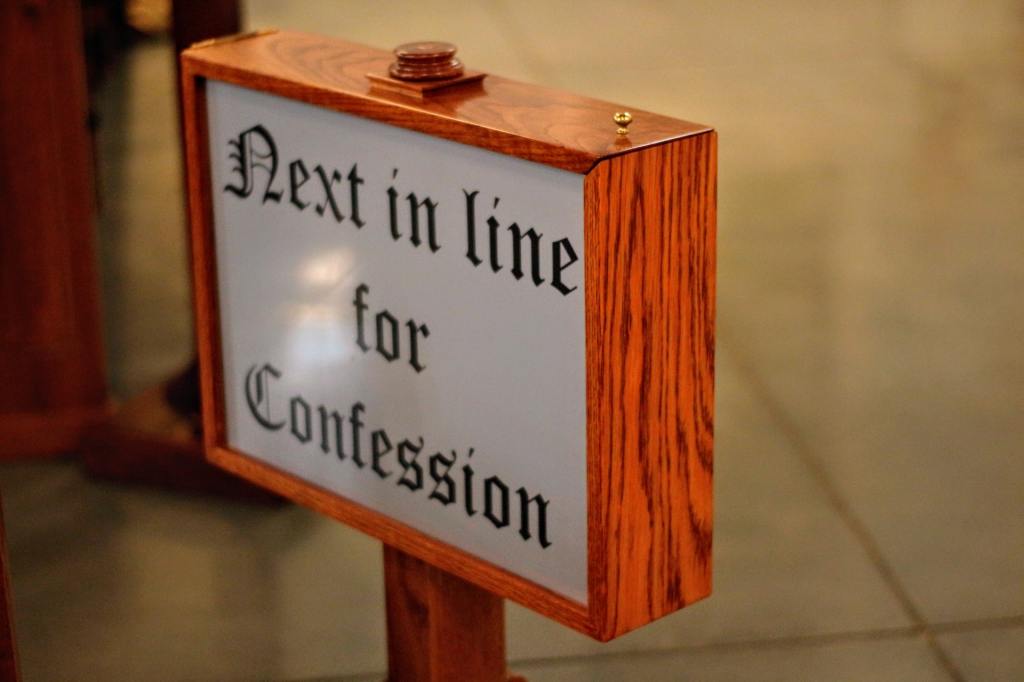
Photo by Shalone Cason on Unsplash

This discomfort with confession seems to be a shared part of mankind’s fallen nature, but if we look at well-known Bible verses on confession, we find that it is really about restoration, a rebirth of man’s relationship with God and a renewal of man to his ideal nature.  It is as different from God being “out to get you” as it could be.  1 John 1:9 encourages confession, because: “If we confess our sins, he is faithful and just to forgive us our sins and to cleanse us from all unrighteousness.”  God wants to give us forgiveness and cleansing, not condemnation and guilt.  Isaiah 1:18 explains this cleansing more poetically:

Come now, let us reason together, says the LORD:
though your sins are like scarlet,
            they shall be as white as snow;
though they are red like crimson,
            they shall become like wool.

Confession doesn’t need to be a dirty word.  The word “confess” means loosely to say the same thing about something, so confession means we agree with God (say the same thing he does) about sin – that it is bad.  But confession also applies to the rest of 1 John 1:9, that God “is faithful and just to forgive us our sins and to cleanse us from all unrighteousness.”  Full confession includes agreeing about the steadfast and dependable character of God, His faithfulness and justice, as well as His desire to forgive and cleanse.  If we doubt this desire, consider what He voluntarily suffered on the cross to provide for this forgiveness, and to demonstrate His enduring love.

By adding confession about the good things of God to our confession of our sin, our confession does not make us miserable about our own condition but shows us how different we are from what God wants for us, how deeply our sin needs to be corrected, and how wonderfully God has provided for the removal of sin.

But this does not come easily.  Referencing Hebrews 4:16, which says, “Let us then with confidence draw near to the throne of grace, that we may receive mercy and find grace to help in time of need,” Puritan preacher Thomas Watson wrote that “Christ went more willingly to the cross than we do to the throne of grace.”

Why is this?  Could it be that we have trouble whole-heartedly confessing that “he is faithful and just to forgive us our sins and to cleanse us from all unrighteousness”?  Monty Python joke that “nobody expects the Spanish Inquisition,” but do we fully expect God’s throne to be one of grace when we come to confess?


[1] If you’re not familiar with the skit, here’s a 4-minute example: https://youtu.be/Cj8n4MfhjUc
[2] Carpenter, Humphrey. Tolkien: A Biography.  (1977).  P. 68-69.

The Difference Between Grace and Mercy

The words “grace” and “mercy” are often used interchangeably, as if they mean the exact same thing.  But what if they’re both used in the same sentence?  For example, the apostle Paul almost always opens his letters to the churches with some version of the phrase “grace and peace,” but in 1 Timothy 1:2 he added “mercy”, writing:

To Timothy, my true child in the faith:
Grace, mercy, and peace from God the Father and Christ Jesus our Lord.

If grace and mercy were the same thing, it would be redundant for Paul to use both words, so they must have different meanings.  Paul uses these two words again later in the chapter, in 1 Timothy 1:13b-14, verses that give a clue to the different meanings:

But I received mercy because I had acted ignorantly in unbelief, and the grace of our Lord overflowed for me with the faith and love that are in Christ Jesus.”

Paul had been writing about how before Christ found him, he was a zealous persecutor of Christians, dragging them to prison and also supervising the stoning of Stephen, one of the church’s first deacons, then “But I received mercy…”.  Paul deserved to be punished for his hate of and actions against Christ’s people, but instead received mercy.

Then he writes that “the grace of our Lord overflowed for me with the faith and love that are in Christ Jesus.”  Here, Paul is receiving something from God – faith and love.  Did Paul deserve these things?  No, but he got them anyway.

Perhaps mercy is when you don’t get a bad thing that you do deserve, and grace is when you do get a good thing that you don’t deserve.  In Christ, we get both grace and mercy.  Paul’s words in 1 Timothy match this description.  By mercy, Paul didn’t get the punishment he deserved for his sins, and by grace Paul did get the faith and love he didn’t deserve.

Therefore, Paul, along with all of us, have 3 things to be thankful for: God’s mercy, and the faith and love that we get by God’s grace.  None of us deserve the “faith and love” God gives us (or it would not be grace), but when we are saved, we all receive these same gifts.  And we get them in place of what we actually deserve.

So, consider what we have received by grace.  Even our faith is a gracious gift – “For by grace you have been saved through faith. And this is not your own doing; it is the gift of God” (Ephesians 2:8).  This faith we receive is enough to save us and reconnect us to God but is not yet a perfect faith that enables us to fully trust God with all of our life decisions.  We receive a love that is part of God’s character and is what we are to give to all people, but not enough for us to love perfectly.  However, when we are reborn in the new heaven and new earth, we will have perfect faith and love.  What a world that will be!

Knowing the difference between grace and mercy gives us more to be thankful to God for, so thank God for both His grace and mercy, and the faith and love that come with them!

When Our Seeds Only Grow Thorns

Sometimes we feel like we’re putting in a lot of effort but getting no results from it.  We’re sowing good seeds but not reaping any harvest.  At times, it seems disappointment is our only reward.  Often this can just be the way things are at the time – we’re doing nothing wrong but it’s just not obvious what God is doing at that time.  We don’t need to change anything.  But there may be times where we’re not reaping good things because we’re deceived that what we’re sowing is what we’re supposed to be sowing.

According to the prophet Jeremiah, the nation of Judah had this problem and as a result they ended up in exile.  In the first half of Jeremiah 12:13, the prophet says of Judah:

They have sown wheat and have reaped thorns;
            they have tired themselves out but profit nothing.

The nation of Judah thought they were sowing good seeds, but they weren’t and there are several examples in Jeremiah’s book.

First, Judah thought they were on the right side politically, with powerful friends and therefore secure.

The nation of Judah allied itself alternately with Egypt and Assyria, who they thought could protect them from Babylon.  Surely these powerful nations could keep Judah from doom at Babylon’s hands.  However, in Jeremiah 3:36 the prophet says:

How much you go about,
            changing your way!
You shall be put to shame by Egypt
            as you were put to shame by Assyria.

Because Judah had trusted these nations, other than God, for their salvation God would put them to shame by His own hand, from which there is no escape.  While there are many good ways to work with others, we should never trust anyone with the help that only God can provide.

Next, Judah thought they had the right cultural heritage.

The people of Judah wouldn’t listen to Jeremiah’s prophesies of doom for the nation because they thought God wouldn’t destroy what they saw as His own nation.  Israel had been taken into captivity by Assyria, but Judah thought it could never happen to them because they were the heirs of Jewish culture.  The people would repeat the phrase, “This is the temple of the LORD, the temple of the LORD, the temple of the LORD,” to remind themselves that they were special because they had the temple, but Jeremiah says in Jeremiah 7:4,

Do not trust in these deceptive words: ‘This is the temple of the LORD, the temple of the LORD, the temple of the LORD.’

The temple was provided as a way to approach God, but Judah thought of it like a magical talisman that would keep God happy so they could do their own thing.  However, God doesn’t want us to follow a checklist – He wants us.  All cultural and political institutions – including ones provided by God – are useless outside of God’s purpose for them.  What He provides He can take away if we abuse it.  When Judah was taken into captivity by Babylon, the temple was torn down and burned.

Last, Judah thought they had the right religion and were diligently practicing it

Judah’s religious leaders and people were diligent in observing the practices laid out in God’s ceremonial law.  They faithfully made the morning and evening sacrifices, observed the three main Jewish festivals, and followed many other ordinances, but in Jeremiah 7:22-23, the prophet said:

For in the day that I brought them out of the land of Egypt, I did not speak to your fathers or command them concerning burnt offerings and sacrifices.  But this command I gave them: ‘Obey my voice, and I will be your God, and you shall be my people. And walk in all the way that I command you, that it may be well with you.’

Because Judah was putting observance above obedience to God, He would therefore discipline them.  The sacrifices were not the objective – the relationship was the objective, but the people made their religion about the sacrifices themselves, not the relationship they were designed to restore.

Do we sometimes practice similar things in the modern church?  Of course we do.

The modern-day equivalent of Judah’s first mistake is when we expect from a political party what only God can give.  Our expectations of them become idolatrous, and we become more likely to compromise God’s principles to support them.  We commit the second mistake when we are convinced our denomination has it all right – the right history, traditions and doctrine – and therefore God will always favor us.  The last mistake happens when we put external religious observances ahead of internal devotion to God.  We may be executing the acts and rituals our religion requires of us, and our peers expect from us, but not giving ourselves fully to God.  We may go to church, but when we leave the church building we don’t take Jesus with us.

Sometimes we think through our political, cultural, and religious activities we should reap wheat, but what is happening when we keep reaping thorns?  Sometimes we need to check that we aren’t repeating Judah’s mistakes.

They have sown wheat and have reaped thorns;
            they have tired themselves out but profit nothing.
They shall be ashamed of their harvests
            because of the fierce anger of the LORD.

Church is Not a Shopping Mall

I recently had a very strange dream, which occurred (kind of) in the church I went to as a kid.  This church, in Washington, D.C., has been around for over 130 years and meets in a stone building and has an amazing pipe organ in the main sanctuary.  The appearance and structure of the church communicates permanence and tradition.

In this dream, I was roughly a teenager on one end of the church building but had to meet up with my family at the other end of the building.  I started out in a place that seemed like the church I knew, but as I travelled to the other end, things got really bizarre.  First, the size of the building seemed to keep expanding and the number of people in it kept multiplying.  Soon I noticed that there was a gift shop selling all sorts of kitsch that had nothing to do with religion.  I kept going in the same direction, trying to find my family, but the building just kept growing as I went, eventually having many levels, with huge moving walkways and escalators.  The dream ended with me still in the church, but this end of it had become a very upscale, very massive, shopping mall.  I remember wondering “how did the church turn into this?”

What to make of this?  Consider what a shopping mall is.  Yes, it’s a large collection of stores in one place, but not a random collection.  Those stores were chosen to be as diverse as possible.  The more of our desires and wants the mall can meet by having different types of stores, the more economically successful the mall will be, and that’s what matters to the mall operator.  People want fancy clothes, jewelry, entertainment, snacks and candy, toys, and many other things.  So, a mall can represent our “do whatever you want” culture.

I wonder if the seed of the dream was something I saw on Twitter a few days before: “There are infinite ways to be non-binary.”  What they were saying is that not only are there not just two genders, but that we can endlessly create new ones with no limit at all.  It’s like a sexual version of the shopping mall, and also a denial that there’s any real right or wrong or that there’s any such thing as an inappropriate desire.  But can we really make ourselves into anything we want to be without consequences?

Consider this: no competent computer engineer would tell us that we can just arrange a diverse group of components any way we want and end up with a working computer.  The engineer isn’t being intolerant or mean, they just know what it takes to make a computer do what it’s supposed to.

Likewise, when Jesus says “Enter by the narrow gate. For the gate is wide and the way is easy that leads to destruction, and those who enter by it are many. For the gate is narrow and the way is hard that leads to life, and those who find it are few,”[1] He is not being intolerant or mean by saying we can’t do whatever we want to, He just knows that we were designed, what we were designed to do, and also what will ultimately satisfy us.

Christian churches are supposed to teach us how to follow Christ, not tell us to do whatever we want to, but now many churches, just like in my dream, have turned into proverbial shopping malls.  In many cases, we’ve forgotten that people are not accidents of random circumstances in nature, and we’ve forgotten that our Creator knows what’s best for us.  We’ve decided to pursue “the way that is easy” forgetting that it “leads to destruction.”  Too many churches, now including the one I went to in DC, say that Jesus will meet whatever needs we think we have, rather than saying that Jesus knows what we need better than we do; that it’s our idea of need that must be changed.

It’s our idea of need
that must be changed

When Jesus said, “For God so loved the world, that he gave his only Son, that whoever believes in him should not perish but have eternal life,” the “world” He loves is the one where we’ve come up with infinite ways to reject Him.  Where we’ve come up with infinite ways to deny that He made us and knows better than us what’s right and wrong, what “leads to life” and what “leads to destruction.”

When God gave His Son, His sacrifice was sufficient for all sin and can cover all the infinite ways we decide to ignore what’s good for us.  Because God loved this world, it’s also true that His people should communicate His love and grace at all times to all people, by word and action.  Yet it’s also true that church is not a shopping mall regardless of what people can imagine in their dreams that it should be.  The church is called to a higher standard of living, a holy standard informed by our Creator’s knowledge of what works.

So, in these troubling times, pray that people will continue to find Jesus, both within and outside the church and what much of it has become.  That God’s people will love holiness, but also love sinners.  Pray that we find the way that is hard but leads to life and that God’s church is a beacon calling people to it.

Amen.


[1] Matthew 7:13-14

The Way of Escape

Reliable knowledge of good and evil is hard to come by, and the wisdom to follow it even harder.  A well-known and oft-quoted Proverb is 1:7, which says:

The fear of the LORD is the beginning of knowledge;
            fools despise wisdom and instruction.

This Proverb tells us that we only gain useful knowledge, wisdom and instruction when we have an attitude of reverent respect for God, and that we are fools if we do otherwise.  Fear of the Lord should be the rudder that guides us through the waves and storms that buffet us in this world.  Every decision we make should have as its foundation: does this honor God?  No other foundation is good enough for our lives to rest upon.

What’s left unsaid here in Proverbs is that we can’t expect this to come easy.  We are constantly tempted to not fear the Lord in our minute-by-minute, hour-by-hour, and day-by-day decisions.  It’s hard, and not just because we aren’t perfect.

Photo by Nathan Dumlao on Unsplash

In the account of the serpent’s confrontation with Eve in the garden in Genesis 3, the serpent’s whole objective was to get Eve to make one decision that wasn’t based on fear of the Lord.  “He said to the woman, “Did God actually say, ‘You shall not eat of any tree in the garden’?”[1]  “The serpent said to the woman, ‘You will not surely die.’[2]  Eventually he wore her down and she ate from the tree God told her not to eat from, all because her reverence for God had been worn down by constant criticism of God by the serpent.  He wanted her to decide for any reason other than the fear of the Lord, to become a fool, and thus bring down humanity.

When we make decisions, are we always being guided by the fear of the Lord, or do we sometimes think “He didn’t really mean that”?  If you’re like me, you find yourself constantly confronted by influences that oppose God.  Are we foolish when we follow these influences?  Yes.  Do we do it anyway?  Yes.  Could there be a hostile spiritual influence pulling us in that direction?  Sure, but it could also just be our own broken wills, prone to go our own way.

However, in 1 Corinthians 10:13, Paul assures us that “No temptation has overtaken you that is not common to man. God is faithful, and he will not let you be tempted beyond your ability, but with the temptation he will also provide the way of escape, that you may be able to endure it.”  And if we fear the Lord, we will believe it.

If we fear the Lord, when we’re tempted, we will know that “he will also provide the way of escape.”  We need to look for it and pray for it until we find it.  When we do, God will remain in the driving seat of our decisions and knowledge and wisdom will be ours.  He can overcome any of our temptations if we let Him and we fear Him.

Let the fear of the Lord be your guide.  There is always a “way of escape.


[1] Genesis 3:1b
[2] Genesis 3:4