Sodom and Gomorrah’s Selfishness

Fellow travelers,

The story of Sodom and Gomorrah from the book of Genesis is well-known even to many who aren’t religious.  Genesis 18 and 19 describe the two cities as extremely wicked, specifically mentioning homosexuality and rape.  The English term “sodomy” even comes from the name of the city of Sodom.  In the Genesis story, Lot and some of his family escape based on Abraham pleading with God for them, “Then the LORD rained on Sodom and Gomorrah sulfur and fire from the LORD out of heaven.  And he overthrew those cities, and all the valley, and all the inhabitants of the cities, and what grew on the ground.”  (Genesis 19:24-25).  This is the most well-known part of the story, and some explanations of why the cities were destroyed found on the internet and elsewhere say Genesis has the “full account” of the story.  Sodom and Gomorrah were destroyed for their excessive sexual sins.

However, there is more.

Ezekiel, a prophet to Jews captive in Babylon centuries after Sodom was destroyed, said: “Behold, this was the guilt of your sister Sodom: she and her daughters had pride, excess of food, and prosperous ease, but did not aid the poor and needy.  They were haughty and did an abomination before me. So I removed them, when I saw it.”  (Ezekiel 16:49-50). Ezekiel was describing the sins of Judah to explain why they had been sent into exile from their Promised Land and said they don’t compare favorably even to Sodom.  Surprisingly, Ezekiel doesn’t even mention any sexual sins in this description.  Not that these sins were irrelevant, but in Ezekiel’s view, Sodom would have been destroyed even without them.  Sodom’s other sins were also abominations.

What’s the point?  I can’t say it any better than the Life Application Study Bible, which notes on Ezekiel 16:49: “Sodom was destroyed because of its pride, laziness, gluttony, and unconcern for the poor and needy. It is easy to be selective in what we consider gross sin. If we do not commit such horrible sins as adultery, homosexuality, stealing, and murder, we may think we are living good enough lives.”

We can’t pick and choose which sins are more or less deserving of God’s judgement, because in His holiness and justice, He must and will judge all sin.  While “lifestyle” sins without repentance may be more dangerous to a church or congregation, even sins we may not consider extreme are dangerous as well.  Ezekiel’s point is that selfishness and a disregard for those in need should be repented of as much as any other sin.  Ezekiel wrote, “Behold, this was the guilt of your sister Sodom: she and her daughters had pride, excess of food, and prosperous ease, but did not aid the poor and needy.  They were haughty and did an abomination before me. So I removed them, when I saw it,” but he also wrote that Judah would be restored by a coming Messiah, the Christ.

That restoration comes through Christ’s sacrifice for all sins, and anyone can have salvation through faith, which drives us to confession and repentance.  As John wrote in 1 John 1:8-10, “If we say we have no sin, we deceive ourselves, and the truth is not in us.  If we confess our sins, he is faithful and just to forgive us our sins and to cleanse us from all unrighteousness.  If we say we have not sinned, we make him a liar, and his word is not in us.”

At the end of our journey, all of God’s people will be cleansed of all of their sins, not just the most noticeable ones, because “he is faithful.”  Not because any of us are less sinful than others.

Your Family is More Important Than Your Furniture – Songs of Ascent #4

A prominent feature of the culture I live in is the demand that everyone must respect the “individualism” of everyone else.  Pressure to affirm whatever anyone else wants affirmed about them has ballooned all over the news, social media, corporate policy, and even in churches.  There’s an assumption built into this, which is that the sincere ability to love someone can be the result of someone else threatening us to do it.  Exert enough legal, social, cultural, or even physical pressure and someone’s fundamental nature can be changed by coercion.  The coal turns into a diamond.

Tomorrow is Sunday, so today we return to the Songs of Ascent, a liturgy used in ancient Israel to prepare for worship at the annual festivals in Jerusalem.  What does this have to do with the last paragraph?  In Psalm 120, the first Song of Ascent, we read (post here) that no matter where we live, or where we come from, no matter our genealogy, we live among people with “lying lips” who can’t get along with each other.  In Psalm 121, we are encouraged to find the answer outside of our current place:

A Song of Ascents.

I lift up my eyes to the hills.
            From where does my help come?
My help comes from the LORD,
            who made heaven and earth.

He will not let your foot be moved;
            he who keeps you will not slumber.
Behold, he who keeps Israel
            will neither slumber nor sleep.

The LORD is your keeper;
            the LORD is your shade on your right hand.
The sun shall not strike you by day,
            nor the moon by night.

The LORD will keep you from all evil;
            he will keep your life.
The LORD will keep
            your going out and your coming in
            from this time forth and forevermore.

The Psalm asks us to take our eyes off of the world around us and look upward for our hope.  Not just talk about the idea of it, but to actually do it.  To turn off the outside world and its circumstances and seek God’s help.  It takes effort because the idea that we can solve our own problems is so powerful.  The fall of Adam and Eve was driven by a curiosity that there may be a better system than the one they already had.  In a literally perfect society, they wanted something else.  If we aren’t intentional about avoiding this trap, it’s easy to not realize we are in it.

We’re All Messed Up
I’ve written much about Tyler Joseph, the songwriter of the band twenty øne piløts, and his campaign to create music and stories that help people deal with mental illness.  In an interview years ago, the interviewer criticized Tyler for calling himself “messed up.”  Was Tyler being too hard on himself?  This was Tyler’s response:

“I know I’m messed up. I think to myself I should be able to control myself.  I look at a lamp and I decide that I’m going to stand up and not hit that lamp. Why can’t I make decisions like that about everything in life. I’m not going to get angry at my brother. I want to be the best brother. Why can’t I do what I want to do? That’s messed up. Something is broken in the way we live. It’s proof that something is not right.”

Tyler is explaining Romans 7:13-21, especially verses 15 and 21, but in a way that’s as plain as day to anyone being honest with themselves.  Romans 7:15 and 21 say: “For I do not understand my own actions. For I do not do what I want, but I do the very thing I hate.”  And “So I find it to be a law that when I want to do right, evil lies close at hand.”

What if the problem with every person individually is that they are unable, no matter how much external pressure is put on them, to treat other individuals the way they should be treated? If true, it puts the first paragraph into an entirely different light.

In this exact moment as I write this, I’m being very careful not to spill my drink on my laptop.  I have no desire to do anything violent to the couch I’m sitting on but just to enjoy having a place to sit.  If I stop writing to check something on my phone, I make sure I put it down gently in a spot where it won’t fall off and hit the floor.  But at the same time, I know I don’t always treat people with the same respect.  I know if I’m interrupted in the middle of what I think is a great thought or phrase I could get irritated and rude.  Not always, but I could.  I know I could be a better son, husband, father, employee, and friend.  So why don’t I?

Why do we treat our furniture better than our family, even in a culture that increasingly demands with all its strength that we prioritize every individual?  Because we are broken in a way that no political or economic system, no culture or tradition, can fix.  One may be better or worse than another, but none of them has the power to solve the real problem that we can’t consistently love people more than we love our furniture.  We have to go somewhere else to find the answer.

Therefore,
“I lift up my eyes to the hills.
            From where does my help come?
My help comes from the LORD,
            who made heaven and earth.”

As pilgrims traveling to Jerusalem, the Israelites were telling a story by making the effort to move.  A story that the towns they leave behind – no matter where they are coming from – don’t have the answer to their most important problems.  On the long journey, they travelled in large groups and slowly, sometimes by foot.  They probably had constant reminders of their own inability to treat the family they traveled with better than whatever furniture or baggage they brought along for the trip. While togetherness is sometimes uncomfortable, together we must lift up our eyes and look for the answer outside of everything we know.

We’re broken and can’t fix ourselves, but “The LORD will keep you from all evil; He will keep your life.”  Take some time out of your week and each day to look up to the hills and seek Him.  To set aside everything else.  To focus on the LORD, because He alone loves us in the way we need to be loved and can help us love others the way they need to be loved.  He won’t seek to break you to make you do it, but He Himself was broken to provide us a way.

A Psalm of God’s Strength and Power

The Bible software I use (Accordance) has the ability to highlight text, but so far I’ve only used it once, for Psalm 21.  In just 13 verses, David wrote “you” or “your” 25 times, referring to God as the source of his success and blessings, past, present, and future.  The short 13 verses of Psalm 21 provide a plethora of praises we can offer to confess that God is powerful, faithful and just.  Here is the entire Psalm, and I’ve bolded all the “you”s and “your”s, which I highlighted in Accordance:

“To the choirmaster. A Psalm of David.

O LORD, in your strength the king rejoices,
            and in your salvation how greatly he exults!
You have given him his heart’s desire
            and have not withheld the request of his lips. Selah
For you meet him with rich blessings;
            you set a crown of fine gold upon his head.
He asked life of you; you gave it to him,
            length of days forever and ever.
His glory is great through your salvation;
            splendor and majesty you bestow on him.
For you make him most blessed forever;
            you make him glad with the joy of your presence.
For the king trusts in the LORD,
            and through the steadfast love of the Most High he shall not be moved.

Your hand will find out all your enemies;
            your right hand will find out those who hate you.
You will make them as a blazing oven
            when you appear.
The LORD will swallow them up in his wrath,
            and fire will consume them.
You will destroy their descendants from the earth,
            and their offspring from among the children of man.
Though they plan evil against you,
            though they devise mischief, they will not succeed.
For you will put them to flight;
            you will aim at their faces with your bows.

Be exalted, O LORD, in your strength!
            We will sing and praise your power.”

What statements did you focus on while reading this?  Did you take the time to think about all 25 “you” statements (and the rest of the Psalm)?  Read it again.

The first section in this Psalm describes how our God is “faithful” in some ways, and the second describes “just.”  The first may come easier, with David giving God credit for all of his strength and success, but the middle section on justice may come across as harsh and harder to swallow.  However, it reminds us that only He knows for sure who His (and our) enemies are.  “Your hand will find out all your enemies.”  Only He determines the fates of others, including some who look like enemies now, but will come to faith in Him later.  With any enemy we can “wait upon the Lord”, as David often urges us, knowing God will either save them, or their plans will come to ruin by His design.

Yet, for those in Christ, “he is faithful and just to forgive us our sins and to cleanse us from all unrighteousness.”  Therefore, we echo David:

“Be exalted, O LORD, in your strength!
            We will sing and praise your power.”

We’re All Little Pharaohs

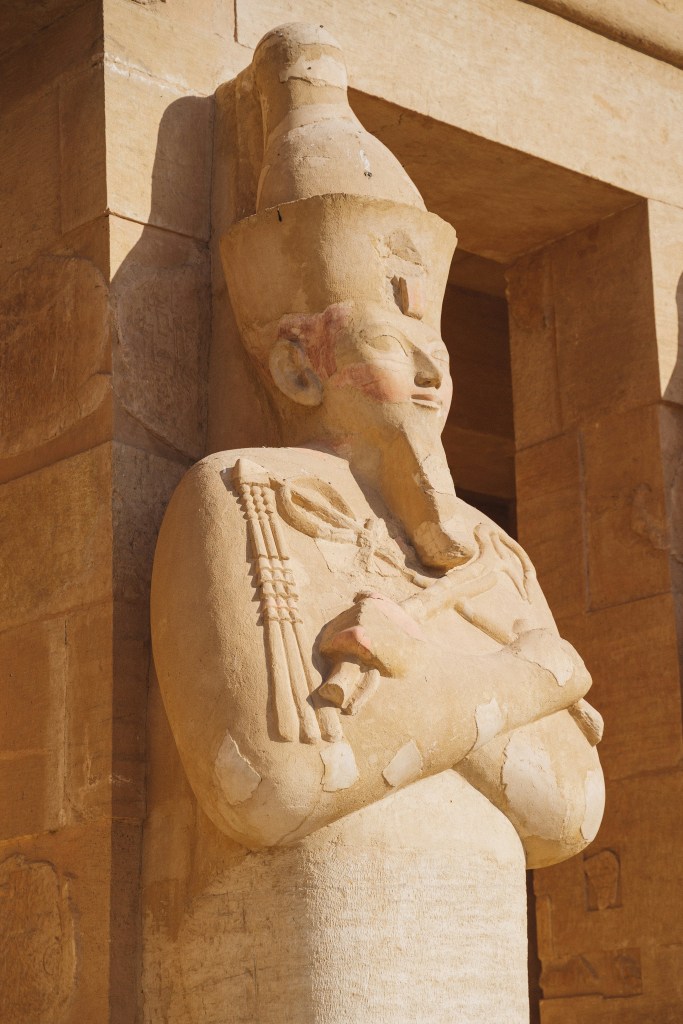
Anyone who knows the story of the Exodus knows who the bad guy is: Pharaoh.  As the leader of Egypt, he is primarily to blame for the enslavement of Israel.  Eventually, through Moses and Aaron, God tells Pharaoh to free the Israelites from slavery, and time and again Pharaoh refuses.  Clearly, Pharaoh is God’s enemy.  However, in his resistance to God, I think Pharaoh fell into some habits any of us could fall into.

First, Pharaoh admitted his need for God only when things were going wrong but shut God out when things were going well.  In Exodus 8:8, Pharaoh asked Moses to “Plead with the LORD to take away the frogs from me and from my people” but once the frogs were gone, Exodus 8:15 tells us that “when Pharaoh saw that there was a respite, he hardened his heart” and refused to do God’s will.  The same thing happens in chapter 9, during the plague of the hail.  Seeing the destruction caused by the hail, Pharaoh says “Plead with the LORD, for there has been enough of God’s thunder and hail” in verse 28, but in verse 34, “when Pharaoh saw that the rain and the hail and the thunder had ceased, he sinned yet again and hardened his heart.

Photo by Alex Azabache on Unsplash

Next, Pharaoh repeatedly negotiated with God to define the scope of His influence.  Faced with the plague of flies, Pharoah said to Moses and Aaron “Go, sacrifice to your God within the land.”[1]  But staying “in the land” was not what God wanted His people to do.  In response to the plague of locusts, Pharoah said “the men among you” could leave and worship God, but he wouldn’t let the “little ones[2] go.  Also, after the plague of darkness, Pharoah said “Go, serve the LORD; your little ones also may go with you; only let your flocks and your herds remain behind.”[3]  In these 3 responses, Pharaoh insisted on limits to where the people should worship, which people should worship, and what they could (and couldn’t) use in worship.

Third, Pharaoh also tried to limit the scope of his own sin, and which sins he would be accountable to God for.  In Exodus 9:27, Pharaoh said, “this time I have sinned” and in 10:17 said “forgive my sin, please, only this once.”  In reality Pharaoh was sinning every time he refused to listen to God, but he wasn’t willing to admit that.  He only admitted a minority of the times he disobeyed.

If you’re like me, this all might sound familiar.  Often our prayers are more fervent and sincere when we need help than they are when we have something to praise God for, or when times are good.  Often, we allow God to govern some parts of our life, but we keep other parts for ourselves, to do what we want with.  Also, we often only admit some of our sins and choose which ones to care about.  We’re all a bit like Pharaoh, the bad guy in the Exodus story.

Fortunately for us, we have something else in common with Pharaoh: the true, Almighty God will defeat all of the “gods” we follow.  Every single one.  Behind the battle between Moses and Pharaoh was a contest between our God and Pharaoh’s gods.  As the Life Application Study Bible notes: “As each gloomy plague descended upon the land, the Egyptian people realized how powerless their own gods were to stop it. Hapi, the god of the Nile River, could not prevent the waters from turning to blood. Hathor, the crafty cow-goddess, was helpless as Egyptian livestock died in droves. Amon-Re, the sun-god and chief of the Egyptian gods, could not stop an eerie darkness from covering the land for three full days.”

When we choose not to obey God, we harden our hearts against Him and follow the “gods” we choose for ourselves, but God will ultimately defeat them all.  God’s purpose in saving us is to deliver us from all other gods, as He delivered Israel from Egypt.  He will deliver us from our slavery to every sin that binds us and make us not follow Him wholeheartedly.

We may be more like Pharaoh than we’d like to admit, but the Pharaoh in us has been killed, nailed to the cross with Jesus. When we reach heaven, all of our other “gods” will be gone and we will be perfected in our obedience to the one, true God, for our good and for His glory!

That’s a deliverance worth looking forward to and praising God for!

Amen.


[1] Exodus 8:25
[2] Exodus 10:10-11
[3] Exodus 10:24

There’s a Place for Us – Psalms of Ascent #3

Fellow travelers,

Today we come back to a weekly series on the Psalms of Ascent, a group of 15 Psalms used as a liturgy for Jews in ancient Israel traveling to Jerusalem for feasts.  Previously I wrote: “To today’s Christian, the Psalms of Ascent remind us not only of our need for salvation apart from law, but they prepare us to regularly contemplate His provision to accomplish that salvation.”  Psalm 119 praises God’s law, but the following Psalms let us know that the law cannot deliver salvation.

The first Psalm of Ascent, Psalm 120, picks up from verse 136 of Psalm 119: “My eyes shed streams of tears, because people do not keep your law,” but it also starts where the pilgrimage starts geographically.  The full Psalm 120 is:

“A Song of Ascents.

In my distress I called to the LORD,
            and he answered me.
Deliver me, O LORD,
            from lying lips,
            from a deceitful tongue.

What shall be given to you,
            and what more shall be done to you,
            you deceitful tongue?
A warrior’s sharp arrows,
            with glowing coals of the broom tree!

Woe to me, that I sojourn in Meshech,
            that I dwell among the tents of Kedar!
Too long have I had my dwelling
            among those who hate peace.
I am for peace,
            but when I speak, they are for war!”

Each person traveling to Jerusalem came from a different place.  Meshech was in the far north; Kedar in the far southeast.  The Psalmist does not live in either place, but the picture is that the same problems exist everywhere.  Everyone lives among people with lying lips, a deceitful tongue, and who hate peace.  Each of us in our own way are such people.  In verse 3 the Psalmist is frustrated about what to do about this: “what more shall be done to you, you deceitful tongue?”  The next verse says that force or coercion won’t solve the problem.  It must be solved internally because mankind is fundamentally broken.  Society isn’t the cause of the problem, but an outcome of the problem, and we are frustrated with it.

However, those following the familiar liturgy of these Psalms would know that this frustration is only the beginning of their preparation to worship in Jerusalem.  The place we all live – this entire creation – is groaning for a solution, a way out, and struggling to find it.  All of mankind is in this boat together, but we’re “gonna need a bigger boat.”  The pilgrimage begins with knowing we have a need that we can’t satisfy ourselves.

On their days- or weeks-long journeys to Jerusalem these pilgrims had to bring the baggage from their home lives with them – literally and figuratively.  They certainly lied to and fought with each other on the way.  The trip lasted too long for them to pretend.  Their baggage was visible to all, and they couldn’t make the trip without it.  But they went.  In today’s church, do we go to a place that is full of “good” people, however we define that?  No, we go to a place with people just like us.  We begin as sinners among sinners, from Meshech to Kedar, but we long for a better place.

If you are in distress, call out to the LORD for a place of peace, not just for eternity but for your journey to it.  The church is “called out” to both places.  The journey is worth it.

Coda
The title of this post, if you haven’t already guessed, comes from the musical West Side Story.  The song is about the love between Tony and Maria, members of rival ethnic groups that insist on fighting even though they aren’t sure why.  Therefore, Tony and Maria long for a place where the world’s hate doesn’t tear them apart.

In more ways than one, the sentiments of the song echo the last verses of today’s Psalm:

“Too long have I had my dwelling among those who hate peace.
I am for peace, but when I speak, they are for war!”

Here is the song from the 1961 West Side Story film:


This post continues a series on the Psalms of Ascent. To start at the beginning, click here, and for the next post click here.