
The Value of Work: A Quint of Quotes

Dear fellow travelers,

Here is another “Quint of Quotes” from my collection on the theme of work:

“We make a living by what we get, but we make a life by what we give.” – Winston Churchill

Photo by Taya Kucherova on Unsplash

“God is more concerned about His workers than He is about their work, for if the workers are what they ought to be, the work will be what it ought to be.” – Warren Wiersbe

“The Christian shoemaker does his duty not by putting little crosses on the shoes, but by making good shoes, because God is interested in good craftsmanship” – Martin Luther

“A holy life will produce the deepest impression. Lighthouses blow no horns; they only shine.” – D. L. Moody

“Whatever you do, work heartily, as for the Lord and not for men, knowing that from the Lord you will receive the inheritance as your reward.  You are serving the Lord Christ.” – Colossians 3:23-24

Manning the Watchtower

 “I will take my stand at my watchpost
            and station myself on the tower,
and look out to see what he will say to me,
            and what I will answer concerning my complaint.” – Habakkuk 2:1

Photo by Casey Olsen on Unsplash

People like to look for patterns and predictability in the world, and even in God’s behavior.  But in Habakkuk’s case, he saw a situation that didn’t make sense to him, that God would use Babylon to brutally punish His people in Judah.  God knew it wouldn’t make sense to Habakkuk, saying “I am doing a work in your days that you would not believe if told.[1]

Habakkuk would have gone into a private corner to sulk, but instead he brought it to God and was willing to be patient and wait to see how He would answer.

Is there something that doesn’t make sense right now in your life?  In my experience, there almost always is.  Therefore, be as vigilant and patient as Habakkuk.  Take your place in watchful hope on the watchtower and see what God will do.


[1] Habakkuk 1:5b

The Queen of Sheba’s Example

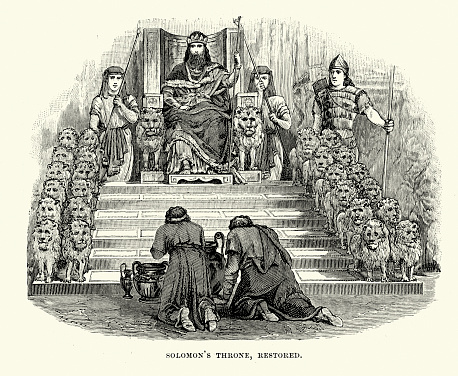
King Solomon, son of Israel’s greatest king David, was also a famous and renowned king.  God asked Solomon what he wanted, and Solomon asked for wisdom to rule the people. In addition, the Lord also gave him “riches and honor, so that no other king shall compare with you, all your days.[1]  His rule was likely the high point of Israel’s kingdom in terms of wealth.  Surely Solomon was bound to draw the attention of other nations and their rulers.

One such ruler is the Queen of Sheba, and we learn about her visit to Solomon in 1 Kings 10.  Sheba was apparently “Sabea,” far away from Jerusalem in southwestern Arabia.  Visiting Solomon was a long and difficult trip for her, especially since she brought many people and gifts along.  Why did she bother?  She came because of reports she had heard of Solomon’s wealth, but also of his wisdom.  1 Kings 10:1 says “she came to test him with hard questions” to see if he was as wise as the reports said.  Solomon answered all of her questions, and she responded that “Your wisdom and prosperity surpass the report that I heard.”[2]

Like the Queen of Sheba, we also hear reports of a King of Israel who surpasses all in wisdom: God Himself.  But like the Queen, do we put as much effort into learning about this King?  She traveled for days, maybe weeks, in order to meet Solomon in person.  Do we set aside enough time to really get to know our King?  Do we engage Him in tough conversations about our lives, testing Him with the hard questions we have?  Or do we keep Him at a distance because we’re not sure how He is relevant for our lives?

Solomon’s father, King David, wrote in Psalm 34:8 –

Oh, taste and see that the LORD is good!
            Blessed is the man who takes refuge in him!

David’s words don’t tell us to sit back and passively learn about God; they tell us to “taste” of God to see that He is “good.”  God does not shower us with blessing upon blessing trying to convince us that He is good while we selfishly go about our lives.   We must learn that He is good by trusting Him and learning to walk with Him.  We turn to Him by learning that repentance is a good thing.  That He is a God worthy of our attention.

When the Queen of Sheba became convinced that Solomon was a good and wise king, in 1 Kings 10:9 she proclaimed:

Blessed be the LORD your God, who has delighted in you and set you on the throne of Israel! Because the LORD loved Israel forever, he has made you king, that you may execute justice and righteousness.

Think of how much more blessed we are to have a King who is infinitely wiser and greater than Solomon!  Learning more of Solomon caused the Queen to burst forth in praise for God, who loved Israel enough to give them a king that will “execute justice and righteousness.”  God still loves His people and has given them a King, our Lord Jesus, who will “execute justice and righteousness” perfectly and for eternity. James 4:8 tells us to “Draw near to God, and he will draw near to you.” 

Even if it requires taking a long, difficult trip, like the Queen of Sheba’s.  He is worth the effort.


[1] 1 Kings 3:13
[2] 1 Kings 10:7

Only God Has Tamed the Tongue

In many Psalms, the authors complain about the evils in the world and compare them with God and His perfect attributes.  Psalm 12 is one of these, and begins with David lamenting the ungodliness he sees in the world in the first verse:

Save, O LORD, for the godly one is gone;
            for the faithful have vanished from among the children of man.”

What is David so upset about?  James 3:7-8 tells us: “For every kind of beast and bird, of reptile and sea creature, can be tamed and has been tamed by mankind, but no human being can tame the tongue. It is a restless evil, full of deadly poison.”  David is upset by people’s inability to “tame the tongue,” which he describes in verses 2 through 4:

Everyone utters lies to his neighbor;
            with flattering lips and a double heart they speak.
May the LORD cut off all flattering lips,
            the tongue that makes great boasts,
those who say, ‘With our tongue we will prevail,
            our lips are with us; who is master over us?’”

David says the words of the unfaithful are lies, flattering, duplicitous, boasting, proud, and rebellious.  These adjectives also describe much of what we see and hear today, and if we’re honest, much of what we say.  How often do we say things just because they came to mind?  And if they are bad things, but we get away with it or get something we want from it, are we emboldened to continue?  After all, “no human being can tame the tongue.”

There is One, however, who has tamed the tongue.  David contrasts His words with ours in verses 6 and 7:

The words of the LORD are pure words,
            like silver refined in a furnace on the ground,
            purified seven times.
You, O LORD, will keep them;
            you will guard us from this generation forever.”

These words are pure, refined, purified, kept, and preserved.  The number seven in the Bible is often used to indicate perfection, so if His words are “purified seven times”, they are perfectly considered and constructed before they are delivered to us.  God keeps all His promises, and His word never expires.

Even when the world is full of people who speak ungodly words, the Lord’s words are pure and can be trusted. Because of this we know He will “guard us from this generation forever.”  Someday our words will be like His words.

Amen

Faith is Not a Democracy

In our lives, there are many “voices” that try to influence us, from the people we know, to the things we read, to all the messages in our culture, and beyond.  These may not be literal voices in our heads, but all of these influences affect our inner dialogue and compete to make us act in certain ways.  Often, we don’t know why we do what we do or feel the way we feel, but chances are we got the idea from somewhere.

For Christians, one of those voices in our minds is God, guiding us in the perfect way to go by His Spirit, but we often let the other voices overrule Him.  This can be especially easy to do when He’s telling us to do something that seems strange to us.  One example is from ancient Israel, when the sins of the nation resulted in God passing sentence on the people, in the form of conquest by, and exile to, Babylon.

Once God had made up His mind, the result was inevitable and God, through His prophets, told His people to submit to Nebuchadnezzar king of Babylon.  Israel was not to follow all the customs of Babylon, or commands from its king[1], but Israel was supposed to submit to Babylon as long as it didn’t make them disobey God.  In this message, His prophets were often lonely voices among many speaking to Israel.  Jeremiah was one of these, and he had to remind the people about whose voice mattered, in Jeremiah 27:8-9.

if any nation or kingdom will not serve this Nebuchadnezzar king of Babylon, and put its neck under the yoke of the king of Babylon, I will punish that nation with the sword, with famine, and with pestilence, declares the LORD, until I have consumed it by his hand. 9 So do not listen to your prophets, your diviners, your dreamers, your fortune-tellers, or your sorcerers, who are saying to you, ‘You shall not serve the king of Babylon.’

I bolded all the different groups of people who were competing to influence Israel.  These were the many voices Jeremiah had to compete with for the people’s attention, and there were perhaps dozens or even hundreds of them.  If people took opinion polls in those days, God’s word would have barely registered in the results.[2]

Also note that these people were “your” (Israel’s) messengers, not God’s.  These people were telling Israel what they wanted to say and to hear, not what God wanted them to hear.  In modern times, this might be like news networks and celebrities saying only what is popular to say or to believe.  Sadly, this also includes many Christians, even preachers, acting as messengers of our own culture’s values rather than as messengers carrying God’s word.

However, the lesson from the Jeremiah passage above is that God does not care about polling data, and He doesn’t want us to care about it either.  Even if many, or even all other, voices contradict God, He is still right.  Christians need to discern between the many influences inside and outside of us and find the ones that are coming from our Lord.  Even if He is telling us to do something strange, like submit to His judgement under a foreign king.

Paul warned his protégé Timothy and he warns us as well: “For the time is coming when people will not endure sound teaching, but having itching ears they will accumulate for themselves teachers to suit their own passions, and will turn away from listening to the truth and wander off into myths.”[3]  These teachers are our modern “prophets, … diviners, … dreamers, … fortune-tellers, or … sorcerers” who seek influence over us.  They may be pastors and teachers, but they can also be the news channels we choose to watch, the politicians we support, the celebrities we emulate, subtle messages in our culture like advertising, things we learn in school or at work, or simply what’s popular at the time.  But only one voice matters and there is only one that deserves our absolute faith – God – no matter how many others vote against Him.

Our actions should not be ruled by a democracy, but by our King.  Be careful who you listen to.


[1] See the book of Daniel for some examples.
[2] Read the story of the prophet Micaiah in 1 Kings 22 for more about how outnumbered God’s true prophets were.
[3] 2 Timothy 4:3-4