Rewind Wednesday: The Song Behind the Blog

Fellow travelers,

With the blog now in year 2, I’ve added Rewind Wednesdays – a look back at older posts.  The first Rewind revisited the first post, and this one, originally posted 3 months later, picks up from a footnote in that first post.  My two teenage kids and I both love the band twenty øne piløts, and this post looks at their song “Taxi Cab” and how it creatively weaves the story of the gospel into its lyrics.  “Driving Toward the Morning Sun (Part 1)” explains some of my reasons for blogging, the name of the blog, and the importance of both truth and tone in writing. Even in sharing the gospel, we should obey the gospel.

More “Rewind Wednesday” to come!

(Estimated reading time 6 minutes, more if you listen to the song)

Rewind Wednesday: 42 is Not the Answer

Last week, the blog celebrated its one-year anniversary and in year two I plan to recycle some old posts.  Why not start with the very first post? The post is linked at the bottom.

“42 is Not the Answer” was first posted on May 20, 2021 and is still my most-viewed post ever.  Re-reading it now before sharing it again, I thought:

  • Wow – I tried to pack way too much in there!  What’s the saying – “To write is human; to edit is divine”?
  • There are some elements of it I thought would be in every post afterward, such as starting with two verses, that I’ve dropped.
  • The “Future” ideas I listed at the end are still largely unwritten.

On the positive side:

  • It is still encouraging for me to read it.
  • It was accurate about what the blog would be about.
  • It got me started, which was the hardest thing to do at the time, and I’m still here, writing.  The blog is still giving me an outlet for creativity in a way that helps me grow spiritually and is an encouragement to others.

More “Rewind Wednesday” to come!

(Estimated reading time 10 minutes)

Finding Port for the Good Ship Ambivalent

From yesterday’s post, you’ll know I am reading King’s X: The Oral History, a book chronicling the history of the rock band King’s X, by Greg Prato.  Yesterday, I dove into one of their more bizarre and unknown songs, but today is about the band’s biggest hit.  “It’s Love” got to “#6 on Billboard’s Mainstream Rock charts and #1 on the FM Radio Airplay charts. It was our highest-ranking single, ever,”[1] according to Ty Tabor, the band’s guitarist and sometimes lead singer, who wrote the song.

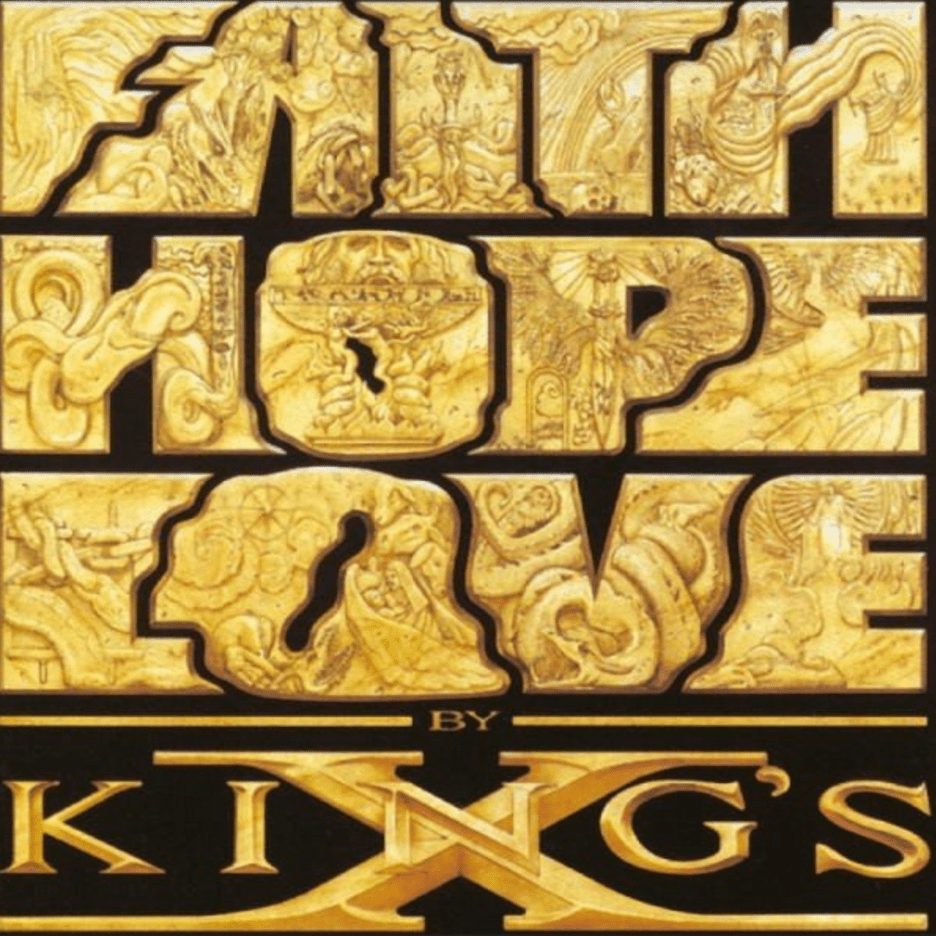
I knew both Christianity and King’s X by reputation before becoming a true fan of either, but both were growing at the same time in me during college.  Having heard of King’s X but never actually heard their music, I once saw one of their CDs in a friend’s dorm room.  My friend said it was his roommate’s but that he wasn’t much of a fan.  Before leaving I picked up the CD and looked at it.  The album, called “Faith, Hope, Love” had a cool cover, and included the song “It’s Love.”

Album cover of “Faith Hope Love” by King’s X

Later, the memory of that album cover made the triad of faith, hope, and love jump out at me whenever I saw it in the Bible, including 1 Corinthians 13:13, which says: “So now faith, hope, and love abide, these three; but the greatest of these is love.”  This triad is all over the place and there are many verses explaining the relationships between them.  Seeing these references also made me come back to the band and give them a listen. The rest, as they say, is history.

Before getting into “It’s Love”, you can find the lyrics here, or listen to the song here.  I promise it’s an easier one to listen to than “Six Broken Soldiers” and also that this post will be shorter than yesterdays.

Overall, the message is fairly simple: Ty says he doesn’t know everything, but the thing he wants to share from his experience is that love is the most important thing in life.  Love both keeps the world from falling apart (“holding back the weather”), but also eventually love is what requires a loving God to bring about a plan to fix what’s wrong with the world (“the same will let it go”).

But there’s one line in the song I didn’t really get until reading about it recently: “There’s a ship on the ocean, and I can’t decide if I like it.”

There Ty is, enjoying good company, the beach, and the ocean, but he wasn’t sure about the ship on the ocean.  There’s an ambivalence about the ship, and a suggestion that maybe it’s an exception to the overall message of “love,” but I couldn’t figure out more than that.  I wasn’t alone in not getting it.

In the book, Ty says his brother didn’t understand the line, so he explained: “my point was, man’s progress is wonderful and everything, but when the ship turns over and poisons all the fish, that’s not so wonderful. So, it was me contemplating all that we do and all that I’m happy with about it, but how much destruction it causes. It’s yet again one of those socially conscious songs. I just had to say it.”[2]  It was almost that Ty was struggling with whether love applied when someone does something that “poisons all the fish.”  In tricky, real-life situations, does love still rule?  Ty doesn’t seem sure.

Contemplating What is Crooked
Yesterday I quoted Romans about Paul’s inner conflict, but later in the same chapter, Paul wrote: “So I find it to be a law that when I want to do right, evil lies close at hand.” (Romans 7:21). This idea that even our best efforts at goodness in this world are tainted is not a new one.  Solomon referred to something similar twice in the Old Testament book of Ecclesiastes, in 1:15 – “What is crooked cannot be made straight, and what is lacking cannot be counted.”  And also in 7:13 – “Consider the work of God: who can make straight what he has made crooked?”

What Paul and Solomon are getting at is that there are things in this world, including us, that will remain crooked and unfixed until God’s plan is completed in eternity.  The Bible tells us that all of creation is cursed by God because of our sin.  Some things are wrong because God has made them so.  Until a person establishes this in their own heart and mind, they will chase the wind of worldly utopia until they become hopelessly ambivalent, or continue on, highly motivated but frustrated and angry.  The phrase “under the sun” comes up 28 times in the book of Ecclesiastes (by my quick count) and refers generally to the actions of mankind done without consideration of God’s wisdom or eternal consequences.  Everything done “under the sun” is lacking, and none of it can provide the satisfaction and meaning true wisdom can deliver.

It’s Still Love
Since “under the sun”, even good things come with a cost, what do we do?  We can’t be ambivalent to those costs to the point of not caring, but we also can’t be so committed to removing these costs that our efforts become another cost.  The world is broken, but also people are broken, and how we treat them matters.

Despite any ambivalence about the ship on the ocean, it’s still “love that holds it all together.”  Therefore, the priority is always to focus on obedience and thankfulness to God, who tells us to love, not on utopian alternatives to God that tell us something is more important than loving every one of our fellow humans.  The proverbial ship on the ocean and its problems are seen by God and are part of His plan.  He cares about our conflicts and paradoxes, but still tells us to have faith, hope, and love.

However, rejection of love means prioritizing our own, temporary, interests and decide who we should love and who we should hate based on that.  One side will defend the necessity of the ship – and more ships – at all costs, because it’s good for the economy.  They can make money and enjoy what little time on earth they have.  The other side will condemn those who poison the fish, or might possibly poison fish in the future, because this earth is all they have, and they want to protect it.  “Under the sun” there is no nuance or ambivalence about the ship, but our opinion of the ship determines everything, including whether we can enjoy the beach and the ocean that we do have.

The answer lies not in some abstract move to the center politically, but in knowing that there is more than what exists “under the sun.”  Regardless of the conflicts inherent in living with broken people in a broken world, faith in God to save us, hope in His provision of a perfect future, and the priority of love for God and others, is always the right answer.  We can be a little ambivalent about the ship on the ocean, but we should have no ambivalence about love, nor about its partners, faith and hope.  We should pursue them with everything God has gifted us with and give Him the glory.  We can’t fix all the world’s problems, but we can show the world the character of its Creator and show it the way to a better world.

“So now faith, hope, and love abide, these three; but the greatest of these is love.”  Always.


[1] Prato, Greg. King’s X: The Oral History (2019).  P. 105.
[2] Prato, Greg. King’s X: The Oral History (2019).  P. 95.

Do You Have a Caged-Up Gorilla in Your Trunk?

I’ve been a fan of the rock band King’s X for many years and am currently reading King’s X: The Oral History, a book by Greg Prato that chronicles the history of the band entirely through quotes from the band, those who have worked with the band, music journalists, and other musicians.  They have a musical style all their own, combining heavy rock influences with complicated arrangements and Beatle-esque vocal harmonies.  Some even credit them with inventing the “grunge” genre, not just by often tuning their instruments to a lower, heavier tone, but also through their gritty lyrics as a contrast to the “hair metal” that dominated rock in the early and mid 1980s.  On top of the musical style, I also liked that in the late 1980s and early 1990s there were a lot of Christian themes in their lyrics but written around the reality of their struggles with their faith and with aspects of Christian culture and the music industry.  Unfortunately, these struggles continue for them, and only one of the three members seems to still be a Christian.

One of the reasons I bought the book was that it promised to cover “every song” in their catalog, and since some of their lyrics are enigmatic, I wanted more of the story.  The rest of this post is about one of those songs, how the book (understandably) didn’t explain it, and what I was able to get from it anyway.

When I unwrapped the book, the first thing I did was to find the hoped-for explanation of the lyrics for “Six Broken Soldiers.”  Written by the band’s drummer, Jerry Gaskill, it’s a different style than other songs and the lyrics seem intriguingly random.  Flipping through pages, I quickly found Jerry’s only comment on the song:

“It’s always hard for me to talk about lyrics, because I don’t like to say exactly what I’m thinking, because then that takes away from anything that you may get from it. When I write, I put everything I feel and think into each line, so it comes off very ambiguous sometimes, and even unintelligible sometimes. But I have specific things I’m thinking when I wrote that. Basically, it’s just me talking about me.”[1]

Jerry Gaskill

Bummer.  Although I was hoping for more specifics, I definitely understand an artist’s desire to let the audience interpret the work in their own way.  So, if “it’s just me talking about me,” what do I see knowing that, and re-reading the lyrics?  Below I’ll go into some of the lines and my take-aways, but it might be handy to have the lyrics, which you can find here, or if you want to hear the song, click here.  There are parts of it I don’t get, and will skip in my comments, but which meant something to the author and that might mean something to you.

Us Talking About Us
In general, I think the song describes the complexity of human personality, not just Jerry’s, but everyone’s, and how little we understand it.  First, the title of the song says a lot.  Brokenness is right there, but also “six” says we are broken in many ways.  We can all identify with having problems, and more than one of them.  With “soldiers” I think of our struggle against our problems, and that even the “soldiers” we have to fight them with have their own problems.  Our brokenness affects our ability to combat it and there’s no easy fix.

The opening verse suggests that our surrounding culture and heritage are not enough to solve these problems, and often don’t even care about them.  Is all we have an “American library” to deal with our sickness?  How often do you hear something on the news, or something a politician promises, and think – that’s exactly the answer to my specific situation?  Probably rarely, and even rarer if you consider whether they can actually do it, and on time for it to help you.  A lot of what is available to us is too vague and too ineffective to be what we really need.

The next part is series of seemingly random short phrases that are metaphorically part of our personality.  For me the lyrics include these parts:

  • Among the “Six broken soldiers in the trunk of my car”, there are parts of us we share with others (“Two of them speak”) and parts we’d rather not (“four go to bars”).  If this is what it means, then it also implies the parts we hide are much larger than the parts we let others know about.  All of it is baggage we carry with us everywhere we go, as in the trunk of our car.
  • “A caged up gorilla” – There are parts of us we don’t like, that might be harmful, and that we can barely control.
  • “three local bands” – There are parts of us that are experiences that led to where we are now, for good or ill.  King’s X had multiple, earlier versions before the current one, and so do we all.

Lastly, Jerry mentions an internal parrot that speaks multiple languages, all of them unintelligible, while “the audience he scans.”  Parrots repeat what they hear without understanding it so this line could mean there’s a lot that goes on inside ourselves that we don’t understand.  This echoes Paul’s frustration with himself in Romans 7:15 where he says: “For I do not understand my own actions. For I do not do what I want, but I do the very thing I hate.”  Our internal thoughts and motivations aren’t always reliable, and we don’t always know where they come from.

The parrot scanning the audience means he is looking for confirmation from outside that he is doing the right thing.  The irony is that when we don’t understand ourselves, why would we expect others to consistently understand us better and be able to guide us?  Do other people’s internal parrots speak more intelligibly than ours?  If they don’t, is popularity or majority rule a good guide for our decisions?  He has “sixpence and a quarter,” but doesn’t know what to do with it.

Not a very hopeful song, so what to take away from it?

First, that there is far, far more diversity inside of any one individual for even that individual to understand.  How can any society, armed with only an “American library,” hope to truly deal with people as actual individuals?  We can claim to respect the individual and stand for diversity and inclusion, but are such things even possible without vastly oversimplifying the situation?

Second, that there is far, far more brokenness in each individual for anyone other than God to fully diagnose and treat.  From what vantage point can we actually see the truth we each need, know the answers to our problems, and effectively apply them?

Before moving to the last section, I must clarify that I’m not saying human efforts at solving our problems are totally wrong and useless.  Many people manage their problems well enough alone and others manage with a lot of help from different sources.  Good friends, family, and in some cases therapy and medication, are very helpful.  We know a lot more about human psychology and other related topics than we used to.  The “American library” is not a static thing, but grows and changes over time, sometimes improving and becoming more effective, but not always.  Sometimes “progress” creates more, newer, problems before the old ones are solved.   Therefore, when honestly looking at the human condition with eyes wide open, we seem doomed to always fall short of a full solution with the resources we have.  What we have is not sufficient, but we have hope.

Where Does Hope Come From?
While our Six Broken Soldiers seem hopeless, there is an answer from outside our inner confusion and from beyond our material existence.  Members of King’s X are (or were) fans of C.S. Lewis[2], who wrote this description of mankind from Aslan, the fictional kingly lion who represents Jesus, in Prince Caspian, part of the Chronicles of Narnia series:

“You come of the Lord Adam and the Lady Eve. And that is both honor enough to erect the head of the poorest beggar, and shame enough to bow the shoulders of the greatest emperor on earth.  Be content.”[3]

Against our problems, we have far, far more dignity and nobility and talent than could possibly come by some cosmic accident.  We are each individual creatures of a loving God, and we have far more than an “American library” at our disposal.  We have Someone who knows us fully as the complex people we are, who loves us completely, and who was broken so that we might be delivered from our brokenness.

Therefore, come to Jesus, bring your Six Broken Soldiers, and ask Him to heal all of them.  He is an infinite resource.  There’s nothing about you He doesn’t already know and understand, and nothing He does not have a solution for.


If you don’t know how to do that or what that means, read this earlier post about what it means to have a loving, personal relationship with our Maker and Lord Jesus, who guides and empowers us to love as He does.


[1] Prato, Greg. King’s X: The Oral History (2019).  P. 97.
[2] Their first album was titled “Out of the Silent Planet,” and they later released a song referencing a chapter in “That Hideous Strength,” two books written by Lewis.
[3] Lewis, C.S.  Prince Caspian (1951).
Happy 1st Anniversary to Driving Toward Morning!

Fellow travelers,

Although the blog was registered earlier, May 20, 2021, is the date of the first post and so today I wish Driving Toward Morning a happy 1st anniversary!  Thank you to everyone who has read, liked, and commented on the blog.  A special thank you to anyone who has shared it with their friends, or used what they found here to encourage others.

I am thrilled to still be writing and encouraged by the impact it’s had on my life, from challenging me when I am complacent, from encouraging me to be more public with my faith, from growing deeper connections with friends and family, to creating some new connections with other bloggers.  As the “About” page here says: “Purpose #1 of this blog is to force me to think about, ponder and organize my thoughts around Christianity’s relevance to my life and to others. Purpose #2 is to proclaim the truths of the Gospel of the kingdom of Jesus Christ into our present world.”

Although I thought for years about starting this blog, where I thought I had a plan, I found that things ended up differently:

  • Aiming for more than a post every two weeks seemed like too much, and it would take over a year to write the main ideas I had.  I’ve posted 115 times so far, but oddly most of those early ideas remain unfinished and unposted.
  • I intended Facebook as a way to advertise the blog to others.  Instead, I started a Facebook group in October, which became a driver for me to post more frequent, shorter, and often devotional-like content.
  • I initially struggled to keep posts under 2500 words, sometimes breaking things up into 2 parts.  Now the average post is less than 700 words, with some less than 100.
  • Keeping a thread going through multiple posts was harder than expected.  I’ve started and (so far) dropped several threads and series.

So, a lesson of year 1 is that planning is often futile!  On the “About” page of the blog I wrote very early that “If the Lord wills, I will continue to write and do this or that. (James 4:15)”. I don’t know how long this will last and what it will evolve into, but I’m grateful for the outlet and for any encouragement it has brought to its readers.

What to expect in year #2 (other than to expect the unexpected):

  • Re-blogging.  I plan to re-post existing content in an effort to post more consistently, to bring back some posts I liked or that got good responses, or to bring back topics I intended to continue, but didn’t.  Hopefully I can tie up some loose ends.  “Rewind Wednesday” is probably where these will end up.
  • An attempt to be more predictable about the size/length of posts.  On Facebook, I’m going to add a reading time estimate above each link to the blog.  Also, I’m going to try and keep the longer posts to a regular cadence.  Maybe reserve long reads for the weekend?
  • More posts on history, more holiday posts, more groups of (hopefully) thought-provoking quotes, but also perhaps posts on books I’m reading.

Lastly, the “About” page also says that “As a layman, I have only my own experience in life, study and prayer to offer.  This is not a ‘proof’ blog, but an encouragement blog.  As a writer, I consider how to stir up my readers to love and good works.  (Hebrews 10:24)”  Don’t be shy about letting me know how I’m doing.

Working on this blog has encouraged me, and I hope it has encouraged you as well.  Every one of us has something important to offer for God’s glory and for the benefit of the world around us.