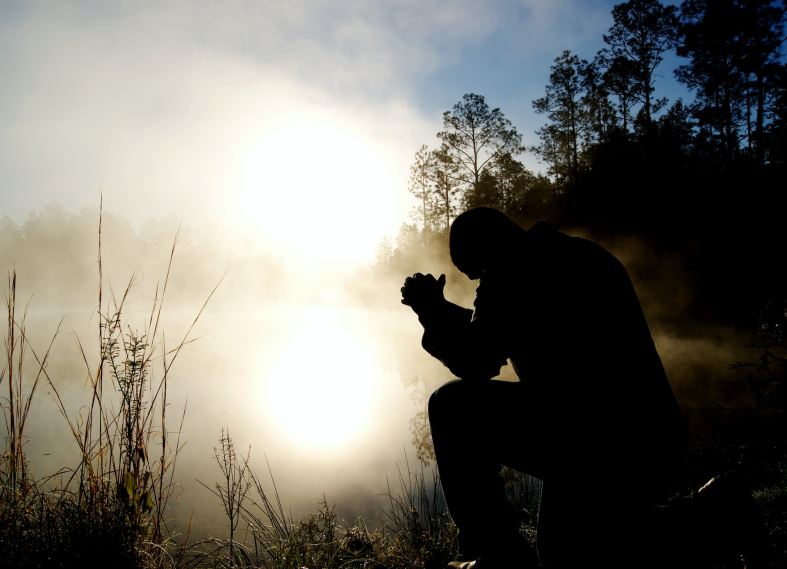
When All You Have is God

Photo by Greg Willson on Unsplash

Near the end of Book 3 in the Psalms (43-89), several Psalms read like cries for help by writers at the end of their rope.  In Psalm 86:14, for example, David writes: “O God, insolent men have risen up against me; a band of ruthless men seeks my life, and they do not set you before them.”  While the exact circumstance is unclear, David knows there is a wide conspiracy against him, and his only hope is to turn to God.  The Psalm opens with “Incline your ear, O LORD, and answer me, for I am poor and needy.”

Likewise, when we feel desperate and don’t know where to turn, these Psalms remind us that God will never turn us away.  On Psalm 86 John Calvin comments that “the more severely any one is oppressed, and the more destitute he is of the resources of human aid, the more inclined is God graciously to help him. That despair therefore may not overwhelm our minds under our greatest afflictions, let us support ourselves from the consideration that the Holy Spirit has dictated this prayer for the poor and the afflicted.”  In other words, because these Psalms are in the Bible, we can be sure that, no matter the mess our own choices or the actions of others have put us in, God in His steadfast love will listen.

Throughout the Psalm, David writes reminders of the character and works of God as a contrast to both his circumstances and his feelings of futility.  Like him we must always remember that our character is never so bad that God loving us is inconsistent with His character, and that our circumstances are never so bad that loving us is beyond His power to achieve.

When all you have is God, He is enough.

Even for the most desperate, there is always a way out, as Paul wrote in 1 Corinthians 10:13 – “No temptation has overtaken you that is not common to man. God is faithful, and he will not let you be tempted beyond your ability, but with the temptation he will also provide the way of escape, that you may be able to endure it.” In Psalm 86, David does not just pray for a miraculous deliverance, but in verse 11, David looks for the way of escape: “Teach me your way, O LORD, that I may walk in your truth; unite my heart to fear your name.”  A united heart is one that feels no anxiety because it knows it is seeking God’s will and willing to act on it based on reverence for Him.  God may urge us to merely wait for His deliverance, or prod us to actions we may not expect, but in all cases, He knows the way, because He is the Way. Only He can unite our hearts.

Bring your desperate anxiety to Him and let Him show you the way forward.  When all you have is God, He is enough.  When you feel your faith is weak because you can’t see or feel God in your life or the world around you, begin with “Incline your ear, O LORD, and answer me, for I am poor and needy,” and He will listen.

Popular Orthodoxy: A Quint of Quotes

Fellow travelers,

Here is another “Quint of Quotes” from my collection.  These five somewhat related sayings suggest the particular time and place we live in may not be very different from every other time and place.  I hope you find them interesting and thought-provoking.

Now the serpent was more crafty than any other beast of the field that the LORD God had made.  He said to the woman, “Did God actually say, ‘You shall not eat of any tree in the garden’?…the serpent said to the woman, “You will not surely die.” – Genesis 3:1,4

“Every age has some ostentatious system to excuse the havoc it commits. Conquest, honour, chivalry, religion, balance of power, commerce, no matter what, mankind must bleed, and take a term for a reason” – Horace Walpole, British politician, in 1762

There is a way that seems right to a man, but its end is the way to death.” – Proverbs 14:12, 16:25

“At any given moment there is an orthodoxy, a body of ideas of which it is assumed that all right-thinking people will accept without question. It is not exactly forbidden to say this, that or the other, but it is ‘not done’ to say it… Anyone who challenges the prevailing orthodoxy finds himself silenced with surprising effectiveness. A genuinely unfashionable opinion is almost never given a fair hearing, either in the popular press or in the high-brow periodicals”. – George Orwell, in the 1945 introduction to ‘Animal Farm.’

For the time is coming when people will not endure sound teaching, but having itching ears they will accumulate for themselves teachers to suit their own passions, and will turn away from listening to the truth and wander off into myths.  As for you, always be sober-minded, endure suffering, do the work of an evangelist, fulfill your ministry.” – 2 Timothy 4:3-5

Godly Habits for Leaders and Others

All the people benefit from leaders and rulers who fear God.  In Deuteronomy, when God reluctantly says Israel may set a king over them in the future[1], He also required the king to have specific habits to cultivate a fear of God in them:

And when he sits on the throne of his kingdom, he shall write for himself in a book a copy of this law, approved by the Levitical priests.  And it shall be with him, and he shall read in it all the days of his life, that he may learn to fear the LORD his God by keeping all the words of this law and these statutes, and doing them, that his heart may not be lifted up above his brothers, and that he may not turn aside from the commandment, either to the right hand or to the left, so that he may continue long in his kingdom, he and his children, in Israel.”  (Deuteronomy 17:18-20, emphasis mine)

These requirements have several parts.  First, the king was to “write for himself in a book a copy of this law.”  “This law” refers to what we now think of as the first five books of the Bible – all 187 chapters of it.  Imagine the time that would take, but this tedious exercise was designed to help the king internalize the message.  Quickly skimming over the Bible would not do.

Second, the king had to get this copy “approved by the Levitical priests,” to make sure nothing was added or left out, but also to remind the king that His authority is subject to God’s authority, as intermediated by the priests at that time.  Regardless of what laws the king might pass, God’s laws would always reign supreme and eternal.

Third, the king was to “read in it all the days of his life,” because it takes time and effort to dig the treasures of wisdom out of the Bible.  However, it is worth the effort because Psalm 19:10 tells us these truths are:

More to be desired are they than gold,
                        even much fine gold;
sweeter also than honey
                        and drippings of the honeycomb.

Also, the king would be surrounded by reminders of his worldly greatness every day, so constant meditation on the law would show him his reliance on God.  The king needs a constant reminder that he is under God, whose law applies to everyone.

These habits exist “that he may learn to fear the LORD,” which leads to “doing” the law.  Even the king is expected to do what God commands, not just tell others to.  With “doing” as the objective, the king will remain humble and learn the fear of God, because we may be able to know God’s word, but doing it is the real challenge and we can only succeed by His grace.

These habits also exist to make sure the king does not err “either to the right hand or to the left.”  This encouragement is later echoed in Moses’ words in Joshua 1:7-8, but what does it mean?  I think it means that without constant saturation in God’s word, we can fall into a trap of not following God’s positive will, but instead defining ourselves by what we’re against.  In trying to avoid one sin, we drift too far in the opposite direction and into another, equally destructive, sin.  Instead, positive obedience coming from the fear of God should be better than fine gold and “sweeter also than honey.”  Truth is often subtle and not as black-and-white as we’d like it to be.

Most of us aren’t kings, but we can apply the passage from Deuteronomy in our prayers.  1 Timothy 2:1-2 “First of all, then, I urge that supplications, prayers, intercessions, and thanksgivings be made for all people, for kings and all who are in high positions, that we may lead a peaceful and quiet life, godly and dignified in every way.”  But what shall we pray for them?  As Deuteronomy suggests, we should pray that they know God, fear God, and obey God, that they may be humble, and we may prosper.

Also, are you a leader?  Do you serve in a position of authority at your church, workplace, or other organization?  These habits will benefit you and those you serve anywhere.  (In societies where we can easily get a Bible, we don’t need to create our own copies of it, but we should seek to internalize as much of the Bible as possible, through memorization and other means.)  As Solomon wrote in Psalm 127:1 –

Unless the LORD builds the house,
            those who build it labor in vain.
Unless the LORD watches over the city,
            the watchman stays awake in vain.

If you’re not a leader, these habits are beneficial for you as well, as Psalm 128:1 says:

Blessed is everyone who fears the LORD,
                        who walks in his ways!

Amen.


[1] Deuteronomy 17:14-15

Daily Readings for January 5 – 11

Fellow travelers:

Continuing on from last year, each week in 2026 I will post 2 chapters to read per day as the main reading plan, and for anyone who wants to read the whole Bible in 2026, I’ll post the extra chapters to read that week.  The main readings will include nearly all of the New Testament, plus Psalms, Proverbs, Ecclesiastes, the Prophets, and a few other Old Testament books.

Reading 3 chapters a day on weekdays and 4 on weekends almost exactly covers the 1,189 chapters of the Bible, so the “extra” readings will be about 9 chapters per week.  These readings will cover the Pentateuch, the OT histories, a few other OT books, plus Jude and Revelation from the NT.

I hope this encourages others to read and study their Bible more, whatever parts they decide to read.  Follow along (or not) any way you choose!

2 chapter a day plan:

Monday, January 5: Psalm 5, Matthew 5
Tuesday, January 6: Psalm 6, Matthew 6
Wednesday, January 7: Psalm 7, Matthew 7
Thursday, January 8: Psalm 8, Matthew 8
Friday, January 9: Psalm 9, Matthew 9
Saturday, January 10: Psalm 10, Matthew 10
Sunday, January 11: Psalm 11, Matthew 11

Extra chapters for those reading the whole Bible in 2026:
Genesis 7-15

Oh, Taste and See!

In response to a reader suggestion, I’ve figured out what Bible verses quoted the most here and will write a series about those verses.  Today’s post is #1 of a top 10 countdown, starting with the verse quoted the least out of the 10 most quoted, Psalm 34:8.

 “Oh, taste and see that the LORD is good!
            Blessed is the man who takes refuge in him!

In my Accordance[1] Bible notes for this verse, I wrote: “God does not shower us with blessing upon blessing until we are convinced He is good and then we turn to Him.  We must learn that He is good by trusting Him and learning to walk with Him.  We learn that repentance is a good thing.”  To me, there’s a lot in this verse.

One thing is that we must be active in our relationship with God, rather than waiting around for Him to solve our problems.  We must each “taste and see,” not “wait and see.”  The Psalmist (David) is comparing knowledge of God to food spread out before us.  Unless we act and decide to eat the food, we will never truly know how good that food is.  This requires us to turn from what we would do otherwise, which may be sin, and turn to God for our refuge.  Repentance is often a requirement for learning of God’s goodness; we don’t learn about it by going our own way.  We must take steps in response to our trust in Him.

Second, we don’t learn that He is good through the experiences of other people, but through our own experience, which we can only get through acting.  Often when we ask people what something tastes like, the answer is “it tastes like chicken.”  This isn’t literally true, but it does tell us that taste is hard to accurately share with and communicate to another person.  We only really know what something tastes like through personal experience, and we can only know how good God is through personal experience.

It’s also implied that if we don’t taste of God’s goodness for ourselves, we might misunderstand it.  We might believe incorrect things about God that we pick up from other sources than Him.   Sometimes these messages come from the secular world, but sometimes they even come from within the church, because nobody and no church (and no blog!) is perfect.  We can only get perfect and pure information about God from God Himself and as you might guess, that means consistent private Bible study, prayer, and meditation.

“Tasting and seeing” is similar in the verse to “taking refuge.”  This verse means a lot to me because it can be a reminder when life isn’t going well, or if I just feel like it’s not going well, that I might need to take a different approach or get a different perspective from God.  The verse suggests that the man who does not take refuge in him is not blessed, therefore we should make sure we are taking refuge in Him.  Only by seeking out His answers to our problems can we know Him and experience His blessing, which we should value over all other kinds of blessing.

So, dear readers:

Oh, taste and see that the LORD is good!
            Blessed is the man who takes refuge in him!


[1] Bible software I use and highly recommend.  Many of my blog posts start from notes I took in Accordance.